Nikola Tesla Articles
Mr. Tesla's Latest Work - Lecture Commentary
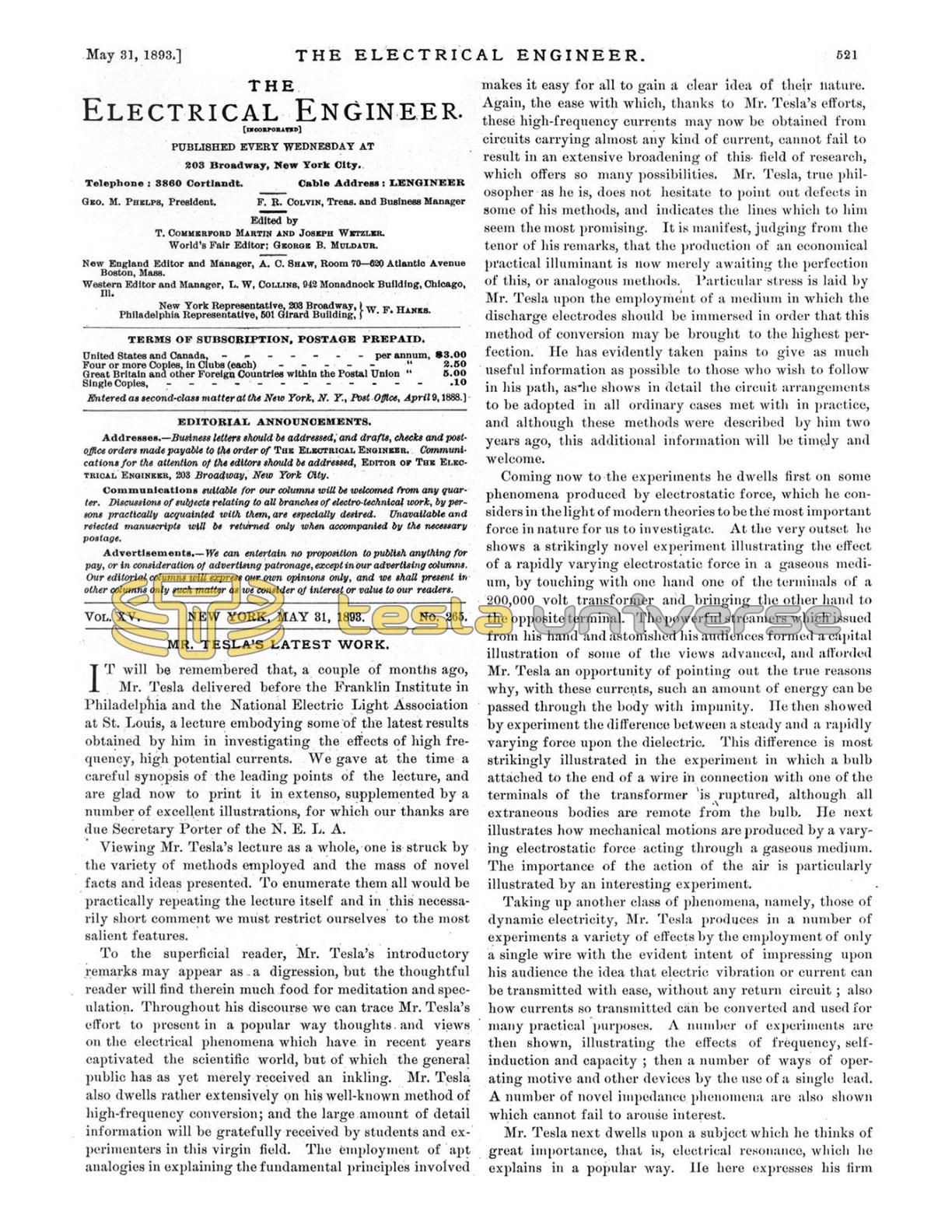
It will be remembered that, a couple of months ago, Mr. Tesla delivered before the Franklin Institute in Philadelphia and the National Electric Light Association at St. Louis, a lecture embodying some of the latest results obtained by him in investigating the effects of high frequency, high potential currents. We gave at the time a careful synopsis of the leading points of the lecture, and are glad now to print it in extenso, supplemented by a number of excellent illustrations, for which our thanks are due Secretary Porter of the N. E. L. A.
Viewing Mr. Tesla's lecture as a whole, one is struck by the variety of methods employed and the mass of novel facts and ideas presented. To enumerate them all would be practically repeating the lecture itself and in this necessarily short comment we must restrict ourselves to the most salient features.
To the superficial reader, Mr. Tesla's introductory remarks may appear as a digression, but the thoughtful reader will find therein much food for meditation and speculation. Throughout his discourse we can trace Mr. Tesla's effort to present in a popular way thoughts and views on the electrical phenomena which have in recent years captivated the scientific world, but of which the general public has as yet merely received an inkling. Mr. Tesla also dwells rather extensively on his well-known method of high-frequency conversion; and the large amount of detail information will be gratefully received by students and experimenters in this virgin field. The employment of apt analogies in explaining the fundamental principles involved makes it easy for all to gain a clear idea of their nature. Again, the ease with which, thanks to Mr. Tesla's efforts, these high-frequency currents may now be obtained from circuits carrying almost any kind of current, cannot fail to result in an extensive broadening of this field of research, which offers so many possibilities. Mr. Tesla, true philosopher as he is, does not hesitate to point out defects in some of his methods, and indicates the lines which to him seem the most promising. It is manifest, judging from the tenor of his remarks, that the production of an economical practical illuminant is now merely awaiting the perfection of this, or analogous methods. Particular stress is laid by Mr. Tesla upon the employment of a medium in which the discharge electrodes should be immersed in order that this method of conversion may be brought to the highest perfection. He has evidently taken pains to give as much useful information as possible to those who wish to follow in his path, as he shows in detail the circuit arrangements to be adopted in all ordinary cases met with in practice, and although these methods were described by him two years ago, this additional information will be timely and welcome.
Coming now to the experiments he dwells first on some phenomena produced by electrostatic force, which he considers in the light of modern theories to be the most important force in nature for us to investigate. At the very outset he shows a strikingly novel experiment illustrating the effect of a rapidly varying electrostatic force in a gaseous medium, by touching with one hand one of the terminals of a 200,000 volt transformer and bringing the other hand to the opposite terminal. The powerful streamers which issued from his hand and astonished his audiences formed a capital illustration of some of the views advanced, and afforded Mr. Tesla an opportunity of pointing out the true reasons why, with these currents, such an amount of energy can be passed through the body with impunity. He then showed by experiment the difference between a steady and a rapidly varying force upon the dielectric. This difference is most strikingly illustrated in the experiment in which a bulb attached to the end of a wire in connection with one of the terminals of the transformer is ruptured, although all extraneous bodies are remote from the bulb. He next illustrates how mechanical motions are produced by a varying electrostatic force acting through a gaseous medium. The importance of the action of the air is particularly illustrated by an interesting experiment.
Taking up another class of phenomena, namely, those of dynamic electricity, Mr. Tesla produces in a number of experiments a variety of effects by the employment of only a single wire with the evident intent of impressing upon his audience the idea that electric vibration or current can be transmitted with ease, without any return circuit; also how currents so transmitted can be converted and used for many practical purposes. A number of experiments are then shown, illustrating the effects of frequency, self-induction and capacity; then a number of ways of operating motive and other devices by the use of a single lead. A number of novel impedance phenomena are also shown which cannot fail to arouse interest.
Mr. Tesla next dwells upon a subject which he thinks of great importance, that is, electrical resonance, which he explains in a popular way. He here expresses his firm conviction that by observing proper conditions, intelligence, and possibly even power, can be transmitted through the medium or through the earth; and he considers this problem worthy of serious and immediate consideration. The views expressed by Mr. Tesla will certainly interest all who have followed his work.
Coming now to the light phenomena in particular he illustrates the four distinct kinds of these phenomena in an original way which to many must have been a revelation. Mr. Tesla attributes these light effects to molecular or atomic impacts produced by a varying electrostatic stress in a gaseous medium. He illustrates in a series of novel experiments the effect of the gas surrounding the conductor and shows beyond a doubt that with high frequency and high-potential currents, the surrounding gas is of paramount importance in the heating of the conductor. He attributes the heating partially to a conduction current and, partially to bombardment, and demonstrates that in many cases the heating may be practically due to the bombardment alone. He points out also that the skin effect is largely modified by the presence of the gas or of an atomic medium in general. He shows also some interesting experiments in which the effect of convection is illustrated. Probably one of the most curious experiments in this connection is that in which a thin platinum. wire stretched along the axis of an exhausted tube is brought to incandescence at certain points corresponding to the position of the striae, while at others it remains dark. This experiment throws an interesting light upon the nature of the stria and may lead to important revelations.
Mr. Tesla also demonstrates the dissipation of energy through an atomic medium and dwells upon the behavior of vacuous space in conveying heat, and in this connection shows the curious behavior of an electrode stream, from which he concludes that the molecules of a gas probably cannot be acted upon directly at measurable distances.
Mr. Tesla summarizes the chief results arrived at in pursuing his investigations in a manner which will serve as a valuable guide to all who may engage in this work. Perhaps most interest will centre on his general statements regarding the phenomena of phosphorescence, the most important fact revealed in this direction being that when exciting a phosphorescent bulb a certain definite potential gives the most economical result. A great many more. observations of Mr. Tesla relating to this subject, of such great interest, might be mentioned, but the careful reader will find in nearly every paragraph a thought or suggestion. The lecture is not one for hasty reading.