Nikola Tesla Articles
Mr. Tesla's Lecture at the Royal Institution
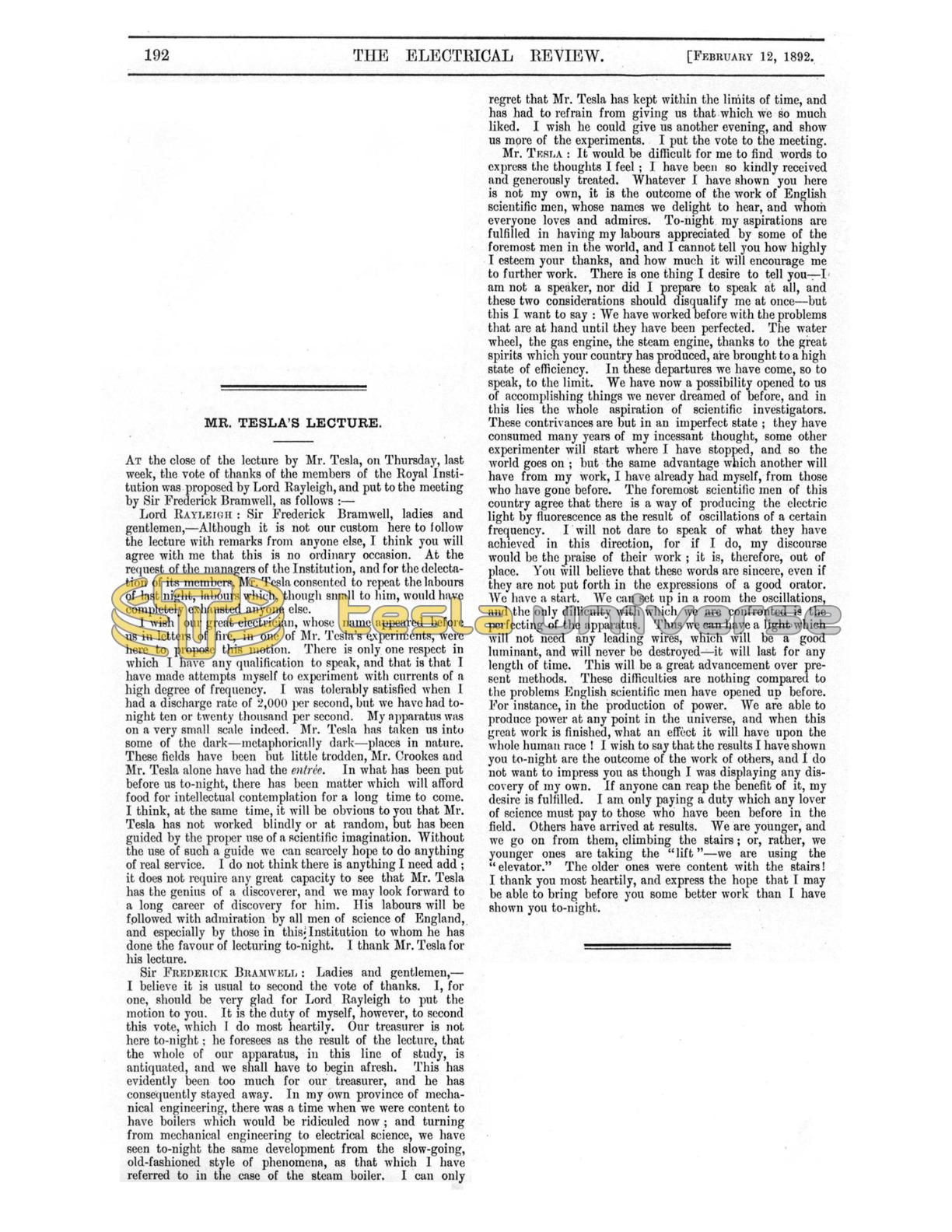
At the close of the lecture by Mr. Tesla, on Thursday, last week, the vote of thanks of the members of the Royal Institution was proposed by Lord Rayleigh, and put to the meeting by Sir Frederick Bramwell, as follows:
Lord Rayleigh: Sir Frederick Bramwell, ladies and gentlemen, - Although it is not our custom here to follow the lecture with remarks from anyone else, I think you will agree with me that this is no ordinary occasion. At the request of the managers of the Institution, and for the delectation of its members, Mr. Tesla consented to repeat the labours of last night, labours which, though small to him, would have completely exhausted anyone else.
I wish our great electrician, whose name appeared before us in letters of fire, in one of Mr. Tesla's experiments, were here to propose this motion. There is only one respect in which I have any qualification to speak, and that is that I have made attempts myself to experiment with currents of a high degree of frequency. I was tolerably satisfied when I had a discharge rate of 2,000 per second, but we have had tonight ten or twenty thousand per second. My apparatus was on a very small scale indeed. Mr. Tesla has taken us into some of the dark - metaphorically dark - places in nature. These fields have been but little trodden, Mr. Crookes and Mr. Tesla alone have had the entrée. In what has been put before us to-night, there has been matter which will afford food for intellectual contemplation for a long time to come. I think, at the same time, it will be obvious to you that Mr. Tesla has not worked blindly or at random, but has been guided by the proper use of a scientific imagination. Without the use of such a guide we can scarcely hope to do anything of real service. I do not think there is anything I need add; it does not require any great capacity to see that Mr. Tesla has the genius of a discoverer, and we may look forward to a long career of discovery for him. His labours will be followed with admiration by all men of science of England, and especially by those in this Institution to whom he has done the favour of lecturing to-night. I thank Mr. Tesla for his lecture.
Sir Frederick Bramwell: Ladies and gentlemen,- I believe it is usual to second the vote of thanks. I, for one, should be very glad for Lord Rayleigh to put the motion to you. It is the duty of myself, however, to second this vote, which I do most heartily. Our treasurer is not here to-night; he foresees as the result of the lecture, that the whole of our apparatus, in this line of study, is antiquated, and we shall have to begin afresh. This has evidently been too much for our treasurer, and he has consequently stayed away. In my own province of mechanical engineering, there was a time when we were content to have boilers which would be ridiculed now; and turning from mechanical engineering to electrical science, we have seen to-night the same development from the slow-going, old-fashioned style of phenomena, as that which I have referred to in the case of the steam boiler. I can only regret that Mr. Tesla has kept within the limits of time, and has had to refrain from giving us that which we so much liked. I wish he could give us another evening, and show us more of the experiments. I put the vote to the meeting.
Mr. Tesla: It would be difficult for me to find words to express the thoughts I feel; I have been so kindly received and generously treated. Whatever I have shown you here is not my own, it is the outcome of the work of English scientific men, whose names we delight to hear, and whom everyone loves and admires. To-night my aspirations are fulfilled in having my labours appreciated by some of the foremost men in the world, and I cannot tell you how highly I esteem your thanks, and how much it will encourage me to further work. There is one thing I desire to tell you - I am not a speaker, nor did I prepare to speak at all, and these two considerations should disqualify me at once - but this I want to say: We have worked before with the problems that are at hand until they have been perfected. The water wheel, the gas engine, the steam engine, thanks to the great spirits which your country has produced, are brought to a high state of efficiency. In these departures we have come, so to speak, to the limit. We have now a possibility opened to us of accomplishing things we never dreamed of before, and in this lies the whole aspiration of scientific investigators. These contrivances are but in an imperfect state; they have consumed many years of my incessant thought, some other experimenter will start where I have stopped, and so the world goes on; but the same advantage which another will have from my work, I have already had myself, from those who have gone before. The foremost scientific men of this country agree that there is a way of producing the electric light by fluorescence as the result of oscillations of a certain frequency. I will not dare to speak of what they have achieved in this direction, for if I do, my discourse would be the praise of their work; it is, therefore, out of place. You will believe that these words are sincere, even if they are not put forth in the expressions of a good orator. We have a start. We can set up in a room the oscillations, and the only difficulty with which we are confronted is the perfecting of the apparatus. Thus we can have a light which will not need any leading wires, which will be a good luminant, and will never be destroyed - it will last for any length of time. This will be a great advancement over present methods. These difficulties are nothing compared to the problems English scientific men have opened up before. For instance, in the production of power. We are able to produce power at any point in the universe, and when this great work is finished, what an effect it will have upon the whole human race! I wish to say that the results I have shown you to-night are the outcome of the work of others, and I do not want to impress you as though I was displaying any discovery of my own. If anyone can reap the benefit of it, my desire is fulfilled. I am only paying a duty which any lover of science must pay to those who have been before in the field. Others have arrived at results. We are younger, and we go on from them, climbing the stairs; or, rather, we younger ones are taking the "lift" - we are using the "elevator." The older ones were content with the stairs! I thank you most heartily, and express the hope that I may be able to bring before you some better work than I have shown you to-night.