Nikola Tesla Articles
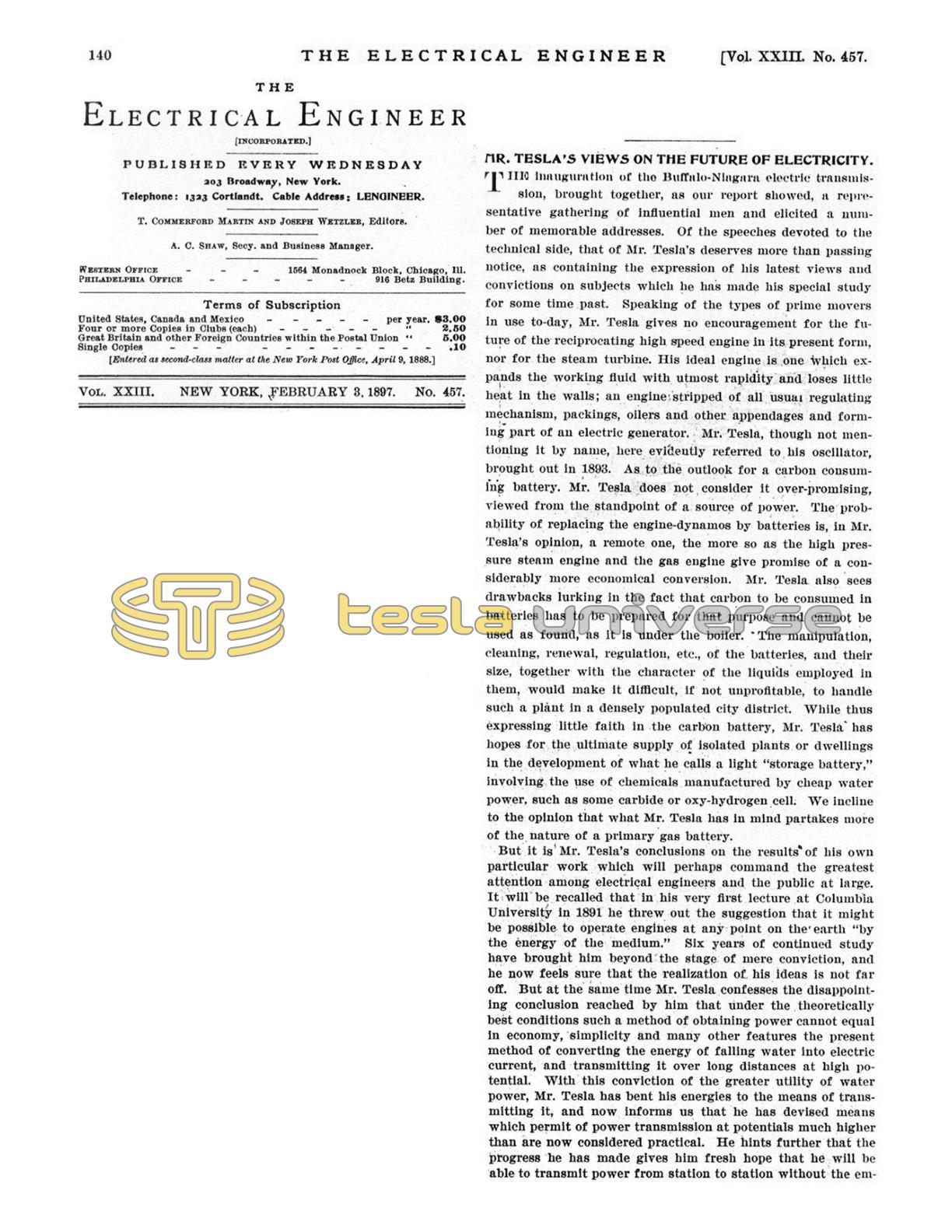
Mr. Tesla's Views on the Future of Electricity
The inauguration of the Buffalo-Niagara electric transmission, brought together, as our report showed, a representative gathering of influential men and elicited a number of memorable addresses. Of the speeches devoted to the technical side, that of Mr. Tesla's deserves more than passing notice, as containing the expression of his latest views and convictions on subjects which he has made his special study for some time past. Speaking of the types of prime movers in use to-day, Mr. Tesla gives no encouragement for the future of the reciprocating high speed engine in its present form, nor for the steam turbine. His ideal engine is one which expands the working fluid with utmost rapidity and loses little heat in the walls; an engine stripped of all usuai regulating mechanism, packings, oilers and other appendages and forming part of an electric generator. Mr. Tesla, though not mentioning it by name, here evidently referred to his oscillator, brought out in 1893. As to the outlook for a carbon consuming battery. Mr. Tesla does not consider it over-promising, viewed from the standpoint of a source of power. The probability of replacing the engine-dynamos by batteries is, in Mr. Tesla's opinion, a remote one, the more so as the high pressure steam engine and the gas engine give promise of a considerably more economical conversion. Mr. Tesla also sees drawbacks lurking in the fact that carbon to be consumed in batteries has to be prepared for that purpose and cannot be used as found, as it is under the boiler. The manipulation, cleaning, renewal, regulation, etc., of the batteries, and their size, together with the character of the liquids employed in them, would make it difficult, if not unprofitable, to handle such a plant in a densely populated city district. While thus expressing little faith in the carbon battery, Mr. Tesla has hopes for the ultimate supply of isolated plants or dwellings in the development of what he calls a light "storage battery," involving the use of chemicals manufactured by cheap water power, such as some carbide or oxy-hydrogen cell. We incline to the opinion that what Mr. Tesla has in mind partakes more of the nature of a primary gas battery.
But it is Mr. Tesla's conclusions on the results of his own particular work which will perhaps command the greatest attention among electrical engineers and the public at large. It will be recalled that in his very first lecture at Columbia University in 1891 he threw out the suggestion that it might be ossible to perate engines at any point on the earth "by the energy of the medium." Six years of continued study have brought him beyond the stage of mere conviction, and he now feels sure that the realization of his ideas is not far off. But at the same time Mr. Tesla confesses the disappointing conclusion reached by him that under the theoretically best conditions such a method of obtaining power cannot equal in economy, simplicity and many other features the present method of converting the energy of falling water into electric current, and transmitting it over long distances at high potential. With this conviction of the greater utility of water power, Mr. Tesla has bent his energies to the means of transmitting it, and now informs us that he has devised means which permit of power transmission at potentials much higher than are now considered practical. He hints further that the progress he has made gives him fresh hope that he will be able to transmit power from station to station without the employment of connecting wires, but he adds that, whatever method of transmission be ultimately adopted, nearness to the source of power will remain an important advantage. We cannot help expressing our gratification at this promised realization of one of Mr. Tesla's fondest dreams, but we hardly expect that the manufacturers of wire will receive the announcement in a like spirit of joy. Mr. Tesla has thrown out enough in his remarks to put the public again on the qui vive. The electrical community will await with impatience the practical demonstration of his new methods, accept the "report of progress" and "extend the time of the committee."