Nikola Tesla Articles
New Inventions of Tesla
At a recent meeting of the New York Section of the American National Electric Light Association, Dr. Nikola Tesla, the inventor, delivered an address which, by the extraordinary ideas and surprising facts set forth in it, has aroused great and general attention in the technical and scientific world.
Dr. Tesla has been working for many years on the inventions he now announces; and while it is impossible to judge their importance until further details are made known, yet what he declares he has obtained, with his special systems, for the transmission over great distances of energy and of speech, would indeed appear to be marvelous discoveries. The inventor’s experiments with high-frequency and high-potential currents — experiments dating back some twenty years or so — were in reality most useful and helped to open to the scientist as well as to the engineer a vast field that even today is far from being explored. His other discoveries have likewise attracted considerable attention; and these latest announcements of his, if confirmed, may well prove the most important of all.
We briefly summarize the interesting address.
Tesla begins by noting how great is the gift of invention and of discovery; the greatest satisfaction he can imagine does not compare with that given by the feeling of triumph that follows every original invention or discovery. It is true that the world is not always ready to accept the inventor’s word, for the skeptics are numberless; and therefore poor inventors are often forced to swallow bitter pills, of which he himself confesses he has had to take his share, together with the enjoyment.
He then recalls that toward 1887 or 1888 he had already developed the rotating magnetic field. But he met with endless opposition and attacks; his patents were fought to the utmost; it even came to denying that he had ever invented anything.
Alluding next to Hertz’s great discoveries, he confesses that he tried to repeat the experiments, but without obtaining any result, although he worked at them for a long time; so much so that he was led to lay his doubts before Hertz himself, who seems to have convinced him.
Then came Röntgen’s discovery in 1895. Tesla had already investigated the marvelous phenomenon and, after long and laborious researches, recognized the true nature of the radiations. He published his results in a series of articles in the Electrical Review, declaring that we were confronted with a new state of matter, never before studied, and showing that the projected particles (electrons) were smaller than atoms, were of various sizes, carried electric charges, and moved at enormous velocity.
Here Tesla declares that among the various branches of the science of electricity there is one to which he has devoted a great part of his life, and that it is therefore proper to speak of it in more detail.
He alludes to the problem of the wireless transmission of energy.
Diagrams are projected illustrating his electrical scheme, as well as other illustrations of the system with mechanical analogies. Then, again with projections, he shows some experiments made in 1899: incandescent lamps were lighted with a single wire. Other diagrams follow illustrating the application of the system with no wire at all, and a lamp is lighted in such a way that he declares the lamp would light even if placed at the antipodes.
Entering into a more detailed account of his system, Tesla says that it comprises five distinct inventions.
The first of these is his transformer. To give an idea of the surprising effects obtained with this apparatus, a view is projected of an experiment repeated very frequently in the years 1892–1896. Behind a screen stands the primary of the transformer; in front, a glass globe about 35 cm in diameter containing a drop of mercury. The experimenter holds the globe in the air, and the inductive effect is so strong as to evaporate the mercury and produce a most brilliant light.
Tesla then describes his “magnifying transmitter,” and shows, still with projections, several curious experiments.
First one sees the apparatus he used in his Colorado experiments, carried out on a vast scale. A colossal sheaf of sparks, more than 40 feet long, is seen issuing from the center of an enormous coil; the discharge is so powerful that it is directed toward an opening made in the ceiling, carried up by the heat generated. Another effect of such a transmitter is shown with a large globe about one meter in diameter, placed above the roof after the roof had been removed. The inventor says that part of the discharge rose as high as a hundred feet; from a distance it seemed as if the place were a prey to flames, and the roar could be heard as far as ten miles away. He remarks that this was one of the most difficult experiments because of the enormous quantity of energy required to reach the desired density.
One then passes to the third invention. Tesla defines it as “the art of individualization, in which the nervous system of the human body is imitated in a rough manner.”
— “I do not wish,” he continues, “to stay here and bore you with theories and details, but I can assure you that, so long as the world is the world, even if all men were Faradays, they would never invent a scheme that would permit the transmission of signals or of quantities of energy at a distance by means of wires as accurately as it has been found possible to do it, without wires, by my system. In fact, in a transmission by wire the secrecy of a message is only the result of isolation in space, whereas with my system we can avail ourselves of the immense benefit given by other combinations that are not at all practicable when the transmission is based upon artificial paths.” —
And after declaring that the secret cannot be obtained with systems of transmission based on Hertzian waves, he passes to his fourth invention, which consists essentially in a special receiver adapted to condense the energy.
Thus we come to his discovery of stationary waves, which is the last and most important of the group.
Before attacking the problem of the economic transmission of energy without wires, Tesla found it absolutely necessary to know how our planet behaves, considered as a large body, in relation to electricity: what its electrical constants are — capacity, resistance and self-induction — and how the current passes through it. For these researches the inventor, not having found an opportunity in New York, went to Colorado and had a laboratory built for the purpose in a suitable place, of which several views are shown.
He then says: “Only a few months had passed, for I was engaged in such experimental researches, when I made the most marvelous discovery that I had ever expected to make in the course of my life. Before expounding it, permit me to confess that more than its practical value, immense though that is, I was struck by its philosophical significance. You know that for a long time man has sought the means of projecting, in one way or another, energy through space; but in all these efforts he has been thwarted by the inexorable laws of nature, which say that every effect diminishes as the distance increases, generally as the square of the distance, and sometimes even more rapidly. Now the discovery I have made brings about a complete revolution in this field, inasmuch as it furnishes the means of projecting energy into space absolutely without loss, from one point of the globe to any other, even to the antipodes, if one wishes. I saw at once that distance would thus be annihilated in its three most practical aspects: transmission of messages, transport of materials, transmission of the energies necessary to our subsistence. One can easily imagine how I remained impressed by such revelations.
“Technically they mean this: that the earth, as a whole, has a certain period of vibration of its own, and that, by impressing upon this enormous body electrical vibrations of the same period, it can be made to oscillate in such a way as to derive innumerable benefits from it. Permit me to mention a single application of the principle.
“Ships could be provided with simple apparatus by means of which they would plough the seas along the shortest course, and the captain of each could know his distance from any reference point, in the simplest manner, within an error of a few feet. We do not today know the exact length of the earth’s diameter: astronomers have not succeeded in determining it within a limit of 1,000 feet. Availing myself of my discovery, without geodetic instruments of any kind, indeed without even leaving his room, an electrician can determine the diameter of the globe within a limit of four feet.
“A thousand such problems, which are of immense practical importance, can be solved in an equally simple manner, and I have often thought that the annihilation of distance is the only means of bringing about an easy understanding and universal peace among the nations. It is for the future to decide whether I have seen rightly or not.
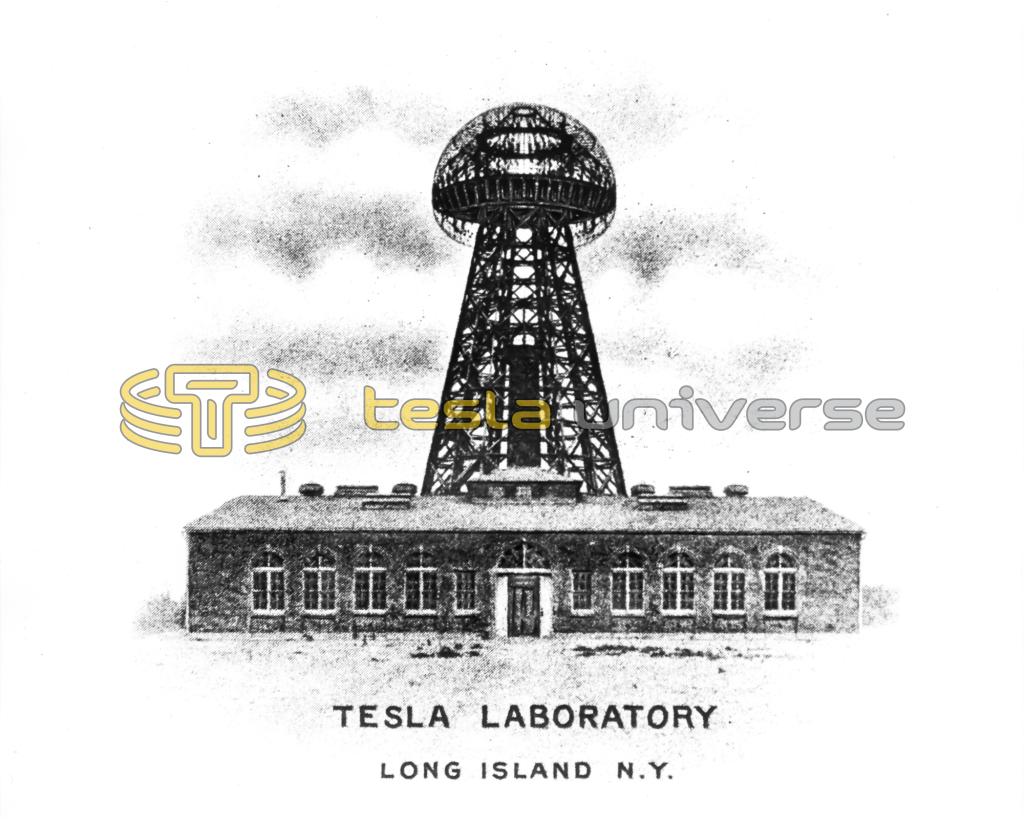
“On returning from Colorado I set about the study of the commercial application of these principles, my Colorado laboratory having served only the purpose of scientific demonstration. Thus it was that in 1901 my Long Island plant arose. This plant is nothing else than what I have called a ‘magnifying transmitter,’ and when it is completed it will give you the means of picking up any telephone and, without the slightest modification in the present stations, of talking as distinctly as if you were at the other side of your table, with any subscriber in the world. It makes no difference where he may be; if one wishes, the voice can even be made to issue from the earth with such force as to be heard miles away.
“The plant was established in the first instance to serve as a telephone exchange of that nature, but it will also lend itself to other important uses. To give you an idea of the power of the effects, I will tell you that when you speak into the telephone there will be electrical energy amounting to a billion horsepower that will carry your voice around the globe. Not only that, but the plant is organized so that hundreds of persons will be able to speak at the same time, at every point of the globe, without the least mutual interference.
“Naturally you must today content yourselves with my word, but I hope to live to see realized what I have undertaken, for I propose to carry my plans forward exactly as they were laid down by me previously.” —
Tesla adds that the carrying out of the project has been delayed for various reasons, one of which would be this: that the world is not yet ready to receive these inventions of his. In the meantime he has devoted himself to the study of other inventions more sought after by practical men.
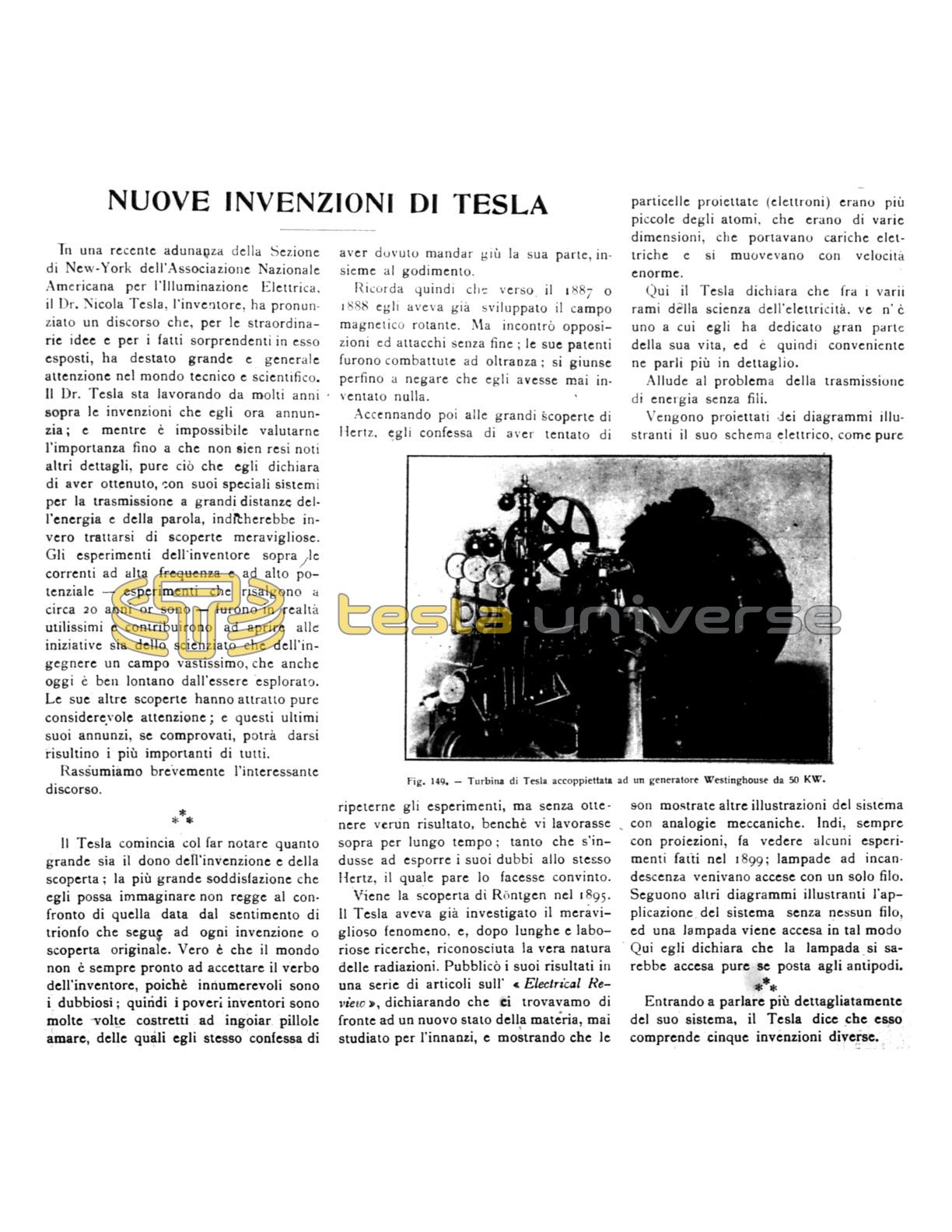
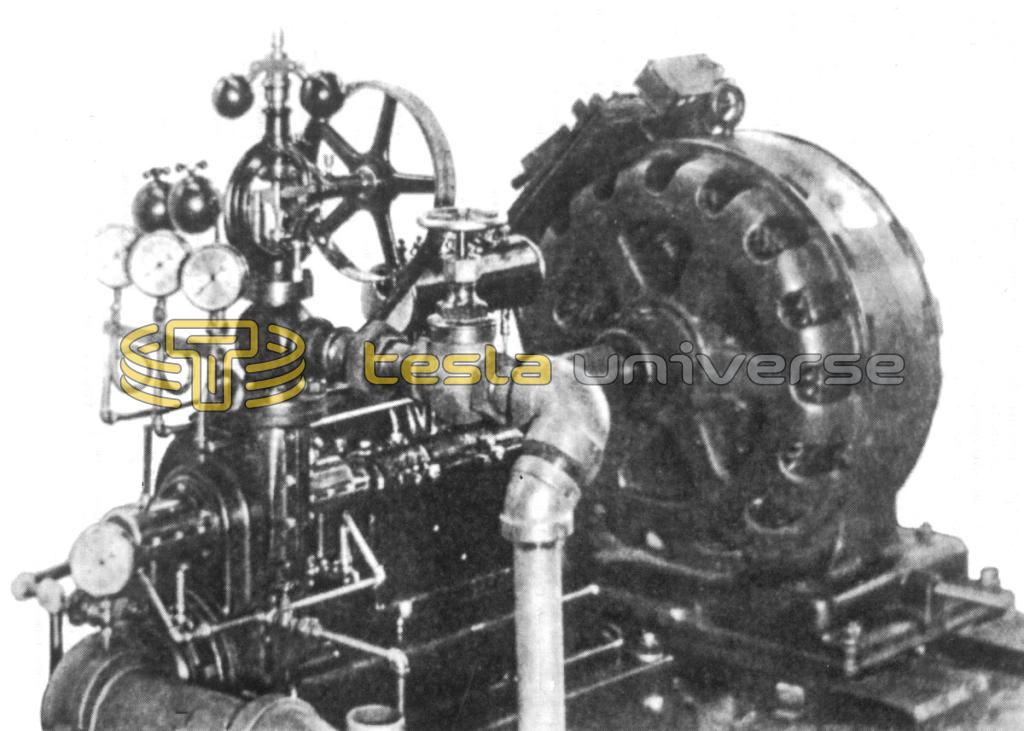
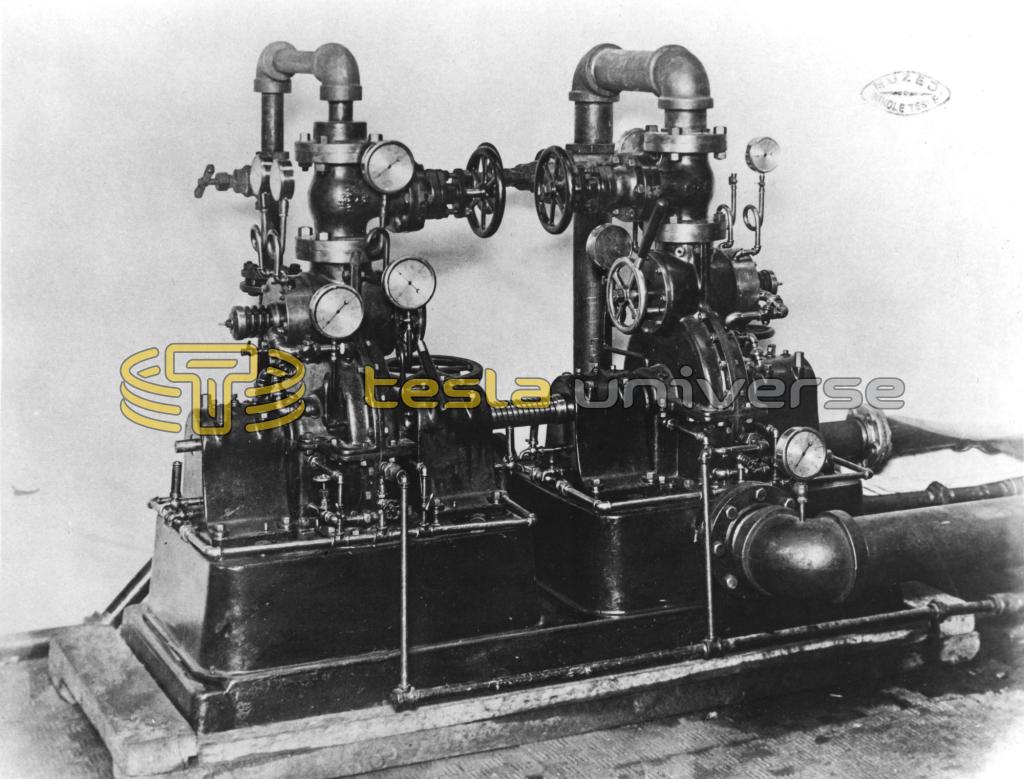
Here he describes a suction and pressure pump of his, and a special steam turbine of his. He declared that in present turbines the limit of efficiency is 65 percent, whereas theoretically in his turbine the efficiency would reach 99 percent (Figs. 149 and 150).
The advantages of this machine, according to the inventor, are very many: extreme simplicity of construction, perfect reversibility, a development of 10 horsepower for every pound of weight; in short a most useful machine, almost ideal, for motor-boats, locomotives, automobiles, etc.
He concludes by asserting that from the application of his principle a complete revolution in the field of mechanics is to be expected.
Now the scientific and technical world will await the practical demonstration of all these possibilities glimpsed by Dr. Tesla.
It is certain that the realization of the facts would produce an enormous advance in electrical and mechanical engineering not only, but would constitute a new epoch in the history of human activity.
Yet, although in the matter of inventions and discoveries the present age has taught us to doubt nothing, and although Dr. Tesla’s past is such as to command our attention for his studies and his works, still the very nature of his conceived applications of electrical oscillations — such as setting the whole globe in vibration, making voices issue from the earth, telephonic communications, those most powerful voices to be heard miles away, putting at the service of such transmissions billions of horsepower, etc. — the very nature of these facts cannot fail to produce in us a little skepticism. All the more so since Tesla declares that the world is not yet prepared for these inventions of his, which he considers quite premature for our times.
Why? Let him do it, and the world will receive them as it has received radiotelegraphy and the aeroplane.
There is no longer any danger of being burned alive like a sorcerer!
Ing. Ennio Zomparelli