Nikola Tesla Articles
Nikola Tesla and the Electrical Outlook
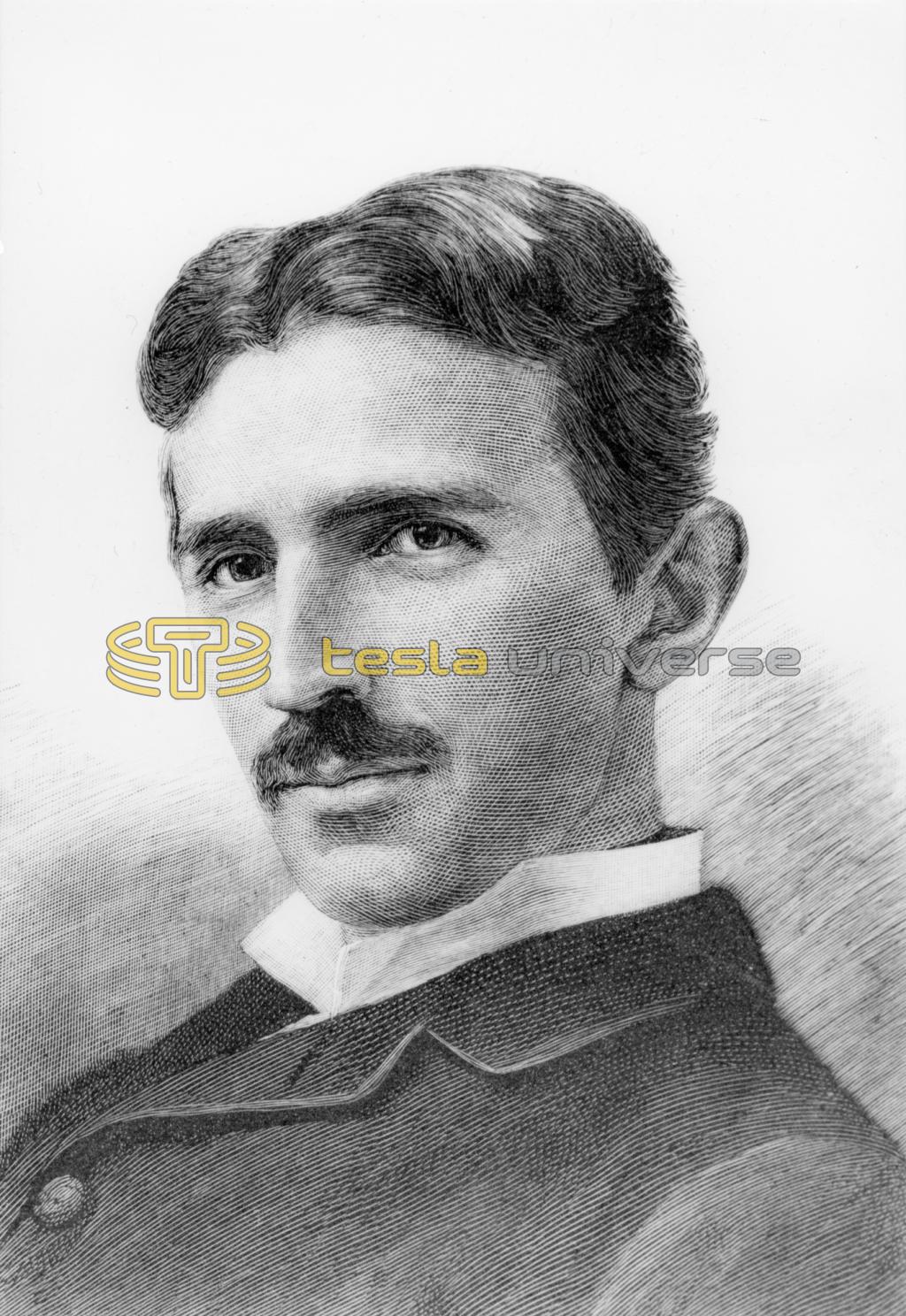
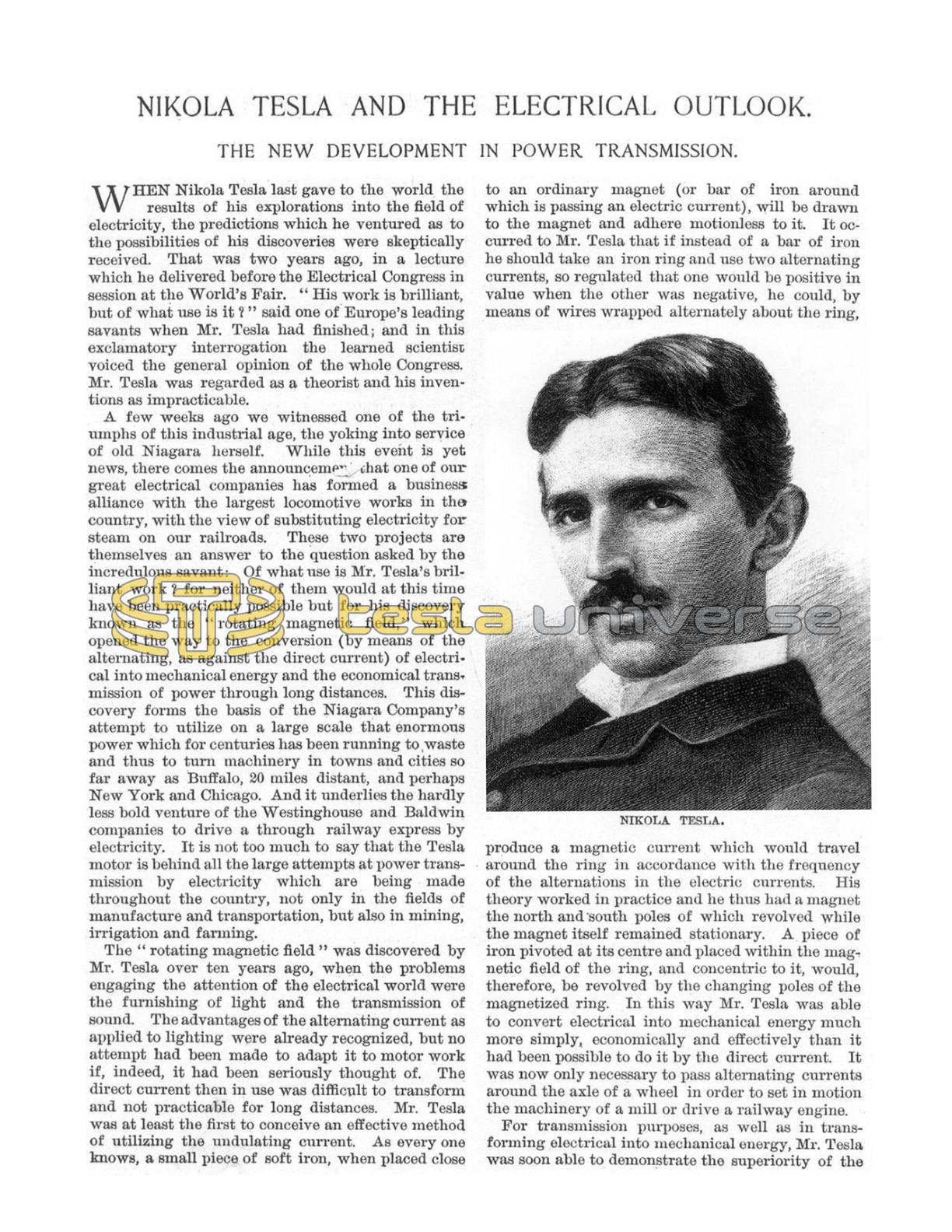
When Nikola Tesla last gave to the world the results of his explorations into the field of electricity, the predictions which he ventured as to the possibilities of his discoveries were skeptically received. That was two years ago, in a lecture which he delivered before the Electrical Congress in session at the World's Fair. "His work is brilliant, but of what use is it?" said one of Europe's leading savants when Mr. Tesla had finished; and in this exclamatory interrogation the learned scientist voiced the general opinion of the whole Congress. Mr. Tesla was regarded as a theorist and his inventions as impracticable.
A few weeks ago we witnessed one of the triumphs of this industrial age, the yoking into service of old Niagara herself. While this event is yet news, there comes the announcemen that one of our great electrical companies has formed a business alliance with the largest locomotive works in the country, with the view of substituting electricity for steam on our railroads. These two projects are themselves an answer to the question asked by the incredulous savant: Of what use is Mr. Tesla's brilliant work? for neither of them would at this time have been practically possible but for his discovery known as the "rotating magnetic field," which opened the way to the conversion (by means of the alternating, as against the direct current) of electrical into mechanical energy and the economical transmission of power through long distances. This discovery forms the basis of the Niagara Company's attempt to utilize on a large scale that enormous power which for centuries has been running to waste and thus to turn machinery in towns and cities so far away as Buffalo, 20 miles distant, and perhaps New York and Chicago. And it underlies the hardly less bold venture of the Westinghouse and Baldwin companies to drive a through railway express by electricity. It is not too much to say that the Tesla motor is behind all the large attempts at power transmission by electricity which are being made throughout the country, not only in the fields of manufacture and transportation, but also in mining, irrigation and farming.
The "rotating magnetic field" was discovered by Mr. Tesla over ten years ago, when the problems engaging the attention of the electrical world were the furnishing of light and the transmission of sound. The advantages of the alternating current as applied to lighting were already recognized, but no attempt had been made to adapt it to motor work if, indeed, it had been seriously thought of. The direct current then in use was difficult to transform and not practicable for long distances. Mr. Tesla was at least the first to conceive an effective method of utilizing the undulating current. As every one knows, a small piece of soft iron, when placed close to an ordinary magnet (or bar of iron around which is passing an electric current), will be drawn to the magnet and adhere motionless to it. It occurred to Mr. Tesla that if instead of a bar of iron he should take an iron ring and use two alternating currents, so regulated that one would be positive in value when the other was negative, he could, by means of wires wrapped alternately about the ring, produce a magnetic current which would travel around the ring in accordance with the frequency of the alternations in the electric currents. His theory worked in practice and he thus had a magnet the north and south poles of which revolved while the magnet itself remained stationary. A piece of iron pivoted at its centre and placed within the mag- netic field of the ring, and concentric to it, would, therefore, be revolved by the changing poles of the magnetized ring. In this way Mr. Tesla was able to convert electrical into mechanical energy much more simply, economically and effectively than it had been possible to do it by the direct current. It was now only necessary to pass alternating currents around the axle of a wheel in order to set in motion the machinery of a mill or drive a railway engine.
For transmission purposes, as well as in transforming electrical into mechanical energy, Mr. Tesla was soon able to demonstrate the superiority of the undulating over the direct current. It will be sufficient here to say that by means of his motor, which is only a development of his ring magnet, power may be sent long distances with but small loss. The magnitude of the field opened up by the Tesla motor will be apparent when it is considered that ten years ago it was not economically possible to transmit power more than a few hundred feet away from the source of production, while to-day its transmission is no longer a question of state of the art, but one of capital only. As early as 1891, Mr. Tesla's method was successfully employed in the experiment of sending 100 horse-power 109 miles from Lauffen to the Frankfort exposition grounds. In Southern California there has been in operation for two or three years a plant which transmits power equivalent to 10,000 volts from a waterfall to a sub-station at Pomona, 13 miles distant, and San Bernardino, 28 miles away; and there is now being projected, also in California, an enterprise which will involve an outlay of from $2,000,000 to $3,000,000 for supplying motors in San Francisco and adjacent cities with 20,000 horse-power from the outlet of Clear Lake, 75 miles to the north. Mr. Tesla believes that it is easily possible at the present time to place 100,000 horse-power on a line at Niagara and deliver it to New York or Chicago, with a loss in energy of less than 25 per cent.; and it would seem that the Cataract Construction Company is also persuaded that this is within the limits of practical achievement.
The alliance of the Westinghouse and Baldwin companies is in line with the policy recommended by Dr. Lewis Duncan in his address on the substitution of electricity for steam in railway practice, delivered last June at the Niagara meeting of the American Institute of Electrical Engineers — that of making electricity an ally instead of an enemy of steam. This union of large railway and electric interests would seem to mark the beginning of a new era in traction, coming as it does along with the substitution of electricity for steam by the Old Colony road on its Nantucket Division out of Boston; the adoption of an electric instead of a steam engine by the Baltimore & Ohio Railroad, for use in hauling heavy express and freight trains through the long tunnel underneath the city of Baltimore, and the installation of an electric line by the Pennsylvania Road from Mt. Holly to Burlington. The purpose of the Westinghouse Baldwin combination, as officially announced, is to develop the possibilities of the Tesla motor as applied to railroad service. It is declared that with this motor, power is assured suffi- cient to draw cars at the rate of 150 miles an hour. This is perhaps the possible speed under favorable conditions of road and equipment rather than the rate likely to be attained in every day travel.
The method of electric traction in use on the three roads named is the trolley, the power being supplied to the motor or motor cars from the central station by means of wires. It is the same system that is in general use upon our electric street railways, except that the alternating instead of the direct current is employed, the direct, as has already been noted, not being practicable in long distance transmission. The trolley, either the overhead or the underground, is the only method that has so far been demonstrated as suitable to general railroad practice. By means of the Tesla motor it is now regarded by conservative railway men and electricians entirely possible to run trains under this system, say from New York to Philadelphia, or through multiplication of the power stations from, Boston to Washington, or even across the continent from New York to San Francisco. But whether or not it would be feasible at the present time for our large companies to change from steam to electricity, in part or throughout, is another question. These are transition days for electric traction and it is not probable that any of them is at present willing to go to the expense of equipping electrically a considerable part of its line with a system which may soon be rendered obsolete by some new method.
Perhaps we already have this new and superior method of traction in the combination steam and electrical engine upon which Mr. Tesla has been at work for many months. The invention has been taken over by the Westinghouse Company and it is probable that it is this application of the Tesla motor that the new alliance is to develop. This engine is designed to do away with the use of the unpopular and well-abused trolley. Instead of drawing its power by wire from a central station, the engine generates its own power by converting steam into electric energy and then into mechanical. By this transformation a large per cent. of the power that is now wasted in steam locomotion is conserved. From the same amount of fuel Mr. Tesla has demonstrated, experimentally, that he can easily obtain twice as much effective energy, and under favorable conditions three times as much. He effects this saving by means of a "mechanical and electrical oscillator," — an engine which is in itself a dynamo, and which operates with small frictional losses. The principle of this mechanism rests on the law of vibrations. With the machine electrical currents may be transmitted of a perfectly constant period and at an absolutely certain rate, and so regulated as to drive with precision an engine or a watch; thus, in railroad practice, overcoming the wear and tear to which cars are now subject by the continual change in steam pressure. The Tesla "oscillator" is really a power station on wheels, instead of a locomotive designed to draw a train of cars. The power which it generates is communicated to the wheels of the cars as well as to its own. This is accomplished by applying the principle of the "rotating magnetic field" in simply passing alternating currents around each axle. Thus an even, steady motion is attained and favorable conditions afforded for a high rate of speed.
Nikola Tesla, who is thus helping so effectively to solve one of the great industrial problems of our day, the economical transmission of power, is still a young man in the very vigor of life. His work has only begun.