Nikola Tesla Articles
Nikola Tesla (Electrical World Insert)
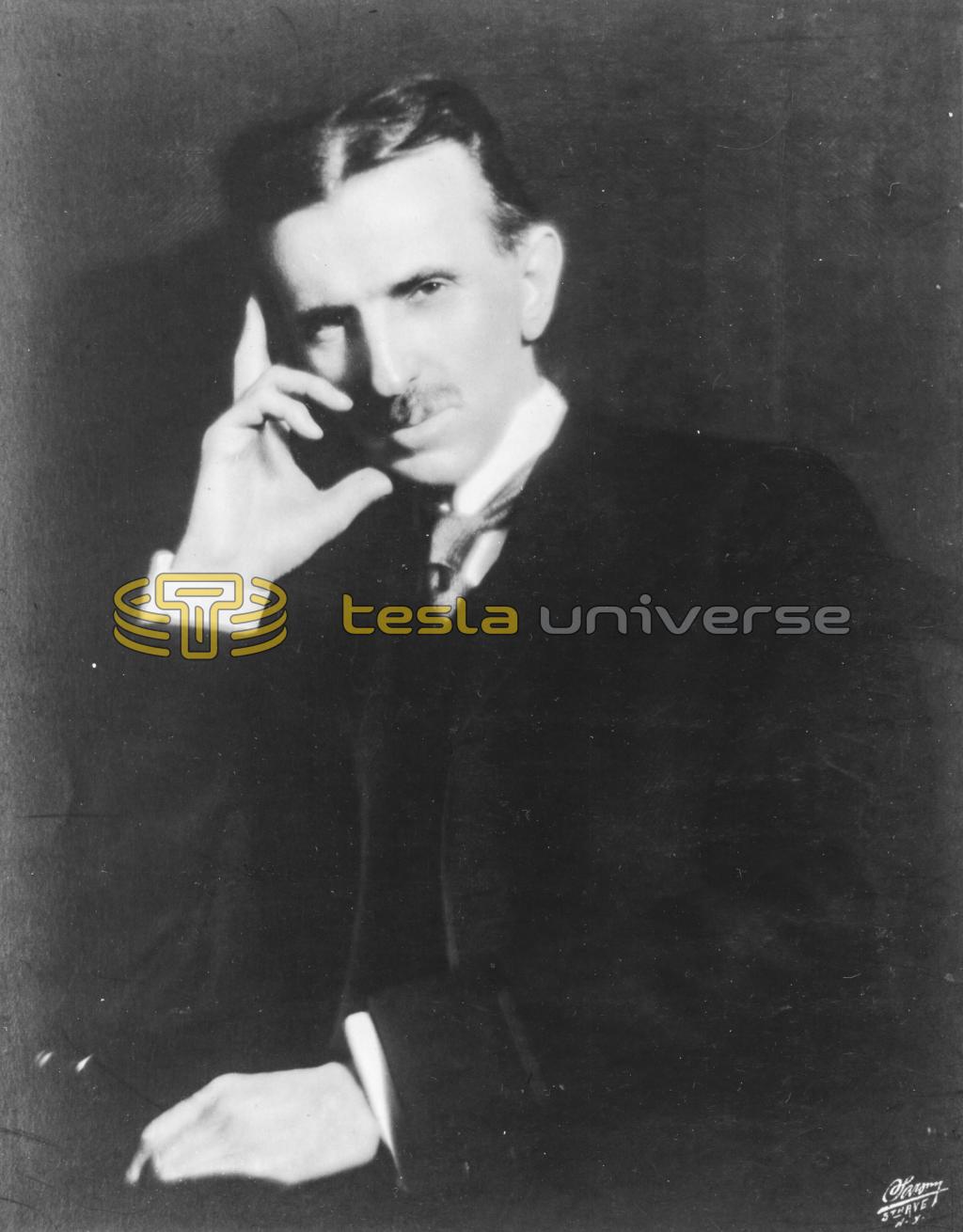
Almost a third of a century has passed since Nikola Tesla announced his discovery of the alternating-current motor, but the principles then enunciated by him will be found in force today wherever alternating current is used. Little things frequently lead to important consequences, and the way in which Tesla was led to his discovery is an exemplification of this trite observation He was a student in Grätz, in Austria, when he became annoyed by the sparking of a small laboratory generator, and the idea came to him that a commutatorless dynamo might be possible. This thought grew upon him, but not until four years later did he make any progress toward its realization. Then the solution suddenly came to him during a moment of recreation. In Europe it was impossible to interest capital in his discovery, so in 1884 he came to America, where his fame had preceded him.
His first employment was with Edison. August 7, 1920 He was able later on to attract capital, and in 1887 he organized a company to further his cherished plans, on which he worked nineteen hours a day. The next year, upon the issuance of the patents, he announced the discovery which was destined to have such a profound effect upon the rapid expansion of the use and application of electrical energy.
Next to this work in polyphase power transmission his researches in the field of high-frequency oscillations are probably of greatest importance. His discoveries in this field include among others the oscillation transformer, the electrical oscillator and the Tesla tube. Work on these lines led quite naturally to his investigations in the field of radio power transmission. In addition he has made various other scientific investigations, especially in the fields of low-weight, high-powered prime movers and atmospheric nitrogen production.
Mr. Tesla was born of Serbian parents at Smitjan, Lika, in Austria-Hungary, in 1857. He studied engineering at Grätz, Prague and Budapest. In 1917, on the twenty-ninth anniversary of the reading of his paper before the American Institute of Electrical Engineers, announcing his discovery in polyphase transmission, he received the Edison medal for "early original work in polyphase and high-frequency electric currents."
