Nikola Tesla Articles
Notes on Mr. Tesla's Lecture on Alternating Currents of Very High Frequency
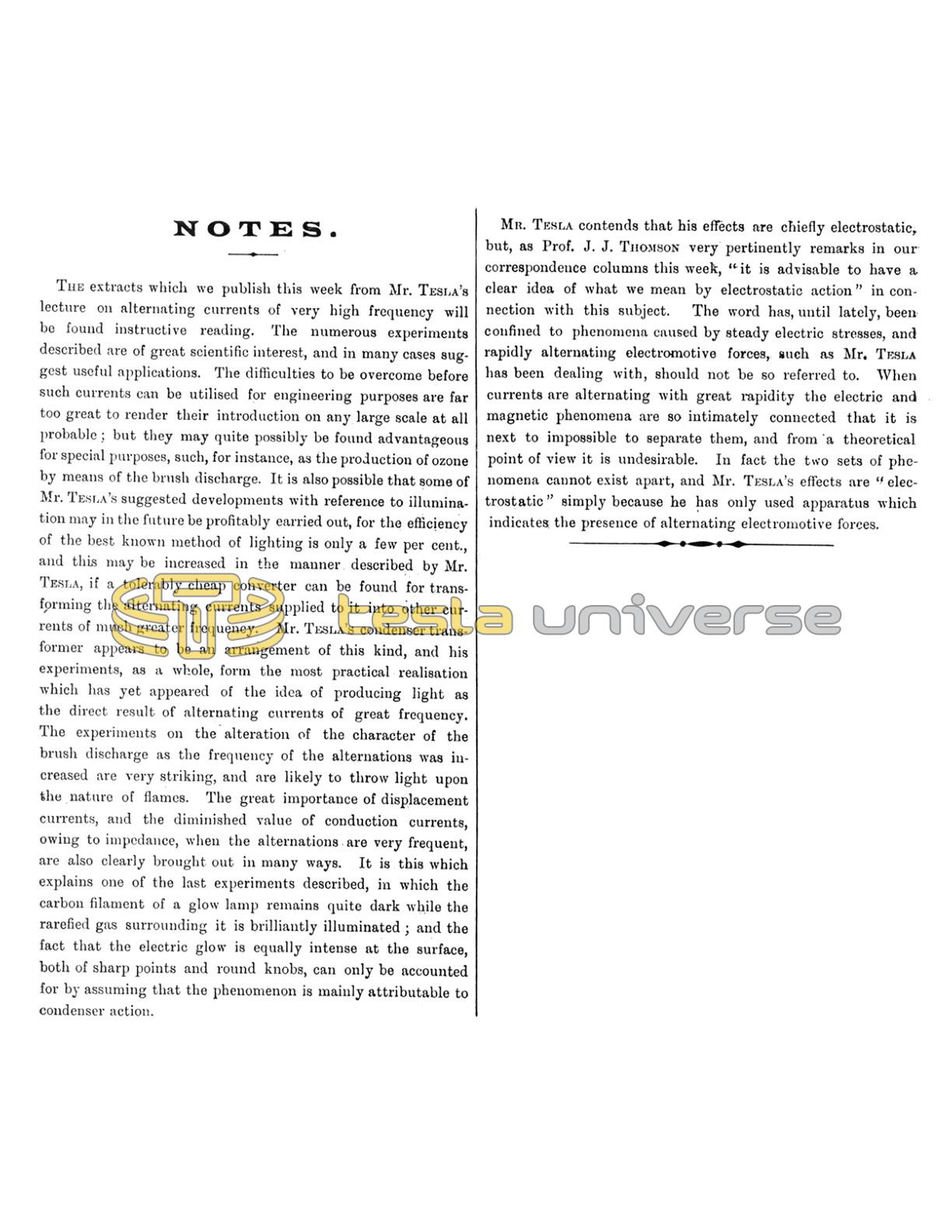
The extracts which we publish this week from Mr. Tesla's lecture on alternating currents of very high frequency will be found instructive reading. The numerous experiments described are of great scientific interest, and in many cases suggest useful applications. The difficulties to be overcome before such currents can be utilised for engineering purposes are far too great to render their introduction on any, large scale at all probable; but they may quite possibly be found advantageous for special purposes, such, for instance, as the production of ozone by means of the brush discharge. It is also possible that some of Mr. Tesla's suggested developments with reference to illumination may in the future be profitably carried out, for the efficiency of the best known method of lighting is only a few per cent., and this may be increased in the manner described by Mr. Tesla, if a tolerably cheap converter can be found for transforming the alternating currents supplied to it into other currents of much greater frequency. Mr. Tesla's condenser transformer appears to be an arrangement of this kind, and his experiments, as a whole, form the most practical realisation which has yet appeared of the idea of producing light as the direct result of alternating currents of great frequency. The experiments on the alteration of the character of the brush discharge as the frequency of the alternations was increased are very striking, and are likely to throw light upon the nature of flames. The great importance of displacement currents, and the diminished value of conduction currents, owing to impedance, when the alternations are very frequent, are also clearly brought out in many ways. It is this which explains one of the last experiments described, in which the carbon filament of a glow lamp remains quite dark while the rarefied gas surrounding it is brilliantly illuminated; and the fact that the electric glow is equally intense at the surface, both of sharp points and round knobs, can only be accounted for by assuming that the phenomenon is mainly attributable to condenser action.
Mr. Tesla contends that his effects are chiefly electrostatic, but, as Prof. J. J. Thomson very pertinently remarks in our correspondence columns this week, "it is advisable to have a clear idea of what we mean by electrostatic action" in connection with this subject. The word has, until lately, been confined to phenomena caused by steady electric stresses, and rapidly alternating electromotive forces, such as Mr. Tesla has been dealing with, should not be so referred to. When currents are alternating with great rapidity the electric and magnetic phenomena are so intimately connected that it is next to impossible to separate them, and from a theoretical point of view it is undesirable. In fact the two sets of phenomena cannot exist apart, and Mr. Tesla's effects are "electrostatic" simply because he has only used apparatus which indicates the presence of alternating electromotive forces.