Nikola Tesla Articles
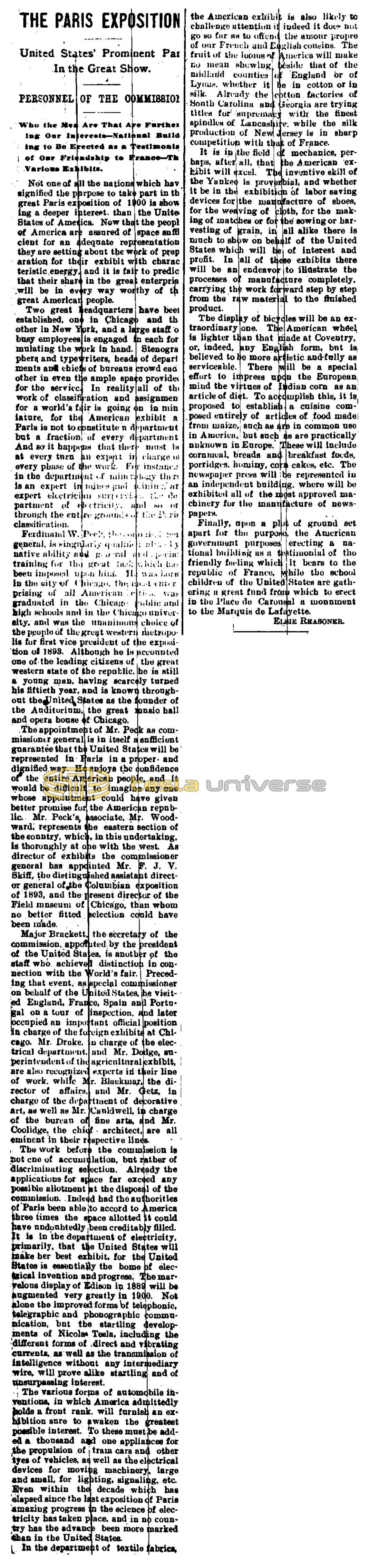
The Paris Exposition
United States’ Prominent Part In the Great Show.
PERSONNEL OF THE COMMISSION
Who the Men Are That Are Furthering Our Interests — National Building to Be Erected as a Testimonial of Our Friendship to France — The Various Exhibits.
Not one of all the nations which have signified the purpose to take part in the great Paris exposition of 1900 is showing a deeper interest than the United States of America. Now that the people of America are assured of space sufficient for an adequate representation they are setting about the work of preparation for their exhibit with characteristic energy, and it is fair to predict that their share in the great enterprise will be in every way worthy of the great American people.
Two great headquarters have been established, one in Chicago and the other in New York, and a large staff of busy employees is engaged in each formulating the work in hand. Stenographers and typewriters, heads of departments and chiefs of bureaus crowd each other in even the ample space provided for the service. In reality all of the work of classification and assignment for a world’s fair is going on in miniature, for the American exhibit at Paris is not to constitute a department but a fraction of every department. And so it happens that there must be at every turn an expert in charge of every phase of the work. For instance, in the department of mineralogy there is an expert in mines and mining; an expert electrician supervises the department of electricity, and so on through the entire grounds of the Paris classification.
Ferdinand W. Peck, the commissioner general, is singularly qualified both by native ability and by special training for the great task which has been imposed upon him. He was born in the city of Chicago, the most enterprising of all American cities, was graduated in the Chicago public and high schools and in the Chicago university, and was the unanimous choice of the people of the great western metropolis for first vice president of the exposition of 1893. Although he is accounted one of the leading citizens of the great western state of the republic, he is still a young man, having scarcely turned his fiftieth year, and is known throughout the United States as the founder of the Auditorium, the great music hall and opera house of Chicago.
The appointment of Mr. Peck as commissioner general is in itself a sufficient guarantee that the United States will be represented in Paris in a proper and dignified way. He enjoys the confidence of the entire American people, and it would be difficult to imagine any one whose appointment could have given better promise for the American republic. Mr. Peck’s associate, Mr. Woodward, represents the eastern section of the country, which, in this undertaking, is thoroughly at one with the west. As director of exhibits the commissioner general has appointed Mr. F. J. V. Skiff, the distinguished assistant director general of the Columbian exposition of 1893, and the present director of the Field museum of Chicago, than whom no better fitted selection could have been made.
Major Brackett, the secretary of the commission, appointed by the president of the United States, is another of the staff who achieved distinction in connection with the World’s fair. Preceding that event, as special commissioner on behalf of the United States, he visited England, France, Spain and Portugal on a tour of inspection, and later occupied an important official position in charge of the foreign exhibits at Chicago. Mr. Drake, in charge of the electrical department, and Mr. Dodge, superintendent of the agricultural exhibit, are also recognized experts in their line of work, while Mr. Blackmar, the director of affairs, and Mr. Getz, in charge of the department of decorative art, as well as Mr. Cauldwell, in charge of the bureau of fine arts, and Mr. Coolidge, the chief architect, are all eminent in their respective lines.
The work before the commission is not one of accumulation, but rather of discriminating selection. Already the applications for space far exceed any possible allotment at the disposal of the commission. Indeed had the authorities of Paris been able to accord to America three times the space allotted it could have undoubtedly been creditably filled. It is in the department of electricity, primarily, that the United States will make her best exhibit, for the United States is essentially the home of electrical invention and progress. The marvelous display of Edison in 1889 will be augmented very greatly in 1900. Not alone the improved forms of telephonic, telegraphic and phonographic communication, but the startling developments of Nicola Tesla, including the different forms of direct and vibrating currents, as well as the transmission of intelligence without any intermediary wire, will prove alike startling and of unsurpassing interest.
The various forms of automobile inventions, in which America admittedly holds a front rank, will furnish an exhibition sure to awaken the greatest possible interest. To these must be added a thousand and one appliances for the propulsion of tram cars and other types of vehicles, as well as the electrical devices for moving machinery, large and small, for lighting, signaling, etc. Even within the decade which has elapsed since the last exposition of Paris amazing progress in the science of electricity has taken place, and in no country has the advance been more marked than in the United States.
In the department of textile fabrics, the American exhibit is also likely to challenge attention if indeed it does not go so far as to offend the amour propre of our French and English cousins. The fruit of the looms of America will make no mean showing beside that of the midland counties of England or of Lyons, whether it be in cotton or in silk. Already the cotton factories of South Carolina and Georgia are trying titles for supremacy with the finest spindles of Lancashire, while the silk production of New Jersey is in sharp competition with that of France.
It is in the field of mechanics, perhaps, after all, that the American exhibit will excel. The inventive skill of the Yankee is proverbial, and whether it be in the exhibition of labor saving devices for the manufacture of shoes, for the weaving of cloth, for the making of matches or for the sowing or harvesting of grain, in all alike there is much to show on behalf of the United States which will be of interest and profit. In all of these exhibits there will be an endeavor to illustrate the processes of manufacture completely, carrying the work forward step by step from the raw material to the finished product.
The display of bicycles will be an extraordinary one. The American wheel is lighter than that made at Coventry, or, indeed, any English form, but is believed to be more artistic and fully as serviceable. There will be a special effort to impress upon the European mind the virtues of Indian corn as an article of diet. To accomplish this, it is proposed to establish a cuisine composed entirely of articles of food made from maize, such as are in common use in America, but such as are practically unknown in Europe. These will include cornmeal, breads and breakfast foods, porridges, hominy, corn cakes, etc. The newspaper press will be represented in an independent building, where will be exhibited all of the most approved machinery for the manufacture of newspapers.
Finally, upon a plot of ground set apart for the purpose, the American government purposes erecting a national building as a testimonial of the friendly feeling which it bears to the republic of France, while the school children of the United States are gathering a great fund from which to erect in the Place du Carrousel a monument to the Marquis de Lafayette.
ELSIE REASONER.