Nikola Tesla Articles
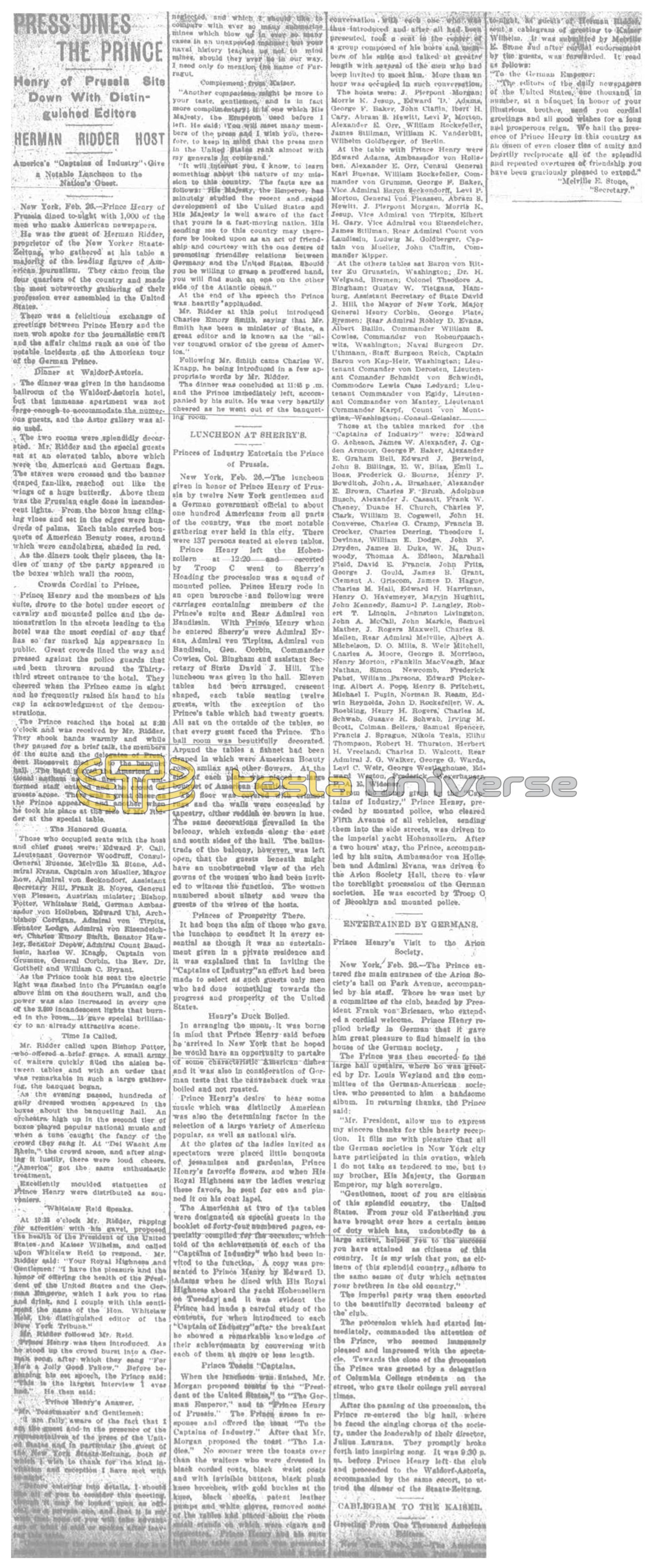
Press Dines the Prince
Webmaster note: This article is incomplete, but because of its uniqueness, it is being posted as-is with the hope that someone will be able to help locate the missing portion. If you have any information, please contact us.
Henry of Prussia Sits Down With Distinguished Editors
HERMAN RIDDER HOST
America’s “Captains of Industry” Give a Notable Luncheon to the Nation’s Guest.
New York, Feb. 26. — Prince Henry of Prussia dined to-night with 1,000 of the men who make American newspapers. He was the guest of Herman Ridder, proprietor of the New Yorker Staats-Zeitung, who gathered at his table a majority of the leading figures of American journalism. They came from the four quarters of the country and made the most noteworthy gathering of their profession ever assembled in the United States.
There was a felicitous exchange of greetings between Prince Henry and the men who spoke for the journalistic craft, and the affair claims rank as one of the notable incidents of the American tour of the German Prince.
Dinner at Waldorf-Astoria.
The dinner was given in the handsome ballroom of the Waldorf-Astoria hotel, but that immense apartment was not large enough to accommodate the numerous guests, and the Astor gallery was also used.
The two rooms were splendidly decorated. Mr. Ridder and the special guests sat at an elevated table, above which were the American and German flags. The staves were crossed and the banner draped fan-like, reached out like the wings of a huge butterfly. Above them was the Prussian eagle done in incandescent lights. From the boxes hung clinging vines and set in the edges were hundreds of palms. Each table carried bouquets of American Beauty roses, around which were candelabras, shaded in red.
As the diners took their places, the ladies of many of the party appeared in the boxes which wall the room.
Crowds Cordial to Prince.
Prince Henry and the members of his suite drove to the hotel under escort of cavalry and mounted police, and the demonstration in the streets leading to the hotel was the most cordial of any that has so far marked his appearance in public. Great crowds lined the way and pressed against the police guards that had been thrown around the Thirty-third street entrance to the hotel. They cheered when the Prince came in sight and he frequently raised his hand to his cap in acknowledgment of the demonstrations.
The Prince reached the hotel at 8:30 o’clock and was received by Mr. Ridder. They shook hands warmly and while they paused for a brief talk the members of the suite and the delegates of President Roosevelt filed up to the banquet hall. The band played the American national anthem as the first of the uniformed staff entered and the crowd of guests arose. There was a great cheer as the Prince appeared and another when he took his place at the side of Mr. Ridder at the special table.
The Honored Guests.
Those who occupied seats with the host and chief guest were: Edward P. Call, Lieutenant Governor Woodruff, Consul General Buenz, Melville E. Stone, Admiral Evans, Captain von Mueller, Mayor Low, Admiral von Reventlow, Assistant Secretary Hill, Frank B. Noyes, General von Plessen, Austrian minister; Bishop Potter, Ambassador Eid, German Ambassador von Holleben, Edward Uhl, Archbishop Corrigan, Admiral von Tirpitz, Senator Lodge, Admiral von Eisendecher, Charles Emory Smith, Senator Hawley, Senator Depew, Admiral Count Baudissin, Charles W. Knapp, Captain von Grumme, General Corbin, the Rev. Dr. Gottheil and William C. Bryant.
As the Prince took his seat the electric light was flashed into the Prussian eagle above him on the southern wall, and the power was also increased in every one of the 3,000 incandescent lights that burned in the room. It gave special brilliancy to an already attractive scene.
Time Is Called.
Mr. Ridder called upon Bishop Potter, who offered a brief prayer. A small army of waiters quickly filled the aisles between tables and with an order that was remarkable in such a large gathering, the banquet began.
As the evening passed, hundreds of gaily dressed women appeared in the boxes about the banqueting hall. An orchestra, high up in the second tier of boxes, played popular national music and when a tune caught the fancy of the crowd they sang it. “Die Wacht Am Rhein,” the crowd arose, and after singing it lustily, there were loud cheers. “America” got the same enthusiastic treatment.
Excellently moulded statuettes of Prince Henry were distributed as souvenirs.
Whitelaw Reid Speaks.
At 10:15 o’clock Mr. Ridder, rapping for attention with his gavel, proposed the health of the President of the United States and Kaiser Wilhelm, and called upon Whitelaw Reid to respond. Mr. Ridder said: “Your Royal Highness and Gentlemen: I have the pleasure and the honor of offering the toast of the President of the United States and the German Emperor, which I ask you to rise and drink, and I couple with this toast the name of the Hon. Whitelaw Reid, the distinguished editor of the New York Tribune.”
Mr. Ridder followed Mr. Reid.
Prince Henry was then introduced. As he arose the crowd burst into a German song, after which they sang “For He’s a Jolly Good Fellow.” Before beginning his set speech, the Prince said this is the largest interview I ever gave. He then said:
Prince Henry’s Answer.
“Your Royal Highness and Gentlemen: I am fully aware of the fact that I am standing in the presence of the representatives of the press of the United States in a gathering which is guest of the New Yorker Staats-Zeitung, both of whom I wish to thank for the kind invitation. I have never met with such a gathering of journalists. I would not have believed it possible. It would be neglected, and when I should like to compare with over so many succeeding millions, I would not have expected to find so many cases in an unexpected manner; but your naval history teaches us not to mind waves; should they arise in our way, I need only to mention the name of Farragut.
Compliment from Kaiser.
“Another comparison might be more to your taste, gentlemen, and is in fact more complimentary; it is one which His Majesty, the German Emperor, has sent. He said: ‘You will meet many members of the press and I wish you, therefore, to keep in mind that the press men in the United States rank almost with my generals in command.’
“It will interest you, I know, to learn something about the nature of my mission to this country. The facts are as follows: His Majesty, the Emperor, has minutely studied the recent and rapid development of the United States and His Majesty is well aware of the fact that yours is a fast-moving nation. His sending me to this country may therefore be looked upon as an act of friendship and courtesy with the one desire of promoting friendlier relations between Germany and the United States. Should you be willing to grasp a proffered hand, you will find such an one on the other side of the Atlantic ocean.”
At the end of the speech the Prince was heartily applauded.
Mr. Ridder at this point introduced Charles Emory Smith, saying that Mr. Smith has been a minister of State, a press editor and is known as the “silver tongued orator of the press of America.”
Following Mr. Smith came Charles W. Knapp, he being introduced in a few appropriate words by Mr. Ridder.
The dinner was concluded at 11:45 p.m. and the Prince immediately left, accompanied by his suite. He was very heartily cheered as he went out of the banqueting room.
LUNCHEON AT SHERRY’S
Princes of Industry Entertain the Prince of Prussia.
New York, Feb. 26. — The luncheon given in honor of Prince Henry of Prussia by twelve New York gentlemen and a German government official to one hundred Americans from all parts of the country, was the most notable gathering ever held in this city. There were 137 persons seated at eleven tables.
Prince Henry left the Hohenzollern at 12:20 and escorted by Troop C went to Sherry’s. Heading the procession was a squad of mounted police. Prince Henry rode in an open barouche and following were carriages containing members of the Prince’s suite and Rear Admiral von Baudissin. With Prince Henry when he entered Sherry’s were Admiral Evans, Admiral von Tirpitz, Admiral von Baudissin, Gen. Corbin, Commander Cowles, Col. Bingham and Assistant Secretary of State David J. Hill. The luncheon was given in the hall. Eleven tables had been arranged, crescent shaped, each table seating twelve guests, with the exception of the Prince’s table which had twenty guests. All sat on the outside of the tables, so that every guest faced the Prince. The ball room was beautifully decorated. Around the tables a fillet had been draped in the colors of American Beauty roses, smilax and other flowers. At the side of each plate was placed a large bouquet of American Beauties.
The floor was covered with crimson rugs and the walls were concealed by tapestry, either reddish or brown in hue. The same decorations prevailed in the alcove, which extends along the east and south sides of the hall. The balustrade of the balcony, however, was left open, that the guests beneath might have an unobstructed view of the rich gowns of the women who had been invited to witness the function. The women numbered about ninety and were the guests of the wives of the hosts.
Princes of Prosperity There.
It had been the aim of those who gave the luncheon to conduct it in every essential as though it was an entertainment given in a private residence, and it was explained that in inviting the “Captains of Industry” an effort had been made to select as such guests only men who had done something towards the progress and prosperity of the United States.
Prince’s Duck Boiled.
In arranging the menu, it was borne in mind that Henry Henry said before he arrived in New York that he hoped he would have an opportunity to partake of some characteristic American dishes and it was also in consideration of German tastes that the canvasback duck was boiled and not roasted.
Prince Henry’s desire to hear some music which was distinctly American was also the determining factor in the selection of a large variety of American popular, as well as national airs.
At the plates of the ladies invited as spectators were placed little bouquets of jessamines and gardenias, Prince Henry’s favorite flowers, and when His Royal Highness saw the ladies wearing these favors, he sent for one and pinned it on his coat lapel.
The Americans at two of the tables were treated as special guests in the booklet of forty-four numbered pages, especially compiled for the occasion, which told of the achievements of each of the “Captains of Industry” who had been invited to the function. A copy was presented to Prince Henry by Edward D. Adams when he dined with His Royal Highness aboard the yacht Hohenzollern on Tuesday and it was evident the Prince had made a careful study of the contents, for when introduced to each “Captain of Industry” after the breakfast he showed a remarkable knowledge of their achievements by conversing with each of them at more or less length.
Prince Toasts “Captains.”
When the luncheon was finished, Mr. Morgan proposed a toast to the “President of the United States,” to “The German Emperor,” and to “Prince Henry of Prussia.” The Prince arose in response and offered the toast “To the Captains of Industry.” After that Mr. Morgan proposed the toast “The Ladies.” No sooner were the toasts over than the waiters who were dressed in black corded vests, black waist coats and with invisible buttons, black plush knee breeches, with gold buckles at the knee, black stocks, patent leather shoes and white gloves, removed some of the tables and placed about the room tables on which were cigars and cigarettes. Prince Henry and his suite left their table and ... conversation with each one who was thus introduced and after all had been presented, took a seat in the center of a group composed of his hosts and members of his suite and talked at greater length with several of the men who had been invited to meet him. More than an hour was occupied in such conversation.
The hosts were: J. Pierpont Morgan, Morris K. Jesup, Edward D. Adams, George F. Baker, John Claflin, Elbert H. Gary, Abram S. Hewitt, Levi P. Morton, Alexander E. Orr, William Rockefeller, James Stillman, William K. Vanderbilt, Wilhelm Goldberger, of Berlin.
At the table with Prince Henry were Edward Adams, Ambassador von Holleben, Alexander E. Orr, Consul General Karl Buenz, William Rockefeller, Commander von Grumme, George F. Baker, Vice Admiral Baron Seckendorff, Levi P. Morton, General von Plessen, Abram S. Hewitt, J. Pierpont Morgan, Morris K. Jesup, Vice Admiral von Tirpitz, Elbert H. Gary, Vice Admiral von Eisendecher, James Stillman, Rear Admiral Count von Baudissin, Ludwig W. Goldberger, Captain von Mueller, John Claflin, Commander Klepfer.
At the others tables sat Baron von Ritter zu Grunstein, Washington; Dr. H. Welgand, Bremen; Colonel Theodore A. Bingham; Gustav W. Steigaus, Hamburg, Assistant Secretary of State David J. Hill, the Mayor of New York, Major General Henry Corbin, George Plate, Bremen; Rear Admiral Robley D. Evans, Albert Ballin, Commander William S. Cowles, Commander von Hohenzollern, Washington; Naval Surgeon Dr. Uhlmann, Staff Surgeon Reich, Captain Baron von Kap-Herr, Washington; Lieutenant Commander von Deroeten, Lieutenant Commander Schmidt von Schwindt, Commodore Lewis Cass Ledyard, Lieutenant Commander von Eardy, Lieutenant Commander von Magdey, Lieutenant Commander Karpf, Count von Montgelas, Washington; Consul Geissler.
Those at the tables marked for the “Captains of Industry” were: Edward G. Acheson, James W. Alexander, J. Ogden Armour, George F. Baker, Alexander Graham Bell, Edward J. Berwind, John S. Billings, E. W. Bliss, Emil L. Boas, Frederick G. Bourne, Henry P. Bowditch, John A. Brashear, Alexander E. Brown, Charles F. Brush, Adolphus Busch, Alexander J. Cassatt, Frank W. Cheney, Duane H. Church, Charles P. Clark, William B. Cogswell, John H. Converse, Charles G. Cramp, Francis B. Crocker, Charles Deering, Theodore L. De Vinne, William E. Dodge, John F. Dryden, James B. Duke, W. H. Dunwoody, Thomas A. Edison, Marshall Field, David R. Francis, John Fritz, George J. Gould, James B. Grant, Clement A. Griscom, James D. Hague, Charles M. Hall, Edward H. Harriman, Henry O. Havemeyer, Marvin Hughitt, John Kennedy, Samuel P. Langley, Robert T. Lincoln, Johnston Livingston, John A. McCall, John Markle, Samuel Mather, J. Rogers Maxwell, Charles A. Mellen, Rear Admiral Melville, Albert A. Michelson, D. O. Mills, S. Weir Mitchell, Charles A. Moore, George B. Morrison, Henry Morton, Franklin MacVeagh, Max Nathan, Simon Newcomb, Frederick Pabst, William Parsons, Edward Pickering, Albert A. Pope, Henry S. Pritchett, Michael I. Pupin, Norman B. Ream, Edwin Reynolds, John D. Rockefeller, Irving M. Scott, Colman Sellers, Samuel Spencer, Francis J. Sprague, Nikola Tesla, Elihu Thomson, Robert H. Thurston, Herbert H. Vreeland, Charles D. Walcott, Rear Admiral J. G. Walker, George G. Ward, Levi C. Weir, George Westinghouse, Edward Weston, Frederick Weyerhaeuser, P. A. B. Widener.
From the dinner given by the “Captains of Industry,” Prince Henry, preceded by mounted police, who cleared Fifth Avenue of all vehicles, sending them into the side streets, was driven to the imperial yacht Hohenzollern. After a two hours’ stay, the Prince, accompanied by his suite, Ambassador von Holleben and Admiral Evans, was driven to the Arion Society Hall, there to view the torchlight procession of the German societies. He was escorted by Troop C of Brooklyn and mounted police.
ENTERTAINED BY GERMANS
Prince Henry’s Visit to the Arion Society.
New York, Feb. 26. — The Prince entered the main entrance of the Arion Society’s hall on Park Avenue, accompanied by his staff. There he was met by a committee of the club, headed by President Frank von Briesen, who extended a cordial welcome. Prince Henry replied briefly in German that it gave him great pleasure to find himself in the house of the German society.
The Prince was then escorted to the large hall upstairs, where he was greeted by Dr. Louis Weyland and the committee of the German-American societies, who presented to him a handsome album. In returning thanks, the Prince said:
“Mr. President, allow me to express my sincere thanks for this hearty reception. It fills me with pleasure that all the German societies in New York city have participated in this ovation, which I do not take as tendered to me, but to my brother, His Majesty, the German Emperor, my high sovereign.
“Gentlemen, most of you are citizens of this splendid country, the United States. From your old Fatherland you have brought over here a certain sense of duty which has, undoubtedly to a large extent, helped you to the success you have attained as citizens of this country. It is my wish that you, as citizens of this splendid country, adhere to the same sense of duty which actuates your brethren in the old country.”
The imperial party was then escorted to the beautifully decorated balcony of the club.
The procession which had started immediately, commanded the attention of the Prince, who seemed immensely pleased and impressed with the spectacle. Towards the close of the procession the Prince was greeted by a delegation of Columbia College students on the street, who gave their college yell several times.
After the passing of the procession, the Prince re-entered the big hall, where he faced the singing chorus of the society, under the leadership of their director, Julius Laurans. They promptly broke forth into inspiring song. It was 9:30 p.m. before Prince Henry left the club and proceeded to the Waldorf-Astoria, accompanied by the same escort, to attend the dinner of the Staats-Zeitung.
CABLEGRAM TO THE KAISER.
Greeting From One Thousand American Editors
New York, Feb. 26. — The American editors ... to-night, as guests of of Herman Ridder, sent a cablegram of greeting to Kaiser Wilhelm. It was submitted by Melville E. Stone and after cordial endorsement by the guests, was forwarded. It read as follows:
“To the German Emperor:
“The editors of the daily newspapers of the United States, one thousand in number, at a banquet in honor of your illustrious brother, send you cordial greetings and the wish of a long and prosperous reign. We hail the presence of Prince Henry in this country as an omen of even closer ties of amity and heartily reciprocate all of the splendid and repeated overtures of friendship you have been graciously pleased to extend.”
Melville E. Stone,
Secretary.