Nikola Tesla Articles
Professor Röntgen's Discovery of a New Radiance
Röntgen's discovery of what appears to be a new form of radiant energy has justly attracted universal attention. The interest attached to it is a twofold one: first, its purely scientific significance; second, its practical importance. The discovery may be stated broadly as follows: if an electric current be sent through a vacuum tube — the so-called Crookes tube, — then, in addition to the heat and fluorescent light generated in the glass of the tube, there is, according to Röntgen’s discovery, another form of radiant energy generated, which we may call the Röntgen rays. The following characteristic elements describe this energy: it produces fluorescence in fluorescent substances, just as ultra-violet light; it affects the photographic plate, just as the actinic part of the solar spectrum; it penetrates all bodies, even the metals, in a greater or smaller degree, and it is neither reflected or refracted appreciably. No other known form of radiant energy resembles the Röntgen rays in this last respect.
Much has been written lately about this discovery, but little has been said which would serve as trusty and intelligible guidance to those who are not familiar with modern electric appliances. It seems desirable, therefore, to give here a brief and simple description of the apparatus, and of the method of operation.
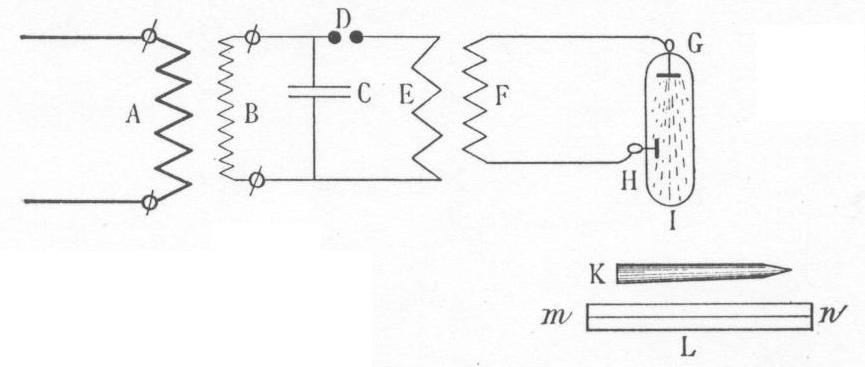
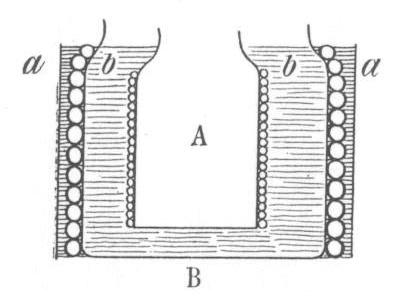
In Fig. 1 we have an ordinary induction coil, AB. Its primary coil, A, is connected to the mains of an alternating current circuit, and the supply of current is regulated by an auxiliary resistance-box. The secondary winding, B, is connected to a Leyden jar, C. A gallon jar with a medium-sized coil gives a sufficiently strong effect. The jar is connected to an oscillatory transformer, EF, which needs a more detailed description. It can be constructed as follows. Take two large glass jars, A and B (Fig. 2); wind about eighteen turns of very coarse, well-insulated wire, aa, on the outside jar, B, and about two hundred turns of fine wire, bb, on the inside jar. Place the jar, A, into B, and fill the space between them with very hot paraffin. Pour very hot beeswax over the outside winding, aa, until a thick crust is formed. This is then an oscillatory transformer. The coarse wire winding, aa, is the primary, and the fine wire winding is the secondary, of this transformer. In Fig. 1 the primary, indicated by E, is connected to the Leyden jar, C, and the secondary to the vacuum tube, GH. The plateholder, L, containing the sensitive photographic plate, mm, is in line with the electrode, G, so that it is in the line of discharge from this electrode. The object, K, to be photographed, is placed between the tube and the plate.
We can pass now to the operation. Observe first that the circuit, CDE, contains an air-gap, D, between two small brass spheres. As soon as the current is admitted into A, there is induced a very high tension current in B, which charges the jar until the tension between the small spheres of the air-gap is high enough to break through. The jar discharges then, and the discharge current will oscillate back and forth in the circuit, CDE, at a rate of several hundred thousand vibrations per second. These vibrations die out rapidly, but the alternating current in B makes a break through the gap, D, at every alternation, and sets up, after each disruptive break, a series of oscillations. In fact, the circuit, CDE, may be compared to a church bell, and the disruptive action at the gap, D, performs the function of the swinging tongue of the bell. After each stroke, a series of waves spreads out into space, — melodious sound waves in one case, silent electric waves in the other. These rapidly-vibrating waves induce in the secondary circuit, F, a series of waves of the same rapidity, but of much higher tension. The oscillatory current in the tube, GH, produces a luminescence in the attenuated gas in the vacuum tube. If the vacuum is not very high, the luminescence is almost entirely within the gas itself; this is not the case in very high vacua. For the purpose of pointing out clearly how these Röntgen rays are produced, it is well to consider briefly the electrical discharge in the tube when the vacuum is very high.
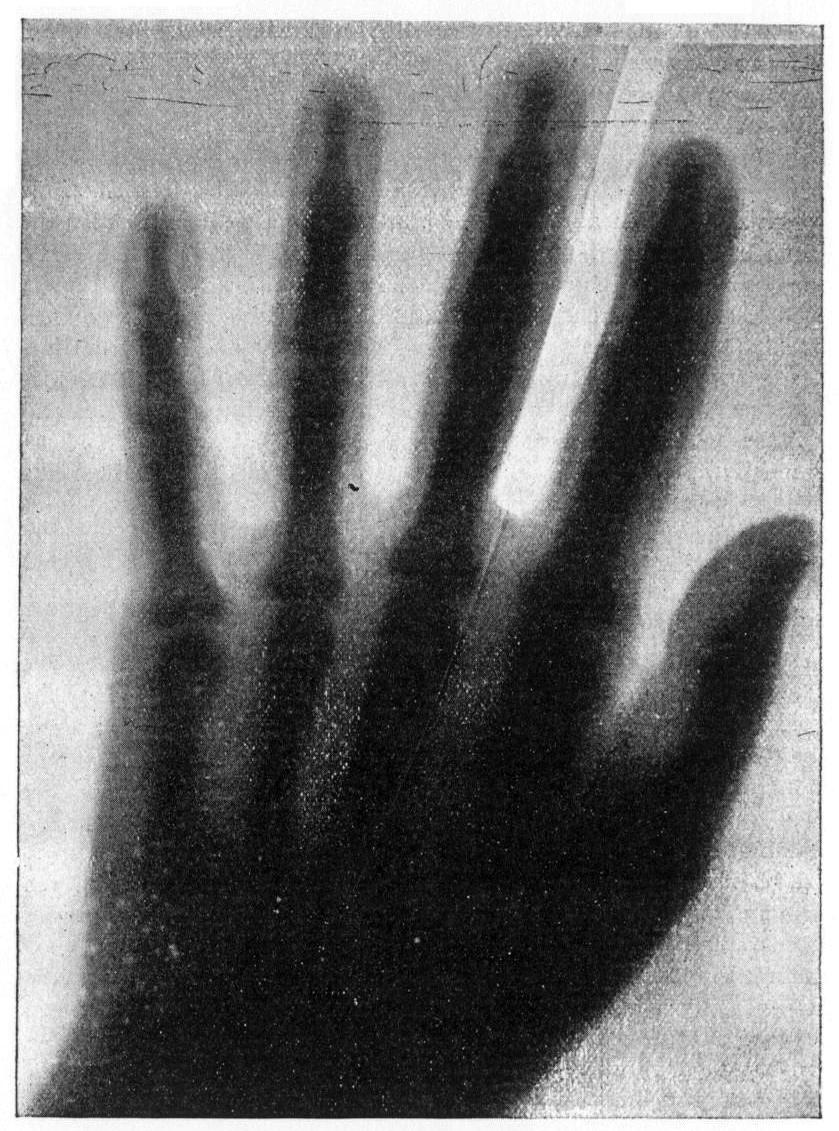
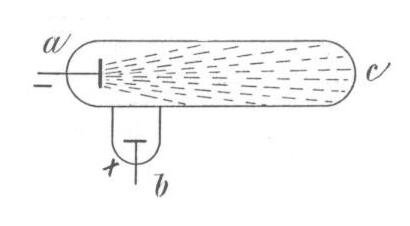
Fig. 3 represents a typical form of a vacuum tube, capable of giving a strong Röntgen effect. Two platinum wires, a and b, carrying aluminum discs, are sealed in a glass tube. They are the electrodes which are connected to the high tension coil. The electrode which at any moment is connected to the negative pole is called the cathode, and that connected to the positive pole is the anode. When the current is oscillatory, as in the arrangement described in Fig. 1, each electrode alternates periodically between being anode and cathode. Thus, in an alternating current reversing one hundred times per second, each electrode will be anode fifty times and cathode fifty times per second. Fix, now, any moment when a is the cathode and b is the anode. Suppose that the air pressure in the tube has been gradually reduced by the action of a mercury pump to something like one millionth of an atmosphere. The electrical discharge, which, as long as the vacuum is not high, appears as a bright luminescence of the gas, is hardly visible at this excessively low pressure.
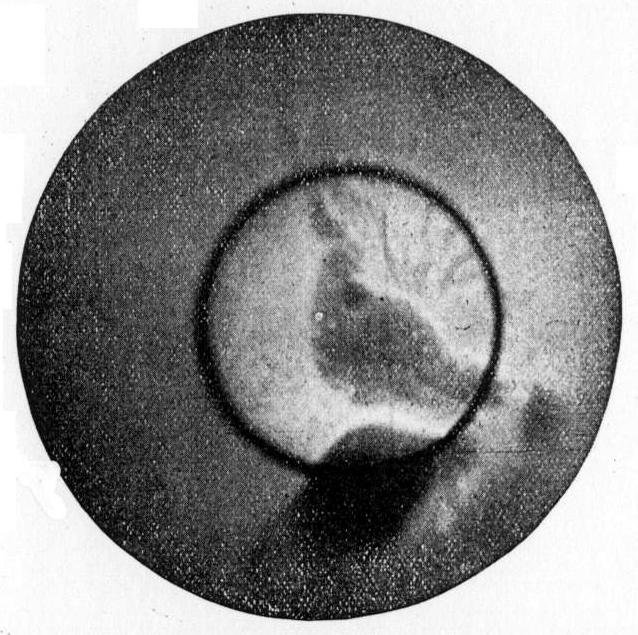
In place of this luminescence of the gas, there appears in very high vacua a vivid fluorescence of the glass, — blue in American glass, green in German glass. This fluorescence is produced by faint streamers which proceed in straight lines from the cathode, as indicated by the dotted lines in Fig. 3. Where these streamers meet the tube, there the fluorescence and the heating of the glass take place. Professor Röntgen finds that this brightly-fluorescing surface in the walls of the tube is the seat of a radiant energy, which possesses the characteristic features described above. These rays, which Röntgen calls the X-rays, can be observed in a dark room by means of a paper screen saturated with an emulsion of a fluorescing substance. The discoverer employed barium platino-cyanid. Wherever the rays strike this screen, they cause it to fluoresce, and the intensity of the fluorescence measures the intensity of the Röntgen rays. By interposing a substance between the tube and the screen, the relative opacity of the substance for these rays can be determined. It is found that even metals are transparent to it, but in various degrees. Thus, if a given thickness of platinum will absorb a certain amount of these rays, it is found that the same amount of absorption will be produced by a lead plate of three times the thickness, by a zinc plate of six times the thickness, and by an aluminum plate of two hundred times the thickness. Wood, ebonite, rubber, water, and organic compounds, are more transparent than metals, but none of them are perfectly transparent, nor is any substance perfectly opaque. A fact deserving an especial mention is that glass, especially that containing lead, is nearly opaque. Bone is much more opaque than flesh; the shadow of a human hand on a fluorescent screen will, therefore, show the skeleton darker than the flesh.
Another method of studying this new form of radiant energy is by means of photography. Röntgen found that a photographic film is affected by the X-rays, but, since these rays are neither reflected or refracted, it is useless to employ lenses. The plate remains shut up in the plate-holder, and the object to be photographed is placed upon it, so as to be between the tube and the plate, as indicated in Fig. 1. The time of exposure varies with the quality of the vacuum and the electric tension employed. It may be as short as four minutes, or it may be as long as two hours. The nearer the tube is to the plate, the shorter is the time of exposure, but evidently the less defined will be the shadow picture. There is good prospect of perfecting both the means of producing the vacua and also the construction of the tubes, so as to produce the X-rays in a larger quantity. This would shorten the time of exposure, and also improve the definition of the photographs.
Röntgen’s experiments have been repeated in this country in several laboratories, — at Harvard, Yale, Johns Hopkins, Princeton, and in the writer’s laboratory at Columbia. At the McGill University in Montreal a bullet was located in a man’s leg by means of this photography. Similar reports have reached us from Europe. Several hospitals in this city intend to put in an outfit suitable for the production of the X-rays. The surgeons expect much help from this remarkable discovery, and the experimental results obtained in this country so far seem to hold out a very bright prospect.
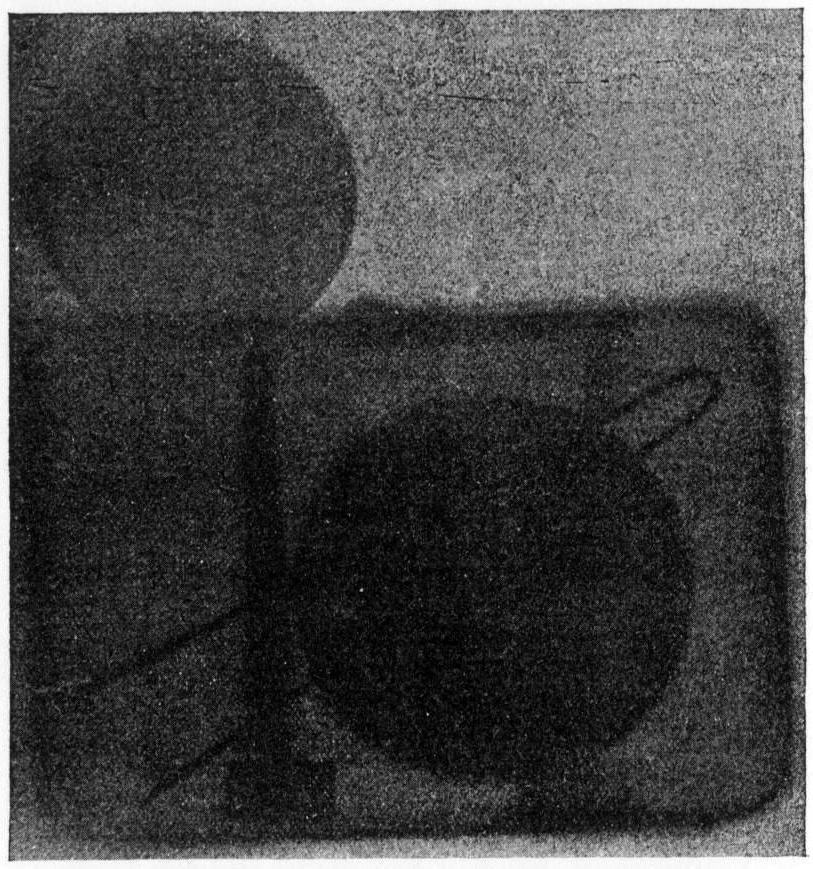
But surgery is not the only profession which is going to reap the immediate benefits from the practical application of this discovery. Metallurgy and mineralogy expect to overcome some of their old difficulties with the aid of the X rays. Various minerals have a various degree of opacity for these rays, and it is not at all difficult to distinguish a real gem from an imitation. The occlusion of metals is particularly easy to detect, since metals seem to be more opaque than other substances. But even the metals themselves have a various degree of opacity, as has been already pointed out. Hence, if two metals are mixed to make an alloy, and the mixture is not perfectly homogeneous, it would be an easy matter to detect the want of uniformity, provided, of course, that a sufficiently thin plate is cut from the sample to be examined; thick plates are too opaque to permit an appreciable part of the X-rays to pass through. It is, therefore, not quite clear to the writer how this new method of photography can be employed in its present stage of development to detect flaws in steel guns and armor-plates, unless these rays are made much more powerful than we have been able to make them so far, and unless also we discover photographic plates which are much more sensitive to these rays than the plates now in the market. The author confesses his belief, however, that we shall, in all probability, soon reach both these improvements. A sufficiently long exposure will, even now, as the writer knows from his own experiments, reproduce the various details in the structure of a body. So, for instance, the photograph of a pair of spectacles in a leather case and separated from the plate by a thin sheet of ebonite will, with sufficiently long exposure, show the curvature of the lenses. The photograph of an aluminum medal will sometimes come out so neat and well-defined as to show the lettering and the figures, — that is, in the negative. In the printing this fine detail is not always clearly shown. But it must be remembered that we are only at the beginning of a new art. We hope, and with reason, that this new photography will reveal the interior structure, not only of dead matter, but also of living organisms.
The photographs accompanying this article explain themselves.
Since writing the above I have been able to collect additional facts which seem of sufficient interest to merit mention.
The apparatus described above was discarded as too complicated and too severe on the tube. A six-plate Holtz machine made by the Galvano Faradic Company of New York was tried and gave complete satisfaction. The Röntgen effect with such a machine is sufficiently powerful, and the wear on the tubes is small. In fact, they seem to improve with use, instead of deteriorating. The tube should be connected in series with the outside coatings of the two jars, and the capacity of the jars should not be too large for the size of the tube. With a pear-shaped Crookes tube of 5 inches diameter half-pint jars give excellent results. A cylindrical vacuum tube without internal electrodes, but with external tinfoil coatings at the extremity of the tube, will do very well as a substitute for a Crookes tube. The vacuum should be as high as anybody can possibly obtain. This is one of the good things of which we cannot have too much, — at least with the methods of exhausting now employed in this country. It should be observed that these methods are perfectly wretched.
Regarding the detail of the things photographed, it is important to observe that Röntgen photography acts differently from ordinary photography. We cannot speak here of over-exposure, unless we specify that it is over-exposure with regard to certain parts which are exposed. Take, for instance, the shadowgraph of a number of objects enclosed in an aluminum cigar box. With a short exposure the details of the structure of the box appear, but those of the enclosed objects do not. With a long exposure the box itself is almost invisible, but the details of the enclosed objects appear. A still longer exposure will make the things enclosed in the box disappear one by one. The most opaque will remain longest. Again, consider the photograph of the human hand. A short exposure gives nothing but the flesh. A little longer exposure brings out the nails. Still longer, and the skeleton begins to appear, whereas the flesh begins to disappear. Still longer, and nothing but the bones appear the various parts being accurately represented in their relative opacity. A still longer exposure will make the various parts of the skeleton disappear one by one, according to their relative opacity. A sufficiently-prolonged exposure would reveal opaque objects concealed in the bone itself. There is no doubt that by a sufficiently long exposure the homogeneity of not excessively thick metal plates can be examined with considerable accuracy.
M. I. P.
February 18, 1896.