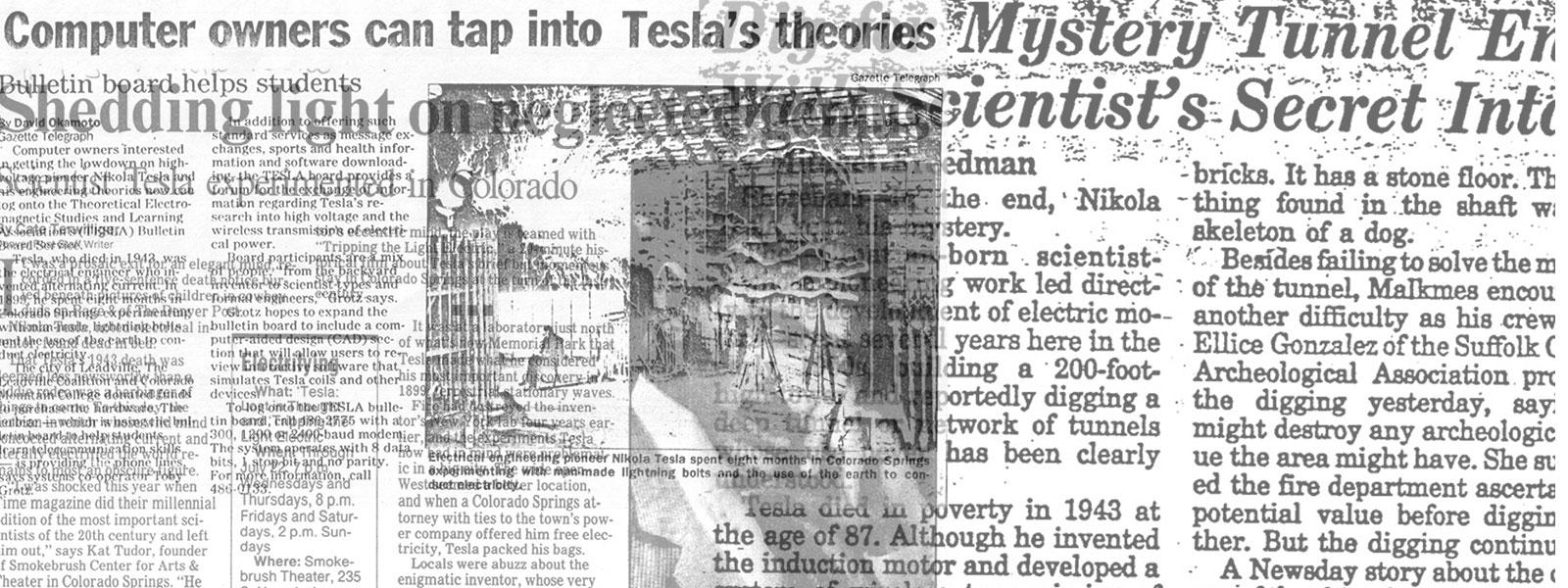
Nikola Tesla Articles
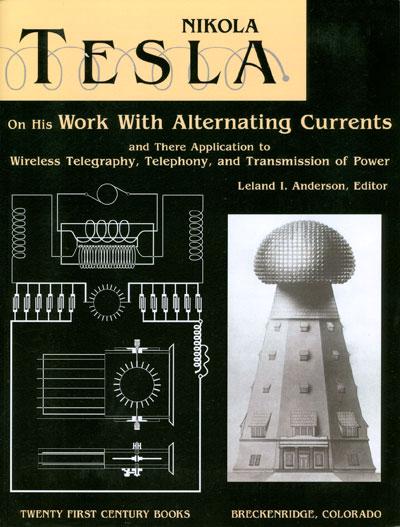
Review of Nikola Tesla On His Work With Alternating Currents and Their Application to Wireless Telegraphy, Telephony, and Transmission of Power
Reviewed by Roger R. Block
Leland I. Anderson's book Nikola Tesla On His Work With Alternating Currents and Their Application to Wireless Telegraphy, Telephony, and Transmission of Power is a must read for all history and radio buffs.
It clearly describes the inner thinking of Tesla, the man, in a way never done before. You get to read Tesla's own words as spoken in a 1916 pre-hearing interview with his legal counsel. This interview never was intended to be made public, but as you read this book, a presence will transcend you to that moment. It is truly a magical transformation in the time domain.

Many new things are brought to light. Interestingly, Tesla had tried to persuade the Navy to sponsor shipboard radio communications after he publicly demonstrated radio remote control of toy boats in 1898. Congress, however, only appropriated $750,000 to John Hays Hammond Jr. after Tesla's patent had expired.
Anderson gives no doubt as to who is the real inventor of radio. He pictures Tesla's actual equipment and patent drawings, and in the text, Tesla is asked by his counsel to describe how each worked.
Unique (non-commutated) rotating dc generators, along with other damped generators, Tesla explains, are the forerunner to his continuous (CW) "mechanical signal" generators. These patented generators had tremendous output power and were used (by Pickard), together with Tesla's "antenna," to transmit signals 200 miles to 300 miles easily. Even the Navy indicated that Tesla's equipment design, covered in his 1900 patents, was the best.
The excitement of looking back almost 100 years is that we know the outcome. The irony is that we have the knowledge to know what does work and how it works.
Tesla's idea for power transmission is the same for information (radio). Anderson documents, in Tesla's own words, his reasoning for how it works. The earth, he explains, is a conductor, and the upper atmosphere is another conductor, but not as good.
The earth is like a balloon (sic) filled with water. As the transmitter, like a pump, slowly "vibrates" the earth (an elastic medium), these vibrations carry to all parts of the globe.
If another tuned "pump" (receiver) is placed some distance away, it will recover power from the transmitter. If the frequency is too high, the vibration will not be felt, and it will die like a ripple on a pond.
It is the earth conducting the energy,; therefore electromagnetic (EM) radiation should be avoided because it only radiates in a non-elastic medium - air. From this theory, the intent to minimize EM leads Tesla to a heavily loaded tuned antenna, all coil with a capacitive hat, which produces extremely high voltages. Tesla refers to requiring 4,000,000 volts of "pressure" to transmit power and information around the globe.
In a later part of the book, Anderson pulls at our hearts as he includes foreclosure proceedings on Wardenclyffe, the site of Tesla's greatest dream for wireless transmission of power and messages, which turned into his financial ruin. Tesla spent $750,000 on the project, and the final dismantling of the specially constructed tower was a major blow to him.
Interesting to read, this book still had me backing Tesla in the hope that history could be rewritten. Unfortunately, in the end, Tesla followers may find reality a bit depressing, but well worth reliving.
(Twenty First Century Books, P.O. Box 2001, Breckenridge, CO 80424-2001.)
Roger R. Block (F) is president of PolyPhaser Corp. in Minden, NV.
