
Nikola Tesla Articles
Syntonic Wireless Telegraphy - Part 2
(Concluded from page 175.)
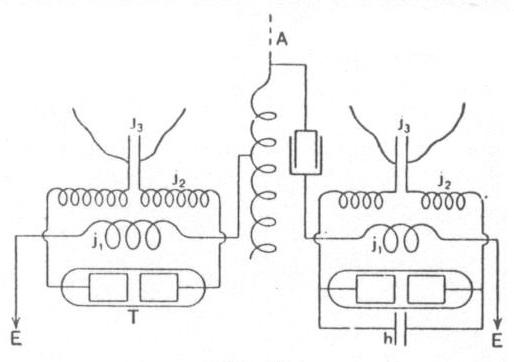
It is easy to understand that if we have several receiving stations, each tuned to a different period of electrical vibration, and of which the corresponding inductance and capacity at the transmitting station are known, it will not be difficult to transmit to any one of them without danger of the message being picked up by the other stations for which it is not intended. But, better than this, we can connect to the same vertical sending wire, through connections of different inductance, several differently tuned transmitters, and to the receiving vertical wire a number of corresponding receivers. Different messages can be sent by each transmitter connected to the same radiating wire simultaneously, and received equally simultaneously by the vertical wire connected to differently tuned receivers. This result, which I believe to be quite novel, I showed to several friends of mine, including Dr. Fleming, F.R.S., in the summer of last year, and to an Admiralty Commission. Dr. Fleming has made mention of the results I showed him, in a letter to The Times, dated Oct. 4, 1900, and in his Cantor lectures delivered before the Society of Arts in November and December, 1900. A further improvement has been obtained by the combination of the two systems. In this case the cylinders are connected to the secondary of the transmitting transformer, and the receiver to a properly tuned induction coil, and all circuits must be tuned to the same period as already described. (See Fig. 16.)
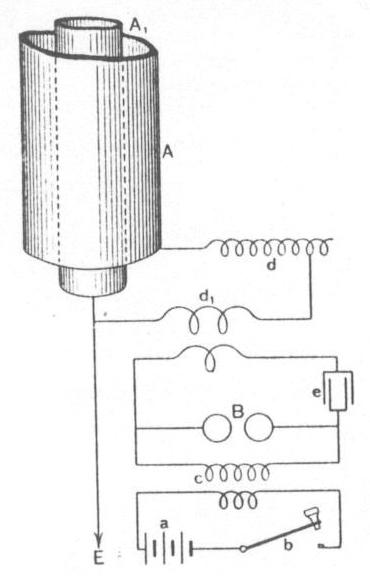
The tuning of the receiver to respond to the period of the transmitter, as used in the old form of transmitter shown in Fig. 1, or in the new one shown in Fig. 7, has enabled results to be obtained over considerable distances with moderate heights. As already published by Dr. Fleming in the letter above referred to, signalling has been successfully carried out over a distance of 50km, with a cylinder only 1.25 metres high, 40in. in diameter. This has led to the possibility of constructing portable apparatus for army purposes which should be of great service in the field. I have succeeded in constructing a complete installation on a steam motor car. On the roof of the car there is placed a cylinder which can be lowered when travelling, its height being only 6 or 7 metres, and by this means communication has been easily carried out with a syntonised station over a distance of 31 miles. A 25cm. spark induction coil worked by accumulators and taking about 100 watts is used for transmitting, and the accumulators can be re-charged by a small dynamo worked by the car motor. I believe such an appliance might have been of use to the besieged garrisons in South Africa and China. A strip of wire netting laid on the ground is sufficient for earth connection, and by dragging it along communication can be established even when the car is travelling. I have recently obtained as good results by not using any "connection" to earth, but only utilising in lieu of earth the electrical capacity of the boiler of the motor car. I also find that signals can be transmitted a considerable distance with the cylinder in a horizontal position.
Last spring I recognised the desirability of carrying out tests between stations situated at much greater distances apart than had been attempted heretofore.† A station was established at the Lizard, Cornwall, and on the first attempt communication was effected with St. Catherine's, Isle of Wight, over a distance of 186 miles, which, I believe, is the record distance over which signals have been sent through space without wires. It is interesting to observe that signals were obtained over this distance with the transmitting apparatus as shown in Fig. 1, or with the arrangement shown in Fig. 7, provided always that a suitable resonating induction coil was employed at the receiving station. The amount of energy used for signalling over this distance is not more than 150 watts, but experiments with a larger amount of energy will shortly be carried out. In the case of the 186 miles transmission, the aerial conductor consisted of four parallel vertical wires 1.50 metres apart, 48 metres long, or in a strip of wire netting of same length. It is interesting to note that in order to communicate between my stations at Poole and St. Catherine's (distance 31 miles) with the same amount of energy and the same kind of aerial wire this must be 20 metres high to obtain signals of about the same strength as those obtained between the 186-mile stations with the 48-metre aerials. This goes to confirm many other results previously obtained, which indicate that with a parity of other conditions the distance varies with the square of the height of the vertical conductors at the two stations. I have always found this law fulfilled, if the height of the conductors at the two stations is approximately equal, although an attempt has been made recently to throw doubt upon its correctness.
You will admit that the progress achieved in syntonic space telegraphy must have enormously increased its field of application and usefulness, since a very great number of non-interfering stations can now be worked in the immediate vicinity of each other. It will probably be of interest if I give you a few examples of the progress made in the practical utilisation of my system. An eminent electrician recently expressed a doubt whether there was at present a single circuit worked commercially on a practical system of wireless telegraphy.** If earning a revenue from working installations can be termed a commercial working, even such an incomplete list of these as time will now permit me to give you, and which are now all in permanent working order, may be sufficient proof that a beginning at least has been made in the commercial utilisation of the system.
In March, 1900, there were in use in the Royal Navy in South African waters, five installations of my system. The Admiralty was apparently well satisfied with its working, since in May of last year they decided to extend its adoption to 32 more ships and land stations. The conditions of the contract were that each apparatus before being accepted should be satisfactorily worked by naval signalmen between two ships anchored at Portsmouth and Portland, over a distance of 62 miles, a considerable portion of which — i.e., 18 miles — lies over land, with intervening hills, and the height of aerial wire was specified not to exceed on each ship 49 metres. The apparatus was delivered in a comparatively short time, no sets having been found unsatisfactory. The apparatus supplied to the Admiralty is, so far, all of the old pattern — i.e., the non-syntonised system; and I have been informed that messages have been transmitted and received by naval signalmen between ships more than 160km. apart. It sometimes occurs that the unfamiliarity of the operators with the particular kind of apparatus used caused unsatisfactory results to be obtained, but I believe this trouble will soon disappear. I am glad to be able to state that arrangements are being made to instal my new syntonic apparatus upon several of His Majesty's ships. I believe that in no other navy in the world is wireless telegraphy being worked regularly over such considerable distances. My system is also used for communication between the Borkum riff and Borkum lightship in Germany, where an ordinary commercial charge is made for messages received from ships, and it is employed, further, on the Nord Deutscher Lloyd's mail steamer "Kaiser Wilhelm der Grosse."
According to an official report of the imperial postal authorities of Oldenburg, the total number of commercial wireless telegrams transmitted from and to the lightship between May 15 and the end of October amounted to 565, and of these 518 came from ships at sea, whilst 47 were transmitted to ships. Of the 518 telegrams, 35·7 per cent. were addressed to the North German Lloyd and 64·3 per cent. to other shipping firms. The installations are worked by ordinary operators in a most satisfactory manner, and on one occasion, assistance was obtained for a man who was taken suddenly ill on the Borkum riff, and it was thus made possible to hand him over promptly for medical treatment on shore.
The system has been in operation at La Panne, near Ostend, and on the Belgian mail steamer, "Princess Clémentine," which plies to Dover. With a height of only 22 metres on the ship it has been found practicable to communicate from Dover Harbour to La Panne, 43 miles away, and this installation has proved of value in saving life and property. Thus, recently, a barque was wrecked on the Rattel bank. The "Princess Clémentine," which happened to pass near, at once sent a message to Ostend, and, before leaving, was able to tell the shipwrecked sailors that assistance was on the way. The men were all saved.†† On another day, coming within sighting distance of the Ruytingen lightship, situated about 15½ miles from Dunkirk, the captain of the "Princess Clémentine" observed that he was being signalled. It appears that the lighting apparatus of the Ruytingen had got out of order. The captain of the mail packet immediately despatched a message, which was received by the installation at La Panne, and repeated to the lighthouse department at Dunkirk. A crew immediately set out for the lightship and effected the necessary repairs, and the great inconvenience and danger of the lightship not being able to have the lights in order was averted.
Another instance of the usefulness of the wireless telegraphy in an emergency was furnished when the "Princess Clémentine" herself went ashore on the Belgian coast during a fog. Within a few minutes of the accident news of it was telegraphed from the stranded ship to Ostend, with the result that a tug was at once despatched to her assistance, and she got off at the next high tide. So successful has the installation of wireless telegraphy been on the mail steamer "Princess Clémentine," between Dover and Ostend, that similar apparatus is to be fitted on the other vessels of the same fleet.
The system has been in use, furthermore, since March 1 last for ordinary commercial telegraphy between the Sandwich Islands, where a regular charge is made for the same. An installation has also been successfully carried out by my assistants for the French Government between Antibes, in France, and Corsica, a distance of 124 miles.
As has already been published in the daily papers, much use has been made of my system in the Navy during the voyage of the Duke and Duchess of Cornwall and York to Australia.
I have tried lately to ascertain how near a tuned transmitter which is radiating waves of a certain frequency must be to a receiver tuned to a different frequency in order that the said receiver shall be affected. I find that if we are working with oscillations which differ very considerably in period, a transmitter capable of sending signals 31 miles to a tuned receiver will not affect a non-tuned one at 50 metres. If the periods of oscillation of the two tunes are more similar to each other, then the non-tuned receiver may be affected even at several kilometres.
Considerable use is still made of the non-tuned system at my experimental stations, in order to be able to communicate with ships fitted with what I call the old system, and also in order to be able to communicate with the naval station at Portsmouth.
Before concluding, I wish to say a few words on a method proposed by Prof. Slaby, and with which I have also carried out some experiments. As transmitter, Slaby uses an arrangement as shown in Fig. 13, which consists of a vertical conductor, in which is interposed a condenser K and a spark-gap B. The top of the wire is not free, but is connected to earth through an inductance CD and a wire E. At the receiving station the arrangement shown in Fig. 17 is employed. It consists in a vertical conductor DC, connected to earth at C, which should be the nodal point of the waves induced in the wire DC, where there is joined another wire, termed an extension wire, of equal length. In this case Slaby places an apparatus which he calls a "multiplicator," connected to the coherer between the end of the extension wire and the earth, or by another arrangement (Fig. 17); he uses a loop wire FGHDCE, the multiplicator being placed between E and F in series with the extension wire J. By means of this arrangement, Slaby, on Dec. 22 of last year, showed the reception of two different messages sent from two transmitting stations situated at unequal distances from the receiving station to be possible, one station being at 4km. and the other at 14km., thus obtaining a result which may be considered similar to that obtained by me some months previously over larger distances (see Prof. Fleming's letter in The Times of Oct. 4, 1900). The information given in Slaby's Paper, as published in the Elektrotechnische Zeitschrift, is exceedingly incomplete. We are not told what was the amount of energy used for the transmission nor the height of the vertical conductor at the receiving station or at the transmitting station at the Aberspree Kablewurks. We are told that the transmission wire was suspended between the chimney shafts. Very little information is given as to the appliance which Dr. Slaby calls a multiplicator. G. Kapp, who is probably acquainted with the details of Slaby's work, commenting on this Paper of his, calls the instrument in question "an especially wound induction coil ('induction-spule') the function of which is to increase the E.M.F. of the oscillations at the ends of the coherer." Upon reading this for the first time, I assumed that the multiplicator was an oscillation transformer performing the function of those described in my patent dated June 1, 1898, and also described in my Royal Institution lecture of Feb. 2, 1901. As I subsequently, however, discovered, Prof. Slaby, referring to the multiplicator, states: "This apparatus in its most simple form consists of a wire coil of a determined shape and form of winding, which depends upon the length of the wave. . . . I might call this apparatus, unknown to my knowledge up to the present, a multiplicator. It is not to be confounded with a transformer, as it has no secondary winding."
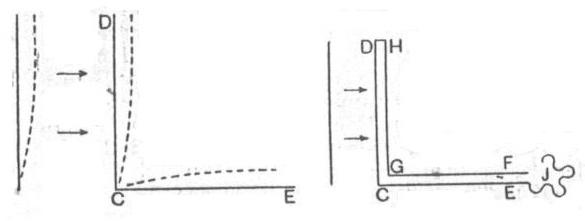
This statement appears to me very ambiguous, as I always have understood that what we call transformers need not have a distinct secondary winding. An appliance called an auto-transformer was used by the Westinghouse Company for regulating the E.M.F. supplied to house lighting installations, which consisted in a single winding, a certain number of turns acting inductively on the adjacent ones. (See "The Alternate-Current Transformer," by J. A. Fleming, Vol. II, pp. 187, 188.) One of the first transformers ever made is shown in the work above referred to, Vol. II., pp. 6 and 7. At page 6 we read: — "Page really made the first experiment in auto-induction and showed that different parts of the same conductor might act as primary and secondary circuits to each other, if in contiguity."
I installed the apparatus described by Slaby at Niton, Isle of Wight, and at Poole, using wires 35 metres high, but with the receiving wire earthed at C (Fig. 17) of the loop I could receive nothing although I tried various frequencies of oscillation. It is, however, probable that I might have received, had I been working over much shorter distances than 50km., as Slaby did in his demonstration, or had I used a greater height of wire. By using, however, my method of connection — i.e., introducing between the vertical wire and earth an oscillation transformer having its circuits tuned to the frequency given by an ordinary vertical radiating conductor of length equal to the Slaby wire AC. I succeeded by means of extremely sensitive coherers in obtaining communication. I then tried the following experiment: — I took down the earth wire ED, and the inductance DC, and used only the conductor AC insulated, with the condenser in circuit for transmitting. An enormous strengthening of the signals at the receiver was immediately obtained, which obviously means a greater ease of working, and the possibility of obtaining signals over greater distances. The reasons which demonstrate that a closed circuit, such as is employed by Slaby, must be a poor radiator, are obvious to those who have studied and read the classical works published since the time of Hertz's experiments.
Dr. Slaby, however, states that the inductance at the top of his loop confines the oscillations to the vertical part AC. If this be the case, the frequency of these local oscillations cannot be equal to that of the whole circuit ACDE, which it has been stated was so easy to calculate, if the translations of Slaby's Paper I am relying on are correct. I believe that, notwithstanding the inductance CD, a considerable amount of energy must pass to earth through the earth wire, which acts as a leak uselessly dissipating energy which should be radiated into space in the form of ether waves. If these conclusions are correct, I am not at all clear as to what necessity there is for employing the earthed conductor ED and the inductance. It is not necessary for obtaining syntonic effects from transmitting stations placed at unequal distances from the receiver, as this can be obtained when using the primitive form of transmitter shown in Fig. 1; and Slaby has not yet described how to obtain different messages from transmitters situated at equal distances from the receivers, which is much more difficult in my experience; nor does it appear possible, with the method he describes, to transmit various messages at the same time from one sending wire as can be done with the system I have just explained. The distance obtained with the closed transmitting arrangement must be comparatively small.
As I have already stated, communication over a distance of 300km. is now being maintained with my system, but I am not aware of anything approaching even 100km. being achieved with the loop transmitter. It may be said that long distances of transmission are not necessarily an advantage, but I notice that the Navy wants long-distance apparatus supplied to it. I have also tried connections similar to Slaby's extension wire in the receiver, but I find that the real sifting out of waves is done in the oscillation transformer, although sometimes it may be desirable to increase the period of oscillation of the aerial conductor by adding inductance to it, or at other times to decrease its period by placing a suitable condenser in series with it. I trust it will not be thought that I wish in any way to minimise the importance of Slaty's work. I only wish to get at the facts and to draw a discussion on a very interesting subject.
Time does not permit me to refer to a great number of experiments upon which I am now engaged, or which have been carried out by others, but I hope on a future occasion to describe better results. I have come to the conclusion that the days of the non-tuned system are numbered. The ether about the English Channel has become, in consequence of great wireless activity, exceedingly lively, and a non-tuned receiver keeps picking up messages or parts of messages from various sources which very often render unreadable the message one is trying to receive. I am glad to say, however, that I am now prepared with syntonic apparatus suitable for commercial purposes. And, as my final word on the general subject for the present, let me say that those who are responsible for the recent development of wireless telegraphy into a practical science cannot fail to find great satisfaction in the reflection that, as already life has been saved that without this discovery would have been lost, so, in the future, apart from its manifold commercial possibilities, valuable as these are, humanity is likely to have before very long to recognise in telegraphy through space without connecting wires the most potent safeguard that has yet been devised to reduce the perils of the world's sea-going population.
DISCUSSION.
Dr. Fleming, F.R.S., said that as he had been permitted to be a little behind the scenes, and had seen some of the apparatus before it was made public, he was able to entirely confirm Mr. Marconi's statements with regard to his experiments. A very great stride forward had been made in syntonic telegraphy. The subject was not a new one — in fact, a large number of patents patents had been taken out in connection with it, most of which, however, embodied more hope than experience. In spite of the fact that there were so many claims of priority in the matter, he had the strongest possible conviction that Mr. Marconi was the first person to actually achieve a true syntonic telegraphy with electric waves. He had done that in virtue of having followed out to their logical issue the fundamental scientific principles of the subject which he had so clearly grasped, one of which was the essential distinction between the radiative and the non-radiative circuit. Many inventors and patentees had professed to have obtained syntonic telegraphy with a simple open aerial insulated radiator of the Marconi type. Although it was possible to produce a kind of bastard syntonic telegraphy by that means, it was not possible to produce true syntonic telegraphy, because the aerial simply produced a sort of etheric impulse or explosion, and not a true train of waves. It was just as possible to produce true syntonic telegraphy by those means as it would be to cause one whip to crack by cracking another near to it. When a closed circuit was taken, which was a powerful powerful absorber of electric energy and associated with a radiative circuit, a circuit, a means was obtained for producing a true train of waves. If those two circuits were tuned together a great improvement was effected on anything previously accomplished. Mr. Marconi had not only constructed a receiver capable of receiving trains of waves, but also capable of not receiving those not adapted to it. No train of waves would act upon his syntonic receiver except those which had a particular period. An analogy might be found in a cork floating on water, which would be bobbed up and down by any wave, long or short, which went over it; but a heavy log of wood floating on the water and tethered to the bottom of the sea' by a spiral spring would only be caused to bob up and down by waves having one particular period. The former corresponded to a simple 213 coherer, and the latter to a syntonic receiver of the kind described in the Paper. He quite agreed with Mr. Marconi that the days of the non-syntonic telegraphy were numbered, because no one would choose a receiver capable of being affected by every vagrant wave when such an instrument as Mr. Marconi's latest form of receiver was available. Among the possibilities which lay in front of the invention was that it would be immediately possible to provide the Admiralty and the Post Office with instruments having an Admiralty or Office frequency, and to register frequency just as a telegraphic address was registered, so that no one else could use that particular frequency. He had had the privilege of riding on the motor car described by the reader of the Paper, and, when many miles from home, they were able to communicate with their hotel and order their lunches. In conclusion, he offered his warmest congratulations to Mr. Marconi on the immense strides he had made in the improvement of his initial invention.
Capt. Kennedy, R.E., said Le wished to explain, in common justice to Mr. Marconi, some of the points connected with the operation of the system in South Africa. A scheme was suddenly conceived and hastily executed of sending apparatus and assistants to instal the system at Durban. But instead of setting it up at that port, it was sent to the Front. No poles were available, and the attempts to substitute kites and balloons were unsuccessful. For want of labour and proper materials progress was slow, and eventually the work was stopped. On arriving in Natal, on the first opportunity, he handed the whole system over to Captain Percy Scott, who worked it most satisfactorily on board the ships at Durban up to the time he left South Africa. The operations in Cape Colony were entirely experimental, and would have succeeded had they been given a fair chance.
The Chairman (Prof. Ayrton) in proposing a vote of thanks to Mr. Marconi for his admirable Paper, said that, after listening to what wireless telegraphy had already done in saving life and ships, they realised why the reader of the Paper, although so young, had acquired fame; why he had won that more substantial reward which sometimes went with fame, but often did not, and also grasped why he had earned what should be dearer to him than fame or wealth — the gratitude of all peoples for having so courageously developed a new sense for the world. Although still far away, he thought they were gradually coming within thinkable distance of the realisation of a prophecy he ventured to make four years ago, of a time when, if a person wanted to call to a friend he knew not where, he would call in a loud, electro-magnetic voice, heard by him who had the electro-magnetic ear, silent to him who had it not. "Where are you?" he would say. A small reply would come, "I am at the bottom of a coal mine, or crossing the Andes, or in the middle of the Pacific." Or, perhaps, in spite of all the calling, no reply would come, and the person would then know his friend was dead. Let them think of what that meant, of the calling which went on every day from room to room of a house, and then think of that calling extending from pole to pole — not a noisy babble, but a call audible to him who wanted to hear and absolutely silent to him who did not; it was almost like dreamland and ghostland — not the ghostland of the heated imagination cultivated by the Psychical Society, but a real communication from a distance based on true physical laws. On seeing the young faces of so many present he was filled with green envy that they, and not he, might very likely live to see the fulfilment of his prophecy.
Mr. Marconi, in reply, thanked Dr. Fleming for his kind remarks. To him he was also indebted for valuable advice on many subjects he did not understand, and in which Dr. Fleming's theoretical knowledge was of great value. In reference to Captain Kennedy's remarks, he wished to give an explanation. When the war broke out in South Africa he was asked whether he could send his apparatus out there. His associates, in reply, made two proposals: (1) To send apparatus for work at the Front, and (2) between shore stations and the transports at Durban. The proposal of using the apparatus at the Front was not accepted by the War Office at the time. The apparatus was sent out without poles because he was informed they would be found at Durban. On the arrival of his assistants in South Africa they pluckily volunteered to go to the Front, thinking the system might be worked with advantage to the English army; but, on reaching the front, poles could not be obtained by which to raise the wires. At that time, according to his old-fashioned system, this was absolutely necessary. Captain Baden-Powell came to the rescue with some well-designed kites, and signals were transmitted about 18 miles. Although the system was never used during operations in South Africa, it was not the fault of the system.
* Paper read before the Society of Arts, May 15.
† See The Electrician, Feb. 15, 1901, 1. 609.
** See The Electrician, Nov. 30, 1900, page 211, and editorial article, page 205.
†† See The Electrician, March 15, 1901, p. 267.
