Nikola Tesla Articles
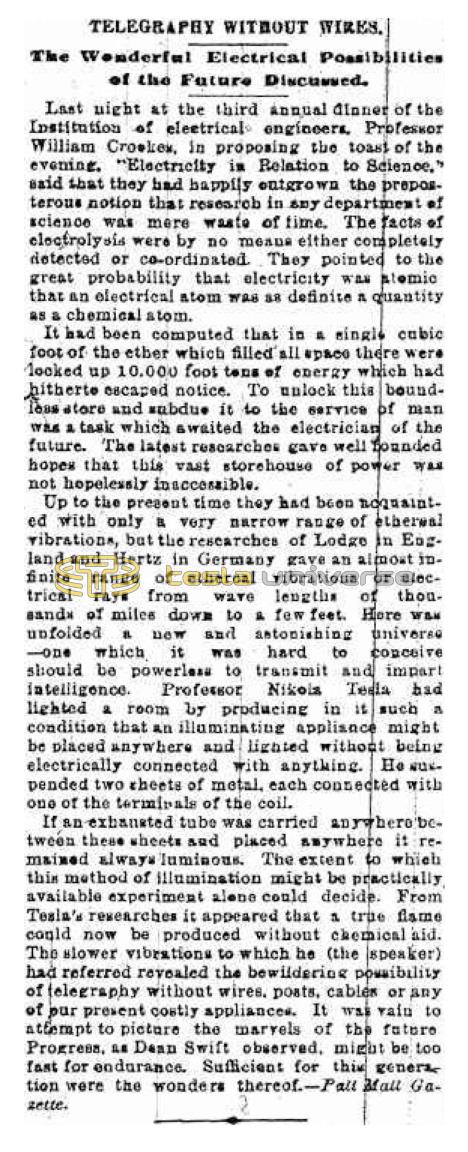
Telegraphy Without Wires - The Wonderful Electrical Possibilities of the Future Discussed
Last night at the third annual dinner of the Institution of electrical engineers, Professor William Crookes, in proposing the toast of the evening. "Electricity in Relation to Science," said that they had happily outgrown the preposterous notion that research in any department of science was mere waste of time. The facts of electrolysis were by no means either completely detected or co-ordinated. They pointed to the great probability that electricity was atomic that an electrical atom was as definite a quantity as a chemical atom.
It had been computed that in a single cubic foot of the ether which filled all space there were locked up 10.000 foot tens of energy which had hitherto escaped notice. To unlock this boundless store and subdue it to the service of man was a task which awaited the electrician of the future. The latest researches gave well founded hopes that this vast storehouse of power was not hopelessly inaccessible.
Up to the present time they had been acquainted with only a very narrow range of ethereal vibrations, but the researches of Lodge in England and Hertz in Germany gave an almost infinite range of ethereal vibrations or electrical rays from wave lengths of thousands of miles down to a few feet. Here was unfolded a new and astonishing universe — one which it was hard to conceive should be powerless to transmit and impart intelligence. Professor Nikola Tesla had lighted a room by producing in it such a condition that an illuminating appliance might be placed anywhere and lighted without being electrically connected with anything. He suspended two sheets of metal, each connected with one of the terminals of the coil.
If an exhausted tube was carried anywhere between these sheets and placed anywhere it remained always luminous. The extent to which this method of illumination might be practically, available experiment alone could decide. From Tesla's researches it appeared that a true flame could now be produced without chemical aid. The slower vibrations to which he (the speaker) had referred revealed the bewildering possibility of telegraphy without wires, posts, cables or any of pur present costly appliances. It was vain to attempt to picture the marvels of the future Progress, as Dean Swift observed, might be too fast for endurance. Sufficient for this generation were the wonders thereof. — Pall Mall Gazette.