Nikola Tesla Articles
The Tesla Condenser-Magnet
In electric apparatus or systems in which alternating currents are employed, the self-induction of the coils or conductors in many cases operates disadvantageously by giving rise to false currents which often reduce the commercial efficiency of the apparatus or operate detrimentally in other respects.
The effects of such self-induction, as is well known, can be neutralized by proportioning to a proper degree the capacity of the circuit with relation to the self-induction and frequency of the currents. This has been accomplished heretofore by the use of condensers applied as separate instruments. In order to avoid the employment of condensers, which involve additional expense, Mr. Nikola Tesla has devised a method of constructing the coils themselves so as to accomplish the same object as the condensers.
Mr. Tesla had found some years ago that in every coil there exists a certain relation between its self-induction and capacity that permits a current of given frequency and potential to pass through it with no other opposition than that of ohmic resistance, or, in other words, as though it possessed no self-induction. This is due to the mutual relations existing between the special character of the current and the self-induction and capacity of the coil, the latter quantity being just capable of neutralizing the self-induction for that frequency.
It is well known that the higher the frequency or potential difference of the current, the smaller the capacity required to counteract the self-induction; hence, in any coil, however small the capacity, it may be sufficient for the purpose stated if the proper conditions in other respects be secured. In the ordinary coils the difference of potential between adjacent turns or spires is very small, so that while they are in a sense condensers, they possess but very small capacity and the relations between the two quantities, self-induction and capacity, are not such as under any ordinary conditions satisfy the requirements contemplated by Mr. Tesla, because the capacity relatively to the self-induction is very small.
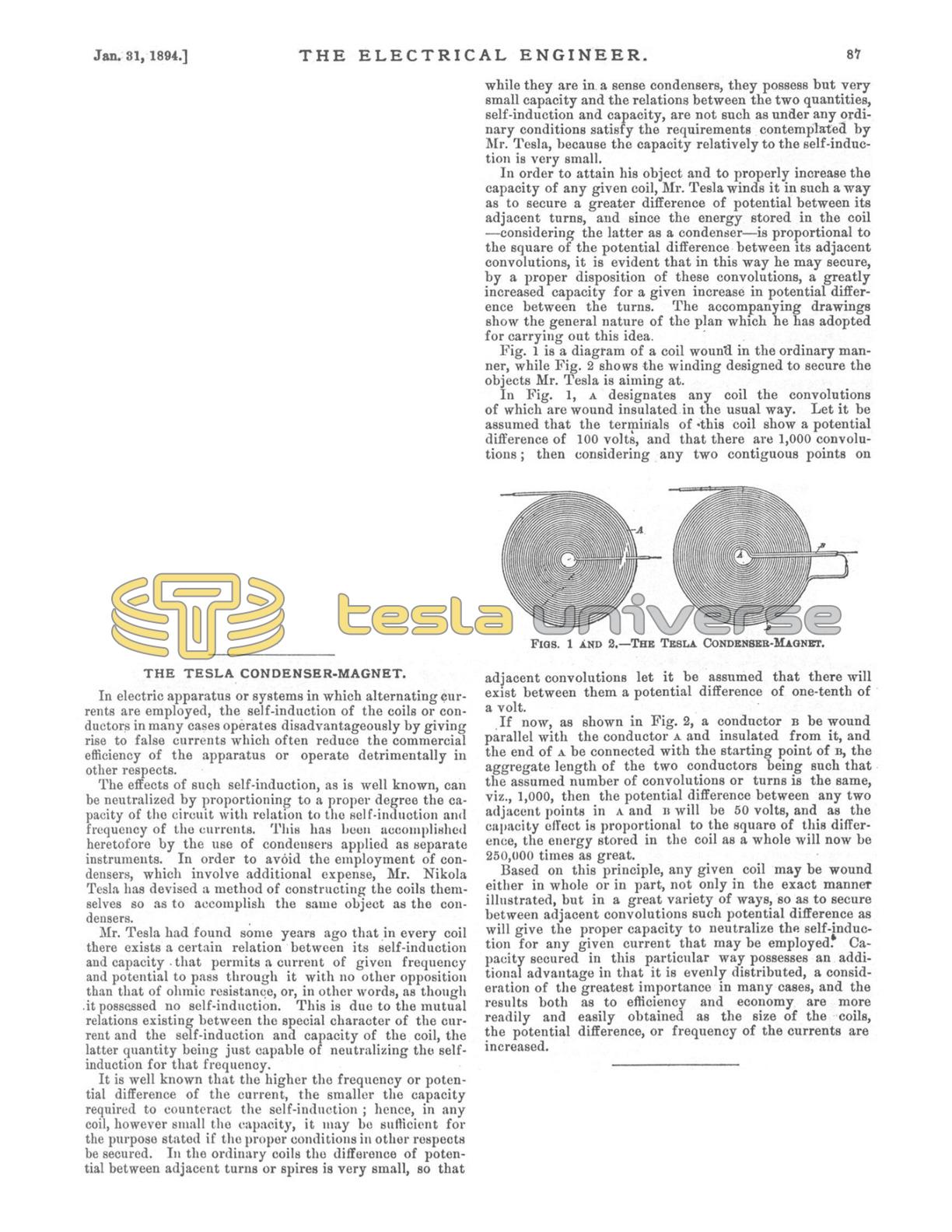
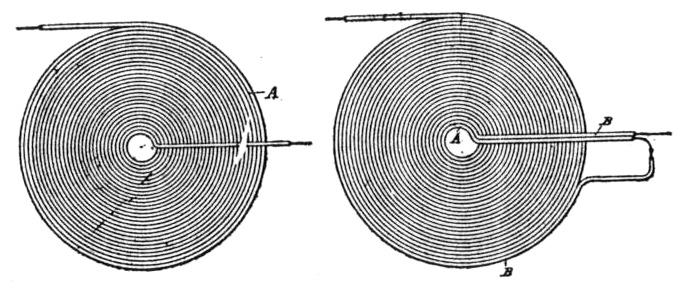
In order to attain his object and to properly increase the capacity of any given coil, Mr. Tesla winds it in such a way as to secure a greater difference of potential between its adjacent turns, and since the energy stored in the coil — considering the latter as a condenser — is proportional to the square of the potential difference between its adjacent convolutions, it is evident that in this way he may secure, by a proper disposition of these convolutions, a greatly increased capacity for a given increase in potential difference between the turns. The accompanying drawings show the general nature of the plan which he has adopted for carrying out this idea.
Fig. 1 is a diagram of a coil wound in the ordinary manner, while Fig. 2 shows the winding designed to secure the objects Mr. Tesla is aiming at.
In Fig. 1, A designates any coil the convolutions of which are wound insulated in the usual way. Let it be assumed that the terminals of this coil show a potential difference of 100 volts, and that there are 1,000 convolutions; then considering any two contiguous points on adjacent convolutions let it be assumed that there will exist between them a potential difference of one-tenth of a volt.
If now, as shown in Fig. 2, a conductor в be wound parallel with the conductor A and insulated from it, and the end of a be connected with the starting point of B, the aggregate length of the two conductors being such that the assumed number of convolutions or turns is the same, viz., 1,000, then the potential difference between any two adjacent points in A and B will be 50 volts, and as the capacity effect is proportional to the square of this difference, the energy stored in the coil as a whole will now be 250,000 times as great.
Based on this principle, any given coil may be wound either in whole or in part, not only in the exact manner illustrated, but in a great variety of ways, so as to secure between adjacent convolutions such potential difference as will give the proper capacity to neutralize the self-induction for any given current that may be employed. Capacity secured in this particular way possesses an additional advantage in that it is evenly distributed, a consideration of the greatest importance in many cases, and the results both as to efficiency and economy are more readily and easily obtained as the size of the coils, the potential difference, or frequency of the currents are increased.