Nikola Tesla Articles
Tesla Gasoline Turbine
An immense amount of work has been done during the past fifteen or twenty years by engineers who have endeavored to produce a simple and practical explosive gas turbine, but the mechanical and thermal hindrances have been so great that up to the present time no single success has been achieved. The turbine is an ideal prime mover; simple in principle, but the accessory apparatus for operating it explosively is very complex and liable to great wear. Thus the products of an explosion must affect the rotor, during which time a number of operations have to be performed.
Fuel and air must first be admitted thru separate channels into a combustion chamber; the mixture is then ignited, all inlets and outlets closed. The comprest gases thus exploded must be directed thru a nozzle to the rotor plates or buckets and the chamber cleaned and made ready for the admission of a fresh mixture.
All these operations are controlled by valves which must be opened and closed at precise moments and therefore are generally controlled by the motion of the turbine rotor itself. Irrespective of the difficulty of keeping the valves in good order at high temperatures, at which they must operate the apparatus taken as a whole, is so complicated that the ordinary form or reciprocating type gasoline engine is more preferable.
Doctor Nikola Tesla, whom the readers of this publication know very well and whose amazing work in the various scientific fields is also universally recognized, again comes into the limelight with a very remarkable explosive gasoline turbine perfected by him recently which he describes in detail in a patent just granted. This remarkable turbine does away with all the troubles and complexity of the former attempted types. Stated briefly, the invention consists in the production of a peculiar shape conduit, thru which the gases are admitted into the turbine, and which has the singular property of permitting their passage in that direction only; in other words, uni-directionally.
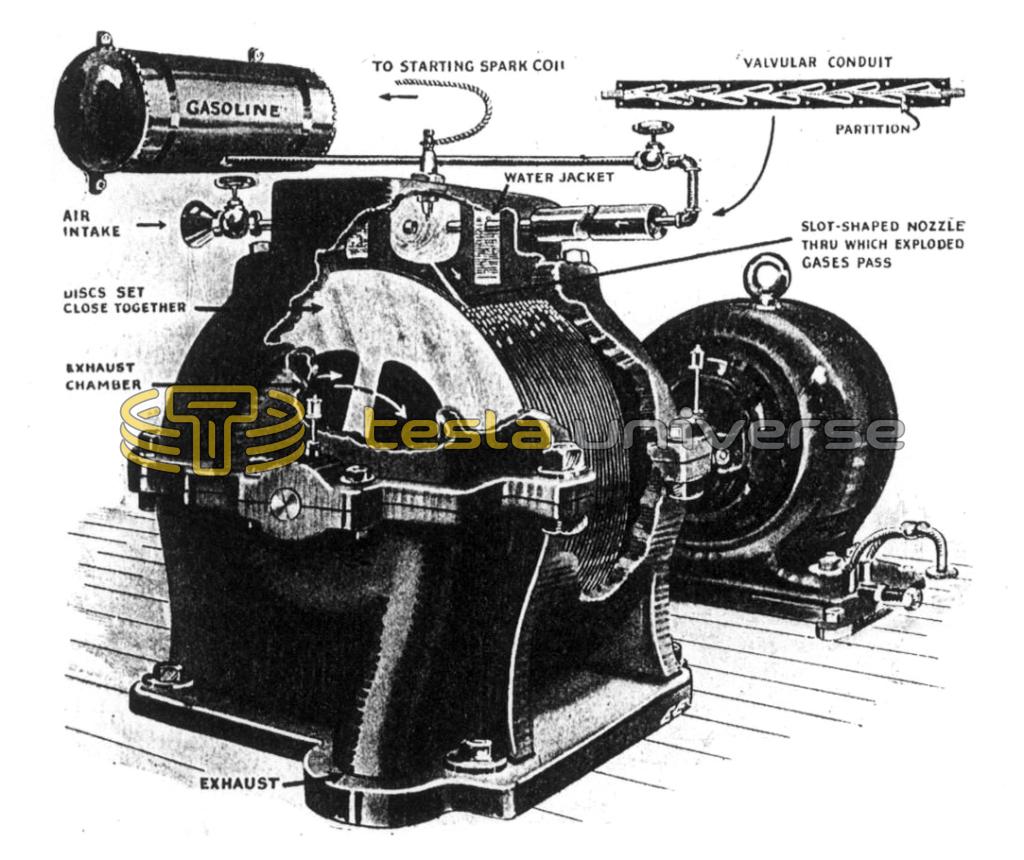
This device when used in connection with his bucketless turbine produces an engine which may be explosively operated by gasoline, alcohol or other fuels and is absolutely devoid of all valves. It is the simplest internal combustion motor conceivable. Owing to the tremendous output of the Tesla turbine, one single disc being practically equivalent in performance to a whole bucket-wheel, a very small machine of this kind is capable of developing an astonishing amount of power. The principle of the operation will be clearly understood by the aid of the accompanying diagram.
Referring to the detailed view of the conduit, we first note a casing of metal or other suitable material which may be milled or prest from sheet metal into the desired form. From its side walls extend alternately projections terminating in buckets which in order to facilitate manufacture are congruent and spaced at equal distances.
In addition to these there are independent partitions, the purpose of which will presently be made clear. There is a nipple at each end provided for pipe connections. The bottom is solid and the upper or open side is closed by a close-fitting plate. When desired any number of such pieces may be joined in series, thus making up a valvular conduit of such length as the circumstances may require.
In elucidation of the mode of operation let it be assumed that the medium under pressure be admitted at the right. Evidently its approximate path will be as indicated by the dotted line, which is nearly straight, that is to say, if the channel be of adequate cross-section the fluid will encounter at very small resistance and pass thru, freely and undisturbed, at least to a degree. Not so if the entrance be at the opposite end.
In this case, the flow will be smooth and continuous, but intermittent, the fluid being quickly deflected and reversed in direction, set in whirling motion, brought to rest and again accelerated, these processes following one another in rapid succession. The partitions serve to direct the stream upon the buckets and to intensify the actions, causing violent surges and eddies which interfere very materially with the flow thru the conduit.
Examining more closely the mode of operation, it will be seen that in passing from bucket to the one next in the direction of disturbed flow the fluid undergoes two complete reversals or deflections upon itself thru 180 degrees, while it suffers only two small deviations of about 10 to 20 degrees when moving in the opposite sense. In each case the loss of head will be proportionate to a hydraulic coefficient dependent on the angle of deflection, from which it follows that, for the same velocity, the ratio of the two resistances will be as that of two coefficients. The theoretical value of this ratio may be 200 or more, but must be taken as appreciably less altho the surface friction too is greater in the direction of disturbed flow. In order to keep it as large as possible, sharp bends should be avoided.
The illustration shows in perspective cross-section a turbine which may be of any type but is in this instance one invented and described by Dr. Tesla, and familiar to engineers. Suffice it to state that the rotor of the same is composed of flat plates which are set in motion thru the same and viscous action of the working fluid, entering the system tangentially at the periphery or outer circumference, and leaving it at the center.
Such a machine is a thermodynamic transformer of an activity surpassing by far that of any other prime mover, it having been demonstrated in practise that each single disk of the rotor is capable of performing as much work as a whole bucket-wheel of the ordinary type. Besides, a number of other advantages, equally important, make it especially adapted for operation as an internal combustion motor.
The upper part of the turbine casing has bolted to it, a separate casting, the central cavity of which forms the combustion chamber. To prevent injury thru excessive heating a cooling jacket may be used, or else water injected, and when these means are objectionable recourse may be had to air cooling, this all the more readily as very high temperatures are practicable. The top of the casting is closed by a plate with a spark-plug inserted and in its sides are screwed two of the new Tesla valvular conduits communicating with the central chamber. One of these is, normally, open to the atmosphere while the other connects to a source of fuel supply.
The bottom of the combustion chamber terminates in a suitable nozzle which consists of separate member of heat-resisting material. To regulate the influx of the explosion constituents and secure the proper mixture the air and gas conduits are equipt, respectively, with regulating valves. The exhaust openings of the rotor should be in communication with a ventilator, preferably carried on the same shaft and of any suitable construction. Its use, however, while advantageous, is not indispensable, the suction produced by the turbine rotor itself being, in some cases at least, sufficient to insure proper working.
But a few words will be needed to make clear the mode of operation. The air valve being open and sparking establisht across the gap, the gas is turned on slowly until the mixture in the explosion chamber reaches the critical state and is ignited. Both the conduits behaving with respect to efflux, as closed valves, the products of combustion rush out thru the nozzle acquiring still greater velocity by expansion and, imparting their momentum to the rotor, start it from rest. Upon the subsidence of the explosion the pressure in the chamber sinks below the atmospheric, owing to the pumping action of the rotor or ventilator and new air and gas are permitted to enter, cleaning the cavity and channels and making up a fresh mixture which is detonated as before, and so on; the successive impulses of the working fluid producing an almost continuous rotary effort. After a short lapse of time, the chamber becomes heated to such a degree that the ignition device may be shut off without disturbing the establisht régime.
The turbine thus shown presents the advantages of extreme simplicity, cheapness and reliability, there being no compressor, buckets or troublesome valve mechanism. It also permits, with the addition of certain well-known accessories, the use of any kind of fuel and thus meets the pressing necessity of a self-contained, powerful, light and compact internal combustion motor for general work. When the attainment of the highest efficiency is the chief object, as in machines of large size, the explosive constituents will be supplied under high pressure and provision made for maintaining a vacuum at the exhaust. Such arrangements are quite familiar and an enlargement on this subject is deemed unnecessary.
In speaking about the rapidity of explosions, Dr. Tesla says, "I have been able to speed up the rate of such explosions until the sound of exploding gases produced a musical note. The device is by far the simplest I have ever seen and I consider myself indeed fortunate in perfecting it at this time. I have also used this valvular conduit to great effect in rarifaction of air or the compression of gases when operated by my oscillator."