Nikola Tesla Articles
Tesla's Aircraft of the Future Page 2
Galaxy - September 1st, 1984
in radio technology, Tesla finds time for aviation.
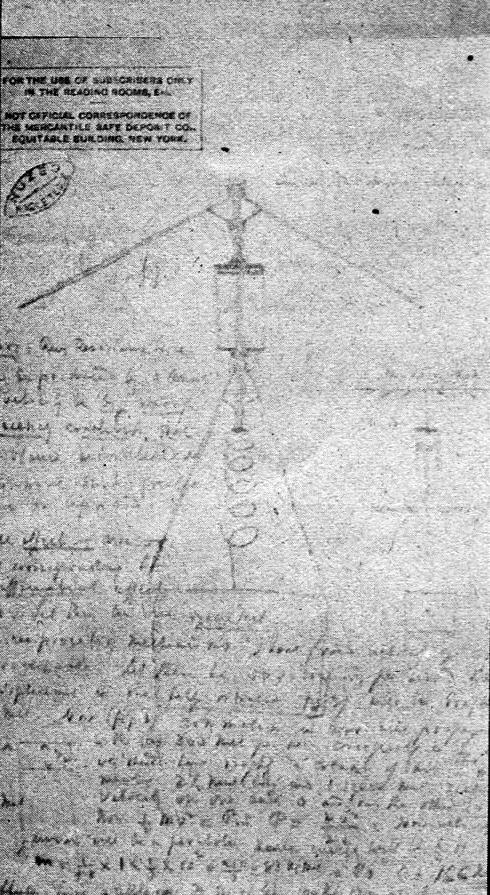
From those years come the first testimonies he left us about his work in aviation. On several sheets of paper dated December 22, 1894, which Tesla marked as "early works in aviation," there is a description and aerodynamic calculation of an aircraft that can be classified as an ornithopter. The idea is several centuries old, and we find it in the works of the great artist and scientist of the Renaissance, Leonardo Da Vinci. An ornithopter is a flying apparatus conceived to imitate the flight of birds with its operation, i.e., it stays in the air by flapping its wings. This method of aircraft construction was abandoned as impractical already at the beginning of the nineteenth century, but Tesla probably thought he had found a powerful enough mechanism to move the wings, so he returned to this old idea. This device was a mechanical oscillator, Tesla's invention, for which he claimed it could oscillate more than 50 times per second. In the case of the ornithopter, it powered two pairs of wings connected to the same base and was supplied with high-pressure steam (Fig 1 and Fig 2). Tesla believed that the key issue in aviation was propulsion, and in this case, as later, he directed his research work in that direction.
From 1899, Tesla worked more intensively on wireless energy transmission. In the autumn of 1901, with the generous help of J. P. Morgan, Tesla began to build the antenna of the world radio station on Long Island as the first step in realizing the plan for wireless transmission. In the world, and especially in the American press, during those years, a large number of articles appeared in which Tesla tried to show that, among other things, wireless power transmission was an ideal solution for aerial transport. These were the years when the fate of aviation was being decided. On the one hand, there were balloons and dirigibles, lighter-than-air aircraft with which brave men like Santos Dumont had already made successful flights, but without great prospects. On the other hand, the use of internal combustion engines and propellers on modern aircraft was yet to come, on which, as we know, the Wright brothers first successfully flew.
Who knows what our civilization and aviation would look like today if Tesla had been allowed to complete his research. Perhaps small, fast, and almost silent aircraft, powered by powerful electric motors, without any fuel tanks, but instead equipped with antennas through which they would receive energy transmitted from distant transmitters on Earth, would fly through the sky. In the article "Tesla will revolutionize transport," published in the New York Press in August 1902, Tesla gave some technical details of his idea. Among other things, he says:
"My invention will also solve the problem of aerial transport. You know that a big problem with aircraft was the fact that balloons had to carry heavy batteries, which pulled them down. By using one of my simple receiving devices, they would get all the necessary power for movement, directly from the air.
This is briefly what I want to improve. And now I will go into some technical details of the plan.
My invention consists of an emitting coil or conductor in which electrical currents or oscillations are created, adjusted to spread such currents or oscillations by conduction through natural media from one distant point to another, and a receiving coil or conductor which, at such a distance, is adjusted to be excited by the oscillations or currents sent from the transmitter.
First, I generally use a multi-turn coil of large diameter, spirally wound, either around a magnetic core or not, as desired. Then I take a second coil made of thicker wire of shorter length, wound in a circle around the first.
The apparatus is used as a transmitter at one point; the first coil in that case gives high voltage (secondary) and the second coil (primary) has a much lower voltage transformer. A suitable current source is included in the primary coil circuit. One terminal of the secondary is in the center of the spiral coil, and from that terminal, currents are conducted by a conductor of another, larger surface, maintained by such means as a balloon at any height suitable for the purpose of emission. The other terminal is connected to the ground.
At the receiving station, a transformer of similar construction is used, but in this case, the longer coil acts as the primary, and the shorter one as the secondary of the transformer. Lamps, motors, or other means for using current are connected to the circuit of this latter.
The main reason for which the apparatus is constructed is the production of extremely high voltage currents, and this is achieved by using primary currents of very high frequencies. It must also be kept in mind that the terminals of the coils must be at appropriate heights, where the atmosphere is rarefied and serves as a conductive medium for the production of current. These will be emitted through such air with much less resistance than in an ordinary conductor.
The receiving station devices respond to currents sent from the transmitter in the following way: The primary coil of the receiver—which is a thin wire coil — is excited by currents that spread through the air by conduction, and these currents induce in the secondary coil other currents suitable for the operation of the devices connected to the circuit.
Obviously, the receiving coils, transformers, or other devices can be movable: for example, when carried by an aircraft floating in the air or by a ship at sea. In such a case, the connection of the terminal of the receiving apparatus to the ground does not have to be permanent, but rather alternating or inductively established."
Tesla, unfortunately, could not test his big ideas and plans for wireless transmission. For reasons that can only be speculated upon, Morgan's collaboration with Tesla abruptly ended at the beginning of 1903. Tesla, surprised himself, wrote to Morgan in April of the same year: "What happened, Mr. Morgan, that now, when I have earned your help more than ever, you have failed me?"
Morgan, however, stuck to his decision and stopped financing Tesla, so the work on Long Island had to be interrupted. Tesla stopped halfway. A large antenna and a laboratory with equipment for wireless transmission had been built, but the construction of a central power station at Niagara, which was necessary for the completion of the project, was yet to come. To that end, Tesla and Morgan negotiated in 1902 to establish a new company with a share value of 5,000,000 dollars. The negotiations ended unsuccessfully, and as it later turned out, the fate of Tesla's great idea of wireless transmission was sealed. The large tower on Long Island was demolished in 1917 because it allegedly represented a good comparative target for German submarines, and Tesla tried to realize the plan almost until his death.
Interest in wireless transmission continued even after Tesla's death, and in recent years it has grown particularly. Although many elements of Tesla's plan are considered fantastic in today's scientific world (not everything is even known), there are nevertheless facts that
