
Nikola Tesla Articles
Tesla's Aircraft of the Future Page 3
Galaxy - September 1st, 1984
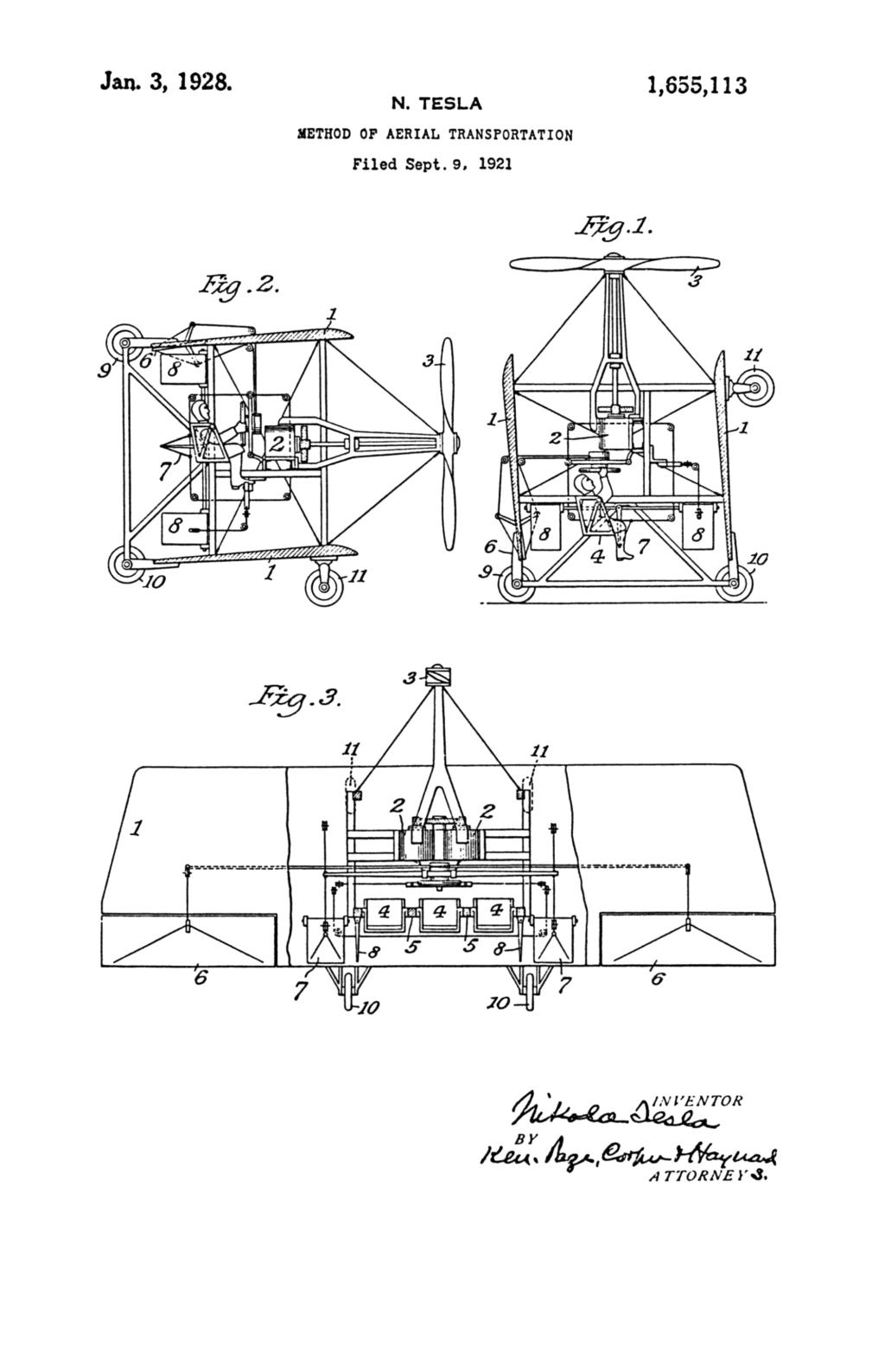
confuse and to this day do not allow the label "impossible" to be placed on this great Tesla idea.
When he realized that Morgan no longer wanted to cooperate, in 1905, Tesla slowly began to think about new inventions that would bring him the much-needed money to continue experiments on Long Island. This time he focused his attention on fluid propulsion. In George Bain's article "Man's Flight" published in The Criterion in March 1905, Tesla, together with Chanute, commented on the exciting attempts of Langley, Lilienthal, and the Wright brothers to fly new types of aircraft. Bain states: "Recently, Nikola Tesla, the famous scientist, told me that the solution to the problem of flight depends, first and foremost, on the discovery of an engine that would weigh very little compared to engines of the same power used today. A saving of 15-20 percent in engine weight, said Mr. Tesla, is trivial. What we must have, and what we will have one day, is an engine that will weigh one-hundredth of the engines we use today."
Speaking of the new engines to come, Tesla had in mind his invention of the bladeless turbine. He began working on this invention in 1905, and in the following few years, he created a whole series of original and practical turbomachines based on a principle previously unused in technology.
The invention of the turbine gave him the basis for constructing his own powerful and lightweight engine and for more serious consideration of an aircraft he would power. As early as June 1908, in a letter to the Times, commenting on previous achievements and problems in aviation, Tesla announced an aircraft of his own design in which he intended to achieve the necessary improvements. From 1908 comes one of Tesla's extremely interesting jet engine diagrams. At a time when even the piston engine was not yet sufficiently developed, thinking about a jet engine represented a distant future.
Tesla primarily conceived his engine for powering his air automobile. It consists of a compressor, above, and a turbine placed below. Both devices have an original construction and are based on his invention. Air is compressed in the compressor and sent through a spiral path to the nozzle. The turbine drives the compressor and is itself powered by exhaust gases which are led from the periphery to the central part and then downwards along the shaft, thus creating additional thrust. Maximum gas utilization and a large volume of air exiting the engine at low speed are the main characteristics of this Tesla turbojet engine. They form a principle still used today in modern engines. It achieves greater economy, lower kinetic energy losses, reduced noise, etc.
From 1911, Tesla began receiving concrete offers to apply his turbine in aviation. One of the first came from Captain Irving Chambers of the American Navy, who, interested in what he read about the turbine, proposed to Tesla that he use his invention to construct a turbine engine that would be used by American military aircraft.
In 1912, Tesla received a letter from Robert Hazen (Haso), who states that he read Tesla's article on high-speed air travel in World Today Magazine and comes forward with the idea of flying over the ocean with an airplane that would use Tesla's turbine engine. In response to this letter, Tesla states that he does not doubt the possibility of such a flight in the slightest. He believes it would be possible to travel at a speed of 300 km/h and that for the flight, only one stop in the Azores would be sufficient.
In 1919, Tesla published two more articles of interest to aviation.
