Nikola Tesla Articles
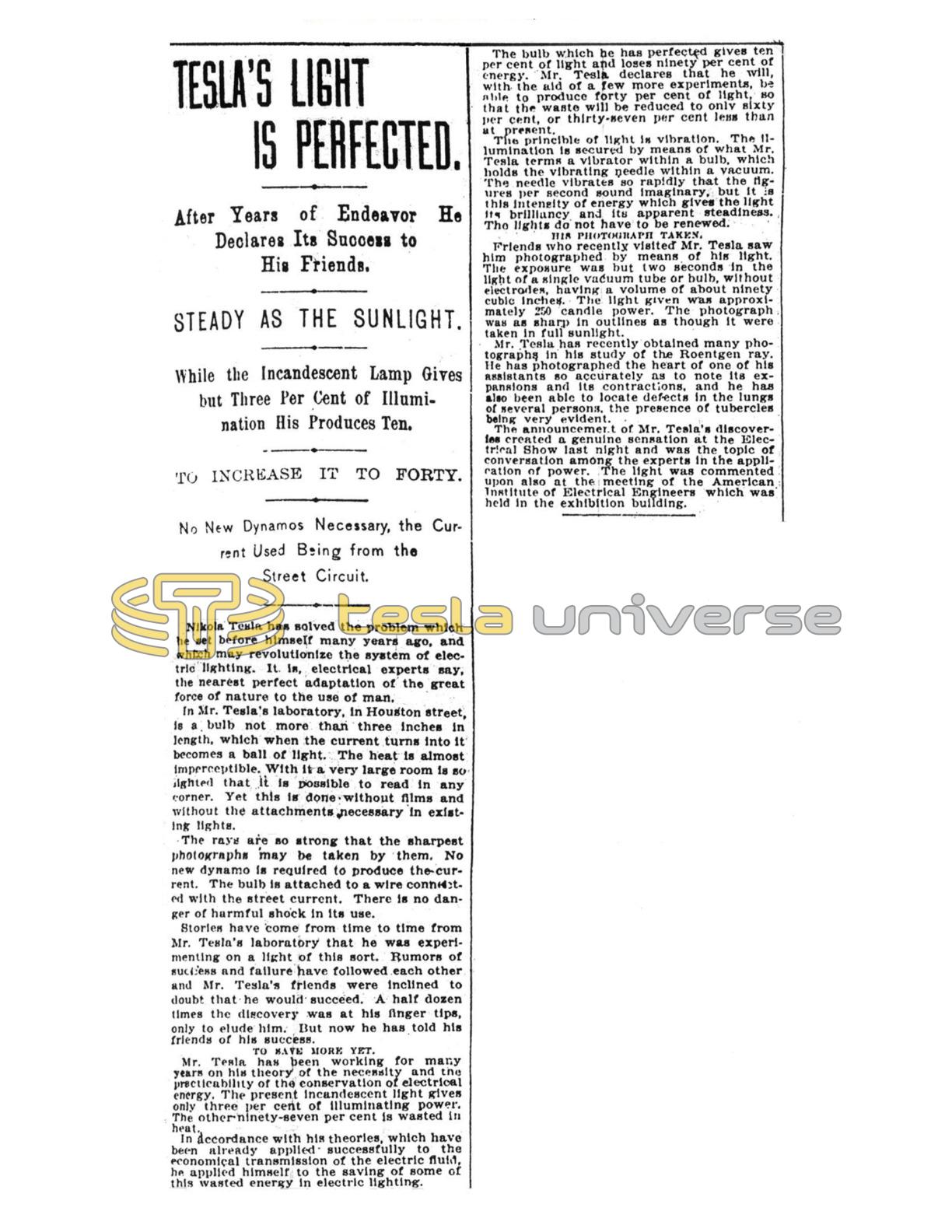
Tesla's Light is Perfected
After Years of Endeavor He Declares Its Success to His Friends.
STEADY AS THE SUNLIGHT.
While the Incandescent Lamp Gives but Three Per Cent of Illumination His Produces Ten.
TO INCREASE IT TO FORTY.
No New Dynamos Necessary, the Current Used Being from the Street Circuit.
Nikola Tesla has solved the problem which he set before himself many years ago, and which may revolutionize the system of electric lighting. It is, electrical experts say, the nearest perfect adaptation of the great force of nature to the use of man.
In Mr. Tesla's laboratory, in Houston street, is a bulb not more than three inches in length, which when the current turns into it becomes a ball of light. The heat is almost imperceptible. With it a very large room is so lighted that it is possible to read in any corner. Yet this is done without films and without the attachments necessary in existing lights.
The rays are so strong that the sharpest photographs may be taken by them. No. new dynamo is required to produce the current. The bulb is attached to a wire connected with the street current. There is no danger of harmful shock in its use.
Stories have come from time to time from Mr. Tesla's laboratory that he was experimenting on a light of this sort. Rumors of success and failure have followed each other and Mr. Tesla's friends were inclined to doubt that he would succeed. A half dozen times the discovery was at his finger tips, only to elude him. But now he has told his friends of his success.
TO SAVE MORE YET.
Mr. Tesla has been working, for many years on his theory of the necessity and the practicability of the conservation of electrical energy. The present Incandescent light gives only three per cent of illuminating power. The other ninety-seven per cent is wasted in heat.
In accordance with his theories, which have been already applied successfully to the economical transmission of the electric fluid, he applied himself to the saving of some of this wasted energy in electric lighting.
The bulb which he has perfected gives ten per cent of light and loses ninety per cent of energy. Mr. Tesla declares that he will, with the aid of a few more experiments, be able to produce forty per cent of light, so that the waste will be reduced to only sixty per cent, or thirty-seven per cent less than at present,
The princible of light is vibration. The illumination is secured by means of what Mr. Tesla terms a vibrator within a bulb, which holds the vibrating needle within a vacuum. The needle vibrates so rapidly that the figures per second sound imaginary, but it is this intensity of energy which gives the light Its brilliancy and its apparent steadiness. The lights do not have to be renewed.
HIS PHOTOGRAPH TAKEN.
Friends who recently visited Mr. Tesla saw him photographed by means of his light. The exposure was but two seconds in the light of a single vacuum tube or bulb, without electrodes, having a volume of about ninety cubic inches. The light given was approximately 250 candle power. The photograph was as sharp in outlines as though it were taken in full sunlight.
Mr. Tesla has recently obtained many photographs in his study of the Roentgen ray. He has photographed the heart of one of his assistants so accurately as to note its expansions and its contractions, and he has also been able to locate defects in the lungs of several persons, the presence of tubercles being very evident.
The announcement of Mr. Tesla's discoveries created a genuine sensation at the Electrical Show last night and was the topic of conversation among the experts in the application of power. The light was commented upon also at the meeting of the American Institute of Electrical Engineers which was held in the exhibition building.