Nikola Tesla Articles
Tesla's London Lecture
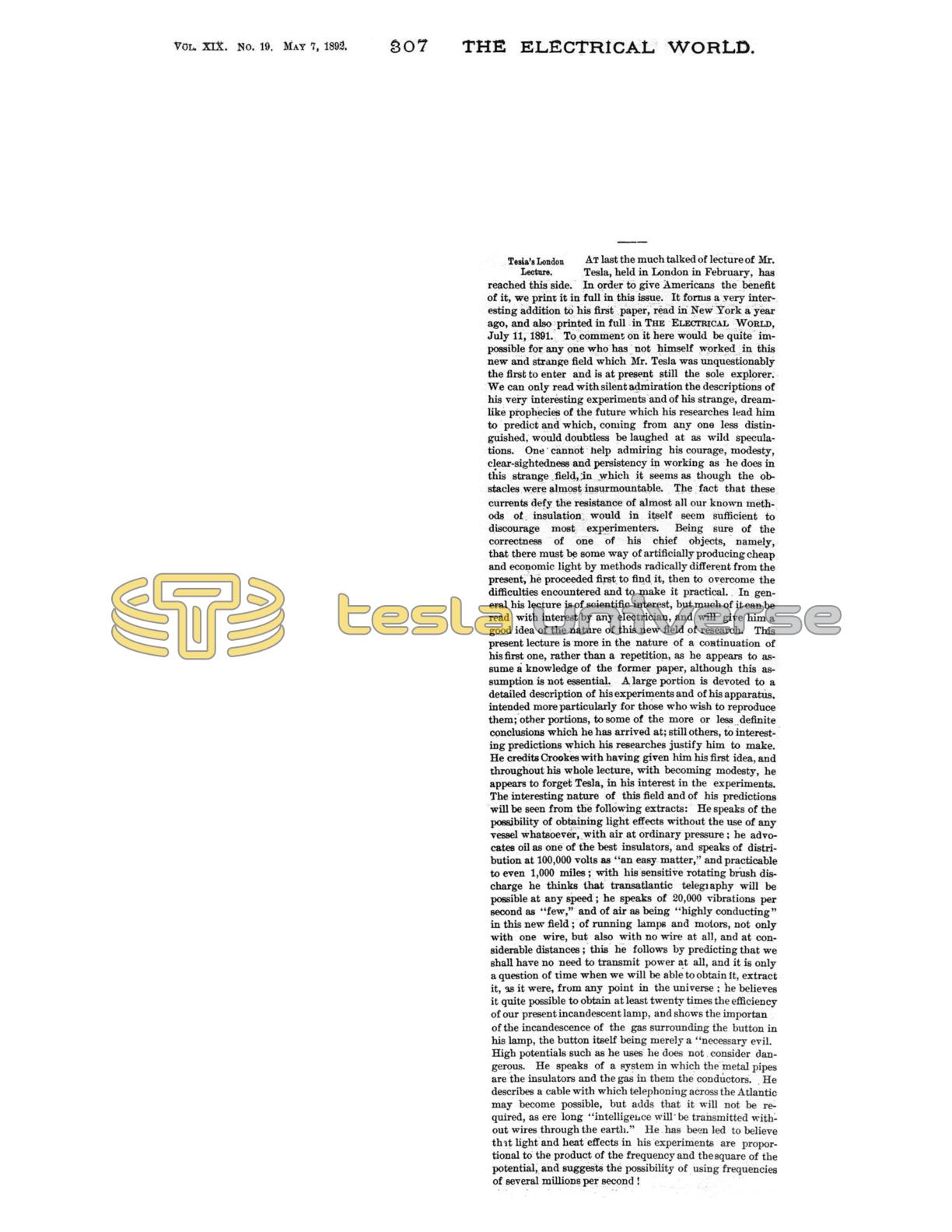
At last the much talked of lecture of Mr. Tesla, held in London in February, has reached this side. In order to give Americans the benefit of it, we print it in full in this issue. It forms a very interesting addition to his first paper, read in New York a year ago, and also printed in full in The Electrical World, July 11, 1891. To comment on it here would be quite impossible for any one who has not himself worked in this new and strange field which Mr. Tesla was unquestionably the first to enter and is at present still the sole explorer. We can only read with silent admiration the descriptions of his very interesting experiments and of his strange, dreamlike prophecies of the future which researches lead him to predict and which, coming from any one less distinguished, would doubtless be laughed at as wild speculations. One cannot help admiring his courage, modesty, clear-sightedness and persistency in working as he does in this strange field, in which it seems as though the obstacles were almost insurmountable. The fact that these currents defy the resistance of almost all our known methods of insulation would in itself seem sufficient to discourage most experimenters. Being sure of the correctness of one of his chief objects, namely, that there must be some way of artificially producing cheap and economic light by methods radically different from the present, he proceeded first to find it, then to overcome the difficulties encountered and to make it practical. In general his lecture is of scientific interest, but much of it can be read with interest by any electrician, and will give him a good idea of the nature of this new field of research. This present lecture is more in the nature of a continuation of his first one, rather than a repetition, as he appears to assume a knowledge of the former paper, although this assumption is not essential. A large portion is devoted to a detailed description of his experiments and of his apparatus, intended more particularly for those who wish to reproduce them; other portions, to some of the more or less definite conclusions which he has arrived at; still others, to interesting predictions which his researches justify him to make. He credits Crookes with having given him his first idea, and throughout his whole lecture, with becoming modesty, he appears to forget Tesla, in his interest in the experiments. The interesting nature of this field and of his predictions will be seen from the following extracts: He speaks of the possibility of obtaining light effects without the use of any vessel whatsoever, with air at ordinary pressure; he advocates oil as one of the best insulators, and speaks of distribution at 100,000 volts as "an easy matter," and practicable to even 1,000 miles; with his sensitive rotating brush discharge he thinks that transatlantic telegraphy will be possible at any speed; he speaks of 20,000 vibrations per second as "few," and of air as being "highly conducting" in this new field; of running lamps and motors, not only with one wire, but also with no wire at all, and at considerable distances; this he follows by predicting that we shall have no need to transmit power at all, and it is only a question of time when we will be able to obtain it, extract it, as it were, from any point in the universe; he believes it quite possible to obtain at least twenty times the efficiency of our present incandescent lamp, and shows the importance of the incandescence of the gas surrounding the button in his lamp, the button itself being merely a "necessary evil." High potentials such as he uses he does not consider dangerous. He speaks of a system in which the metal pipes are the insulators and the gas in them the conductors. He describes a cable with which telephoning across the Atlantic may become possible, but adds that it will not be required, as ere long "intelligence will be transmitted without wires through the earth." He has been led to believe that light and heat effects in his experiments are proportional to the product of the frequency and the square of the potential, and suggests the possibility of using frequencies of several millions per second!