Nikola Tesla Articles
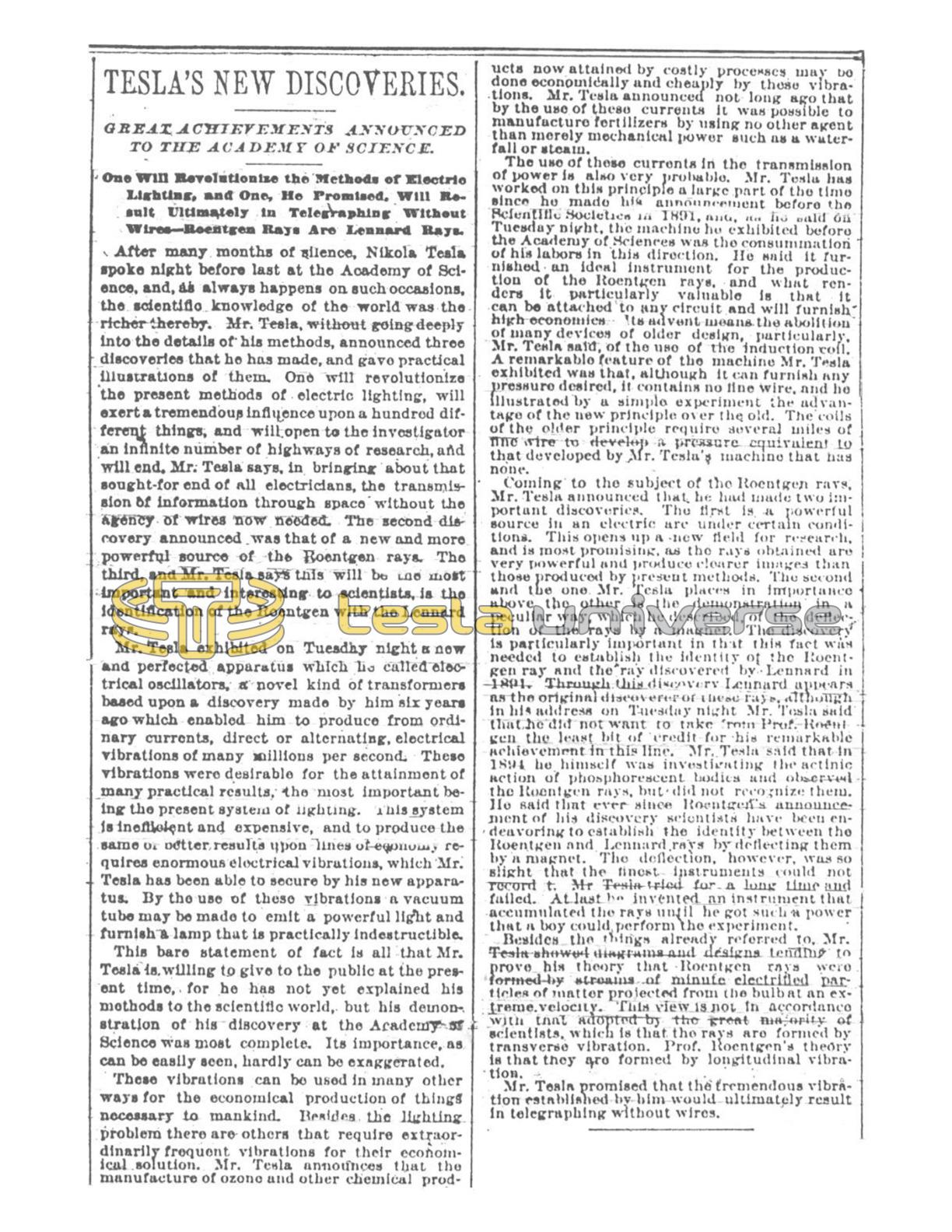
Tesla's New Discoveries - Great Achievements Announced to the Academy of Science
One Will Revolutionize the Methods of Electric Lighting, and One, He Promised. Will Result Ultimately in Telegraphing Without Wires-Roentgen Rays Are Lennard Rays.
After many months of silence, Nikola Tesla spoke night before last at the Academy of Science, and, as always happens on such occasions, the scientific knowledge of the world was the richer thereby. Mr. Tesla, without going deeply into the details of his methods, announced three discoveries that he has made, and gavo practical illustrations of them. One will revolutionize the present methods of electric lighting, will exert a tremendous influence upon a hundred different things, and will open to the investigator an infinite number of highways of research, and will end, Mr. Tesla says, in bringing about that sought-for end of all electricians, the transmission of information through space without the agency of wires now needed. The second discovery announced was that of a new and more powerful source of the Roentgen rays. The third, and Mr. Tesla says this will be the most important and interesting to scientists, is the identification of the Roentgen with the Lennard rays.
Mr. Tesla exhibited on Tuesday night a new and perfected apparatus which is called electrical oscillators, a novel kind of transformers based upon a discovery made by him six years ago which enabled him to produce from ordinary currents, direct or alternating, electrical vibrations of many millions per second. Theso vibrations were desirable for the attainment of many practical results, the most important being the present system of lighting. This system is inefficient and expensive, and to produce the same or better results upon lines of economy requires enormous electrical vibrations, which Mr. Tesla has been able to secure by his new apparatus. By the use of these vibrations a vacuum tube may be made to emit a powerful light and furnish a lamp that is practically indestructible. This bare statement of fact is all that Mr. Tesla is, willing to give to the public at the present time, for he has not yet explained his methods to the scientific world, but his demonstration of his discovery at the Academy of Science was most complete. Its importance, as can be easily seen, hardly can be exaggerated.
These vibrations can be used in many other ways for the economical production of things necessary to mankind. Resides the lighting. problem there are others that require extraordinarily frequent vibrations for their economical solution. Mr. Tesla announces that the manufacture of ozone and other chemical products now attained by costly processes may bo done economically and cheaply by these vibrations. Mr. Tesla announced not long ago that by the use of these currents it was possible to manufacture fertilizers by using no other agent than merely mechanical power such as a waterfall or steam.
The use of these currents in the transmission of power is also very probable. Mr. Tesla has worked on this principle a large part of the time since he made his announcement before the Scientific Societies in 1891, and, as he said on Tuesday night, the machine he exhibited before the Academy of Sciences was the consummation of his labors in this direction. He said it furnished an ideal instrument for the production of the Roentgen rays, and what renders it particularly valuable is that it can be attached to any circuit and will furnish high economies its advent means the abolition of many devices of older design, particularly, Mr. Tesla said, of the use of the induction coil. A remarkable feature of the machine Mr. Tesla exhibited was that, although it can furnish any pressure desired, it contains no fine wire, and he Illustrated by a simple experiment the advantage of the new principle over the old. The coils of the older principle require several miles of fine wire to develop a pressure equivalent to that developed by Mr. Tesla's machine that has none.
Coming to the subject of the Roentgen rays, Mr. Tesla announced that, he had made two important discoveries. The first is a powerful source in an electric are under certain conditions. This opens up a new field for research, and is most promising, as the rays obtained are very powerful and produce clearer images than those produced by present methods. The second and the one. Mr. Tesla places in importance above the other is the demonstration in a peculiar way, which he described, of the deflec tion of the rays by a magnet. The discovery is particularly important in that this fact was needed to establish the identity of the Roentgen ray and the ray discovered by Lennard in 1891. Through this discovery Lennard appears as the original discoverer of these rays, although in his address on Tuesday night Mr. Tesla said that he did not want to take ron Prof. Roent gen the least bit of credit for his remarkable Achievement in this line. Mr. Tesla said that in 1894 he himself was investigating the actinic action of phosphorescent bodies and observed the Roentgen rays, but did not recognize them. He said that ever since Roentgen's announce ment of his discovery scientists have been endeavoring to establish the identity between the Roentgen and Lennard rays by deflecting them by a magnet. The deflection, however, was so slight that the finest instruments could not record it. Mr Tesla tried for a long time and failed. At last he invented an instrument that accumulated the rays until he got such a power that a boy could perform the experiment.
Besides the things already referred to, Mr. Tesla showed diagrams and designs tending prove his theory that Roentgen rays were formed by streams of minute electrified particles of matter projected from the bulb at an extreme velocity. This view is not in accordance with that adopted by the great minority of scientists, which is that the rays are formed by transverse vibration. Prof. Roentgen's theory is that they are formed by longitudinal vibration.
Mr. Tesla promised that the tremendous vibration established by him would ultimately result in telegraphing without wires.