Nikola Tesla Articles
Tesla's Pump
Tesla's research in mechanical engineering has remained relatively unknown to the wider reading public to this day, although in the scientific world interest in certain of Tesla's ideas in this field has not diminished from the moment of their inception; in fact it has even increased in recent years.
Tesla's turbine and pump certainly rank among the most significant of Tesla's inventions in mechanical engineering. These are devices which utilize a principle of operation whose foundations Tesla provided in 1913 in his patents "Fluid Propulsion" No. 1,061,142 and "Turbine" No. 1,061,206.
In his deliberations which preceded these patents Tesla proceeded from the fact that in the practical application of mechanical energy based on the utilization of fluids, with the aim of achieving the greatest possible economy, it is necessary to ensure a gradually variable change in the speed and direction of the fluid's movement, which can be achieved by forcing the fluid to move along natural paths of flow offering the least resistance.
Fluid possesses two special characteristics among others: adhesion and viscosity. These cause a body moving in the fluid to draw with it a certain quantity of fluid; and conversely, a body placed in a moving fluid is drawn along in the direction of motion. Tesla's pump is a device which practically utilizes these properties.
The drawing shows that the pump consists of a rotor which is made up of several flat and rigid disks of suitable diameter, mounted on shaft 2 and secured by nut 3, limiter 4 and spacers 5 of the required thickness. Each disk has a certain number of central openings 6, separated from one another by strips 7 which are appropriately curved in order to minimize energy loss as much as possible. The rotor is placed in a two-part symmetrical housing 8, with bearings 9 and openings 10 which lead to the central opening. There is also the discharge opening 11, which gradually widens and at its end has a standard connection. Housing 8 is mounted on base 12 which is partially shown, and the bearings, which are of conventional construction, have been omitted from the drawing.
The pump operates in the following manner:
When power is supplied to the shaft or, in other words, when, for example, the pump is connected to an electric motor, the rotor begins to rotate in the direction of the continuously indicated arrow and the fluid, due to the already mentioned properties of adhesion and viscosity, after entering through openings 10 comes into contact with the rotor and then two forces act upon it – one tangentially in the direction of rotation and the other radially directed toward the periphery of the disk. United, these two forces propel the fluid with a velocity which gradually increases, along a spiral path all the way to opening 11, when it is ejected outward. This spiral motion is free and undisturbed and essentially depends on the properties of the fluid. As they pass through the rotor the fluid particles may circle one revolution, several revolutions or only part of a revolution. Tesla had discovered that the quantity of fluid which is moved in this way, if other conditions remain the same, is proportional (approximately) to the active surface of the rotor and its effective velocity.
In this way, by increasing the aforementioned elements the characteristics of the pump are improved. The dimensions of the rotor and housing, as well as the spacing between the disks, are determined from case to case. Thus, for example, for greater fluid viscosity it is necessary that the rotor diameter and the spacing between the disks be larger. The pump rotor does not need to have central openings and in that case it should consist of one or more disks, each in its own housing. A pump constructed in this way is best suited for the flow of water containing many admixtures and foreign bodies (drainage and the like).
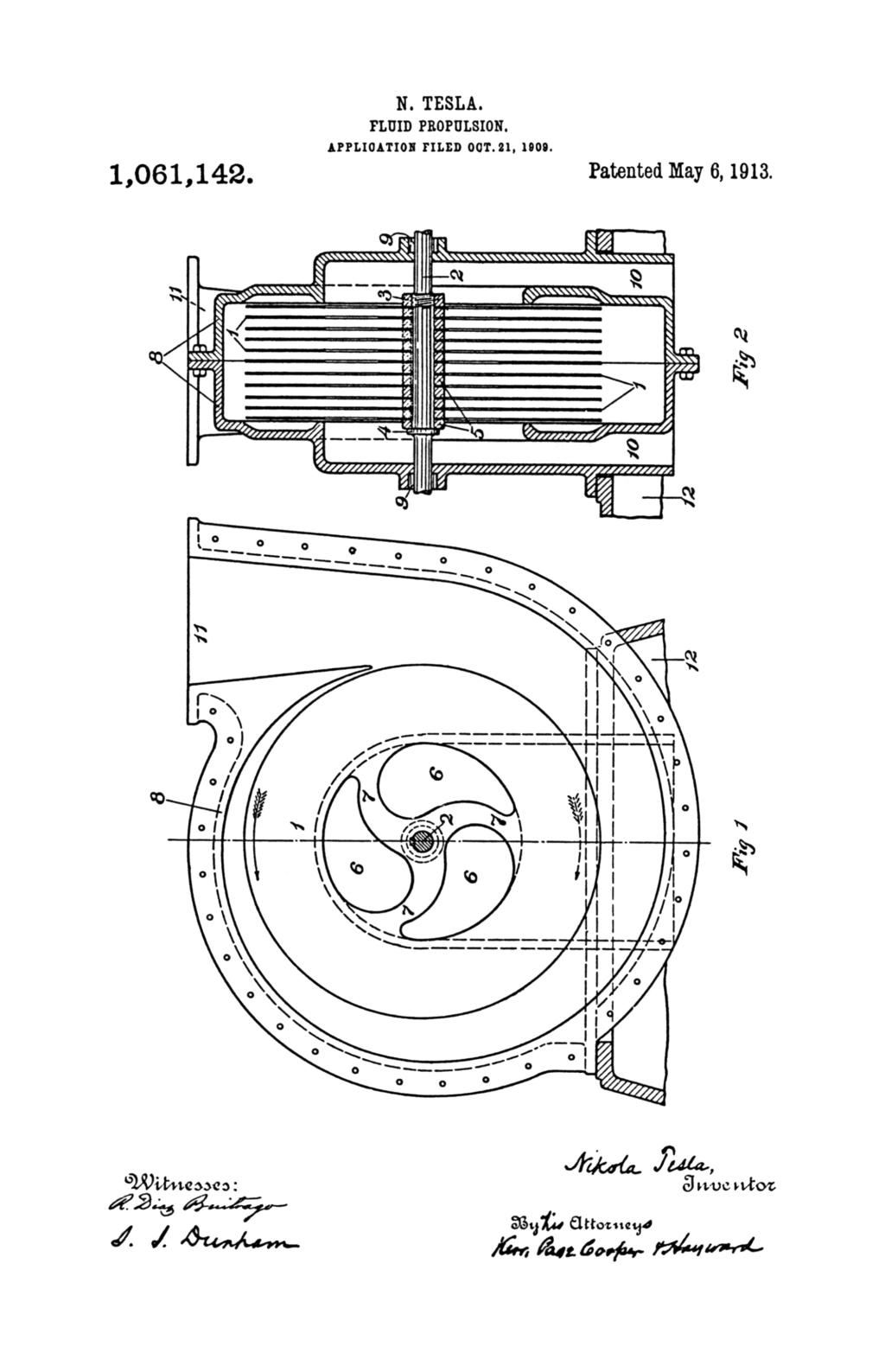
As can be seen from Tesla's drawings and the given description, the fabrication of such a pump is not possible under amateur conditions. The disks are usually fabricated from cold-rolled steel, and the housing from steel or gray cast iron sheet, so it is obvious that the machining of such material requires an extremely high level of equipment with various tools. However, for verification of the principle of operation (for example, for the needs of students in schools) various improvisations are possible both in the choice of material and in the construction.
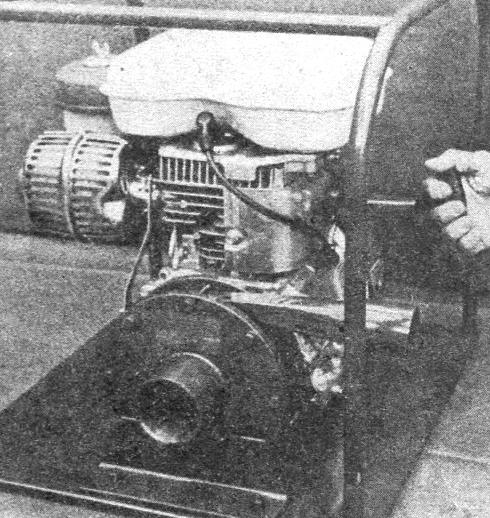
Tesla pumps are today manufactured and sold. They have exceptional constructional features and are widely applicable for pumping not only fluids but also solid materials, as well as mixtures of solids and liquids. They can serve for ejecting sludge, mixtures of oil and sand, toxic materials and harmful gases, for drainage of water, for pumping boiling water and geothermal discharges, in construction for the transport of cement, for fire protection and the like. In comparison with conventional pumps they are characterized by the non-existence of cavitation, long-term operation and small possibility of the occurrence of damage either in the material from which the pump is made or in that which is being pumped. Standard units are produced from 73.5 W all the way up to 370 kW, as well as special models of micro size all the way up to powerful pumps of 4.5 MW for pumping 200,000 L/min.
In Fig. 2 is shown one modern Tesla pump produced in San Diego, California, powered by a 3.6 kW gasoline engine specially applicable for irrigation and fire fighting, weighing 28 kg, and with the capability to deliver 250-380 L/min at a height of 150-300 meters.
B.J.