Nikola Tesla Articles
Westinghouse Engines at the World's Fair
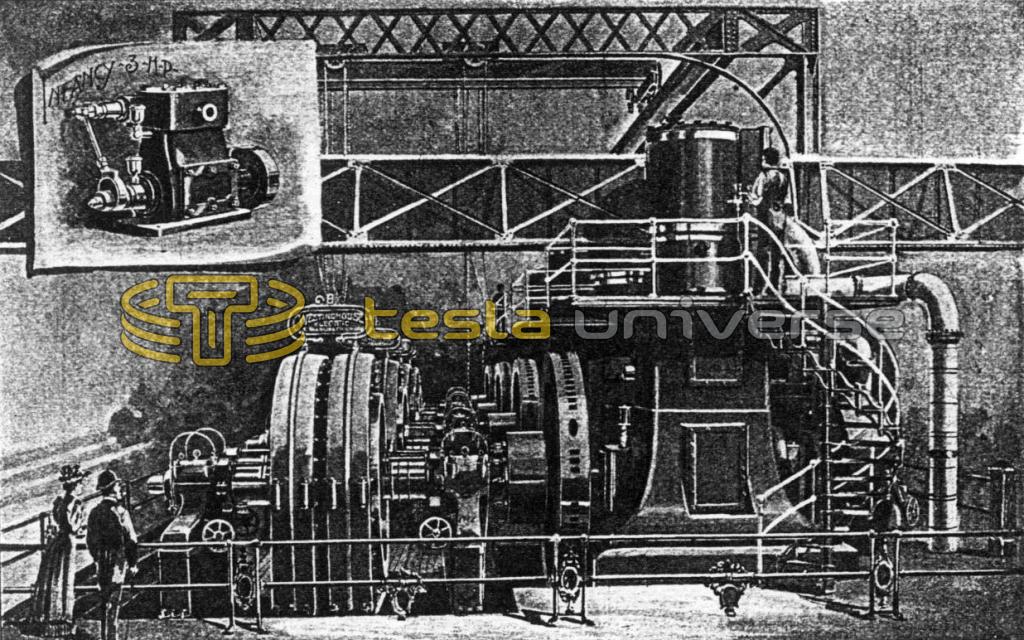
The exhibit of Westinghouse engines attracted much attention among engineers and the public in general, through its size and varied character. The main exhibit of six 1,000-h. p. engines, direct connected to Westinghouse alternating current dynamos, was the most noticeable feature, but in addition to this there were eight of smaller sizes, making in all 14 engines, aggregating 7,695 h. p., being by far the largest exhibit of this kind ever made at any exposition. The accompanying cut illustrates the development of 12 years of practice in this line, the small figure being the first engine constructed and the large one an excellent view of the row of four engines which place 4,000 h. p. developed and utilized within a smaller space than has ever before been attempted on land. The other two engines of 1,000 h. p. were in an adjacent block. similarly connected to dynamos of the same pattern. The history of the construction of these six engines indicates the constructive development which a shop can reach, for they were built from new designs and patterns within four months — in fact seven were built in this time — without losing a casting or spoiling a part. The seventh engine was provided to insure against delay through possible accident in shipment or erection, and upon the successful starting of the six engines at Chicago, the seventh was sold to the Missouri Electric Light Company, of St. Louis, where it is now in operation. This type, while a departure from the regular Westinghouse pattern, involves most of the salient features which have become so well known, and contains various new ones, especially the pneumatic inertia balance which relieves the governor of all weight and inertia of valve parts, and which by the simple turn of a valve is immediately transformed into a steam starting gear. It is believed that this type of compound engine will come into favor rapidly where large units are required, as it combines a high steam efficiency with various approved features of the Westinghouse design. A fact not generally known, but of some interest regarding the operation of these engines, is their relation to the practical service of the Exposition lighting, for, while many lights were carried by other engines on exhibit, operating during Exposition hours, the Westinghouse engines carried lights not only during the regular hours, but all night, Sundays and various odd hours, thus rendering more extended service than is usual in the operation of exhibits.
The two 400-h. p. compound engines of the regular Westinghouse type, in operation in the central block, between the two large Corliss engines, were sold to the Exposition. and will continue to operate through such time as lighting is required. These engines were the first placed in operation last year, furnishing power for incandescent lights previous to the starting of the main exhibits. In the Electricity Building a 270-h. p. Kodak outfit of the regu·lar type, shown in the small cut, was operated in a rather novel way. It being inconvenient to obtain steam in that location, the generator was operated as a motor. driving the engine, the latter being piped to give all the appearance of running under steam. It was difficult to perceive that it was not operated in the usual way, although a few of the more curious would investigate and easily ascertain the facts. This outfit was sold to the Lehigh Traction Company, of Hazleton, Pa.
A somewhat obscurely located though interesting and fine running set of engines were the three 125-h. p. Westinghouse compounds direct connected to three small Westinghouse multipolar dynamos, operating as exciters for the large alternating current machines. These were kept in practically continuous operation, and on Aug. 8 the engineers in charge started the one nearest the aisle for a run which should be absolutely continuous throughout the rest of the Exposition. It was operated for 85 consecutive days and nights, making in that time over 35,000,000 revolutions, and when shut down at the close of the Fair was running with perfect smoothness. Engines of this type have frequently been operated throughout longer periods, but this, so far as known, is the longest run ever made by any engine in a public place. A neighboring blackboard on which hourly records of time and revolution were kept attracte much attention. Two Standard engines of 125 h. p. each were loaned to the Chicago Paper Trade Club to operate its paper making exhibit, and were sold to the Boone Street Railway Company, of Boone, Ia.
The display of steam engines generally at the Exposition was, on the whole, highly creditable and representative, but no exhibit was more characteristic of the product and magnitude of the interests represented than the above.
