
Nikola Tesla Articles
The Wizard of AC
By Ric Bradley
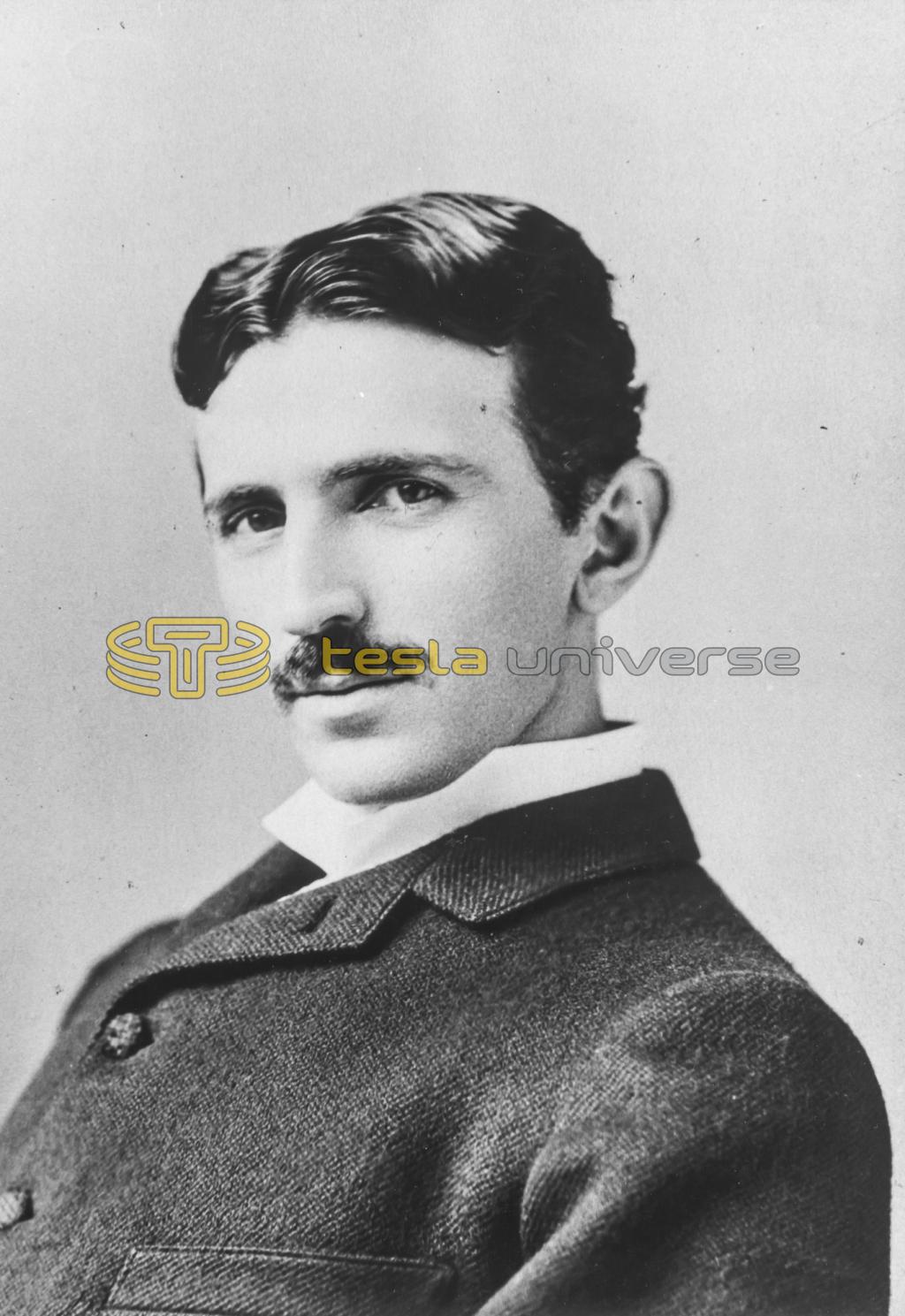
Ask any school child: "Who invented radio?" If you get an answer at all it will doubtless be Marconi — to which The Encyclopedia Americana nods assent. Or ask most anyone: "Who was the great American inventor who brought electricity into all our homes?" Without hesitation, Thomas Edison, right? Wrong both times. The correct answer is Nikola Tesla, a person you may never even have heard of. And there is more. He appears to have discovered X-rays a year before W. K. Roentgen did in Germany, he built a vacuum tube amplifier several years before Lee De Forest did, he was using fluorescent lights in his laboratory 40 years before industry invented them, and he demonstrated the principles used in microwave ovens and radar decades before these gadgets became ubiquitous. Yet we associate his name with none of them.
Why has history so overlooked this man? Was he a closet genius who never shared ideas with others? Did he live in some remote outback where science lay fallow? Or was he so obnoxious everyone shunned him?
None of the above. To the contrary, he lived most of his life in New York City — with a seven month stint in Colorado Springs — and for about 20 years, around the turn of the century, he was adopted by the highest of high society, the most eligible bachelor in town. His backers included such financial and industrial giants as J. Pierpont Morgan, John Jacob Astor, and George Westinghouse. He counted as friends eminent scientists, political tycoons, author Mark Twain, pianist Ignace Paderewski, and magazine editor Robert Underwood Johnson. His honorary degrees, major prizes, and other citations number in the dozens. For awhile he created sensations wherever he went. And in spite of all that, memory of Tesla seems to have followed him to the grave.
Clues to this puzzle can be found in the fascinating story of his life.
Tesla was born in Smijlan, Croatia (now part of Yugoslavia) in 1856, the son of a staid clergyman and an inventive mother. She clearly had the greater influence on him, for at five he already was building little waterwheels and other contraptions, as precocious youngsters are supposed to do. One invention that would have won him no plaudits from the Society for the Prevention of Cruelty to Insects was his June bug machine. He glued live June bugs to the spokes of a wheel, all pointed in the same direction, and then excited them to flight, causing the wheel to turn.
His school record was spotty, but he excelled in science and mathematics, and had an extraordinary memory, one that made learning six languages easy for him, and, later, allowed him to carry blueprints around in his head. (Clue #1: He left a minimal paper trail.) Once, in a physics class at his technical Hochschule, while watching his professor demonstrate a new electric motor the school had just acquired, young Tesla remarked, critically, that the motor did an awful lot of sparking at the commutator rings. Patiently, Professor Poeschl explained to his naive student that, given that the electric current to the motor was direct (DC, as from a battery), there was no way to make the motor run without commutator rings (which automatically switch the current back and forth inside the motor). "Well, then," pressed Tesla, "why not just use alternating current in the first place (AC, as from a dynamo) and skip the commutator rings?" Poeschl devoted the entire next day's lecture to demolishing Tesla's stupid idea, proving why such a motor would be impossible. The device would simply vibrate uselessly, he said; nothing would rotate. That scalding launched Tesla on his career. "Impossible" was his kind of challenge.
Three years later, while watching a sunset in Paris and reciting Goethe's poem Faust to a friend, Tesla suddenly lapsed into a catatonic state. His friend, alarmed, suspecting a petit mal, shook him violently, but all he got back were the words: "A rotating magnetic field!" In the midst of sunset and Faust, Tesla suddenly saw how to convert useless vibration to rotary motion. He would use two electromagnets, oriented at right angles to each other, and he would pass the alternating current through them out of step with each other by a quarter of a cycle, the effect being to produce a magnetic field that goes, not back and forth as with one magnet, but around in a circle. Then the armature of the motor, the rotating part, would be carried around by the magnetic field. Thus, one could take alternating current from a dynamo and make it run a motor directly with no sparking commutator rings at either place. There would be nothing but the bearings to wear out.
At this time, Tesla was working for the Continental Edison Company in Paris, helping design and build the DC machinery that would operate the lights and streetcars of Europe. But Tesla had a better idea: use AC! He built a demonstration model of his AC motor, showed it to his employers, and tried to sell them on its advantages. They were unimpressed. To compound the slight, they refused to compensate Tesla for major improvements he had made on their own DC machinery, as per an agreement. Disgusted, Tesla resigned, took a boat to New York, and went to work for the head man himself — Thomas A. Edison.
But Edison was no more receptive to the idea of using AC than the Parisians had been. He had already invested far too much time and money and energy (and ego) in DC to consider changing. And like the Parisians, he too had no compunction about reneging on a promise to pay Tesla a handsome bonus for solving a particular knotty problem. Once again Tesla resigned in a huff. (Clue #2: As a businessman Tesla was a washout, failing completely to look after his own interests. Later, when people were pirating his ideas shamelessly and becoming wealthy over them, he made no effort to fight them, either in the courts or elsewhere. Instead, he became increasingly secretive.)
There were two more years of frustration, mostly as a day laborer, and then his star began to rise. An executive of the Western Union Tele- graph Company was so impressed by Tesla that he helped him set up the Tesla Electric Company in a shop just a few blocks from Edison's. And now, as Tesla began developing the components of an AC system, with its dynamos, motors, and transformers, the AC-DC war began in earnest. Edison, whose major objective was to light incandescent lamps with low voltage DC, now argued that AC was too dangerous to unleash upon the public, and supported his claim by public demonstrations with stray dogs. Possibly as a result of Edison's claim and demonstrations, the State of New York adopted an AC system for electrocuting its condemned prisoners; Tesla always suspected that Edison had somehow engineered that outcome.
The turning point in the battle came when Tesla gave a lecture before the American Institute of Electrical Engineers in May of 1888, in which he laid out, complete with demonstration models, his concept of the so-called polyphase alternating current distribution system that today is used all over the world. The real advantage of AC over DC is not just that it can run motors without sparking; its real advantage is efficiency. The delivery of electric power depends on two factors, current and voltage, and either one can be small if the other is big. But frictional losses in electrical wires depend only on current, so to keep losses low one need only transmit power at low current and high voltage. This is easy to do with AC, using transformers. There is no comparable way to achieve the same result with DC. Edison planned to have an electric generating plant in every neighborhood and at every factory. There was no way he could effectively transmit electricity for more than a mile or two, using low voltage DC.
One of those who heard Tesla's lecture was George Westinghouse of the Westinghouse Electric Company, and he lost no time in buying Tesla's patents for a million dollars plus royalties. Subsequently, Westinghouse won the bid against Edison Electric (now General Electric) to electrify the 1892 Chicago World's Fair (using AC), and, on the basis of that success, was chosen to develop the world's first major hydroelectric plant — at Niagara Falls in 1895. The battle was over. Edison couldn't have brought Niagara electricity even as far as Buffalo, New York, with his DC. Westinghouse eventually brought it all the way to New York City.
After Westinghouse had taken over the commercial development of alternating current power systems, Tesla moved on to other things. In 1893 he gave another lecture before the American Institute of Electrical Engineers that was no less sensational than the first. In it he displayed what is now known as the Tesla coil, and showed how he could light lights with it, send messages, and run motors — all by wireless. In the course of the lecture he outlined all the elements of the modern radio, complete with antennae, tuned circuits, and loudspeakers (another Tesla invention), and predicted that in the very near future words, music, and pictures would be broadcast through the air. The following year, in a demonstration in Madison Square Gardens, he operated a model boat by remote control. In the same year he made an X-ray shadowgraph of a friend's skull. But then tragedy struck (Clue #3: plain bad luck). One night his building caught fire and burned to the ground, destroying all his apparatus, all his models, everything. It was all resurrected, of course, but in the meantime Roentgen announced to the world his discovery of X-rays, and Guglielmo Marconi, having successfully sent a wireless message a mile, applied for a patent. (Much later, when the Marconi Company sued the United States for infringing on its patent rights during World War I, the Supreme Court ruled that Marconi's patents were not binding since the concepts had been included in Tesla's earlier application. But who today knows about Tesla's priority? (Clue #2 again: Tesla was a washout as a businessman.)
Tesla's most grandiose — and most controversial — scheme was to try to make electrical power available worldwide by exciting resonant electrical vibrations within the earth itself. ("Resonance" means the buildup of large vibrations by means of many small suitably timed impulses — like pushing a child on a swing.) Once these resonant currents were created, he believed, anyone anywhere could tap into their reservoir of power merely by sticking a metal pole into the ground. To test his ideas safely, he needed wide open spaces, hence his trip to Colorado Springs.
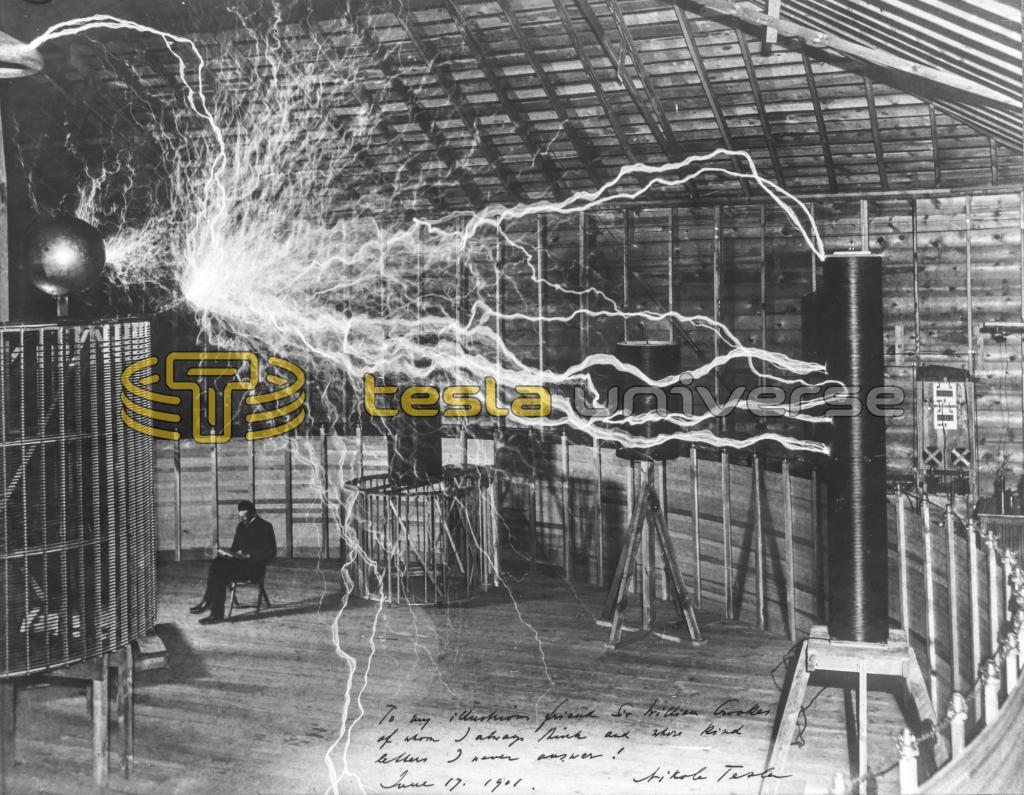
No one knows for certain what he accomplished in Colorado Springs, but we do know he studied electric currents in the earth caused by lightning discharges, and we know he built and briefly operated the world's largest Tesla coil ever — one that produced sparks 130 feet long, created thunder claps that by one account were heard in Cripple Creek, and caused a brand new dynamo in the Colorado Springs generating plant to go up in flames. By his own account, he was delighted with the results of the experiments, but we don't know what they were, nor will we ever know because, as usual, he kept everything in his head (the minimal paper trail of clue #1).
Back again in New York in 1900 Tesla found support for his projects drying up. J. P. Morgan and his associates lacked enthusiasm for any worldwide power project that, even if it worked, couldn't be metered and charged for. And as for the royalties from all those Westinghouse patents, worth perhaps $20 million—well, ten years earlier Tesla had voluntarily relinquished his rights to them as a personal favor to George Westinghouse when his company faced a shortfall (Clue #2). In those days, Tesla never dreamed that the time would come, as indeed it now had, when he would lack funds for his projects.
And now began Tesla's long slow slide into oblivion. Without funds, he could no longer undertake the projects he continually dreamed of. Gradually, the multitudes who had once beat a path to his door died or lost interest. He became increasingly reclusive and eccentric, the archetypical mad scientist who could hint darkly of his death-ray machine while fastidiously wiping germs from his tableware. Doubtless, he could have held a steady job at Westinghouse, perhaps even General Electric, but he chose to be a loner to the end. And that, really, is the most important clue of all in the mystery of his eclipse. Without accomplices, graduate students, disciples, or family (he never married), there was no one around to keep alive the memory of the great man. When he died in 1943, only the Army took note: they searched his papers (in vain) for the design of the "death-ray machine."
Interestingly, though, in Yugoslavia where he spent only his boyhood, he is revered as a national hero.
No student ever slept through the author's class during a demonstration of the Tesla coil, not "with all those sparks flying around and the loud noise." Bradley retired from the physics department in 1987 after serving as dean of the College from 1973-79.
