Nikola Tesla Articles
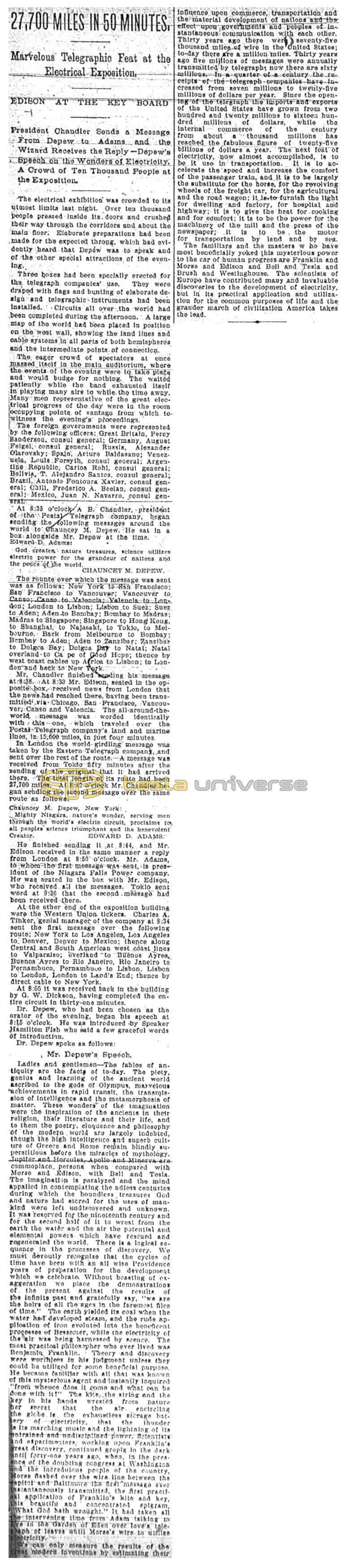
27,700 Miles in 50 Minutes
Marvelous Telegraphic Feat at the Electrical Exposition.
EDISON AT THE KEY BOARD
President Chandler Sends a Message From Depew to Adams and the Wizard Receives the Reply — Depew’s Speech on the Wonders of Electricity. A Crowd of Ten Thousand People at the Exposition.
The electrical exhibition was crowded to its utmost limits last night. Over ten thousand people pressed inside its doors and crushed their way through the corridors and about the main floor. Elaborate preparations had been made for the expected throng, which had evidently heard that Depew was to speak and of the other special attractions of the evening.
Three boxes had been specially erected for the telegraph companies’ use. They were draped with flags and bunting of elaborate design and telegraphic instruments had been installed. Circuits all over the world had been completed during the afternoon. A large map of the world had been placed in position on the west wall, showing the land lines and cable systems in all parts of both hemispheres and the intermediate points of connection.
The eager crowd of spectators at once massed itself in the main auditorium, where the events of the evening were to take place and would budge for nothing. They waited patiently while the band exhausted itself in playing many airs to while the time away. Many men representative of the great electrical progress of the day were in the room occupying points of vantage from which to witness the evening’s proceedings.
The foreign governments were represented by the following officers: Great Britain, Percy Sanderson, consul general; Germany, August Feigel, consul general; Russia, Alexander Olarovsky; Spain, Arturo Baldasano; Venezuela, Louis Forsyth, consul general; Argentine Republic, Carlos Rohl, consul general; Bolivia, T. Alejandro Santos, consul general; Brazil, Antonio Fontoura Xavier, consul general; Chili, Frederico A. Beelan, consul general; Mexico, Juan N. Navarro, consul general.
At 8:35 o’clock A. B. Chandler, president of the Postal Telegraph company, began sending the following messages around the world to Chauncey M. Depew. He sat in a box alongside Mr. Depew at the time.
Edward D. Adams:
God creates nature treasures, science utilizes electric power for the grandeur of nations and the peace of the world.
CHAUNCEY M. DEPEW.
The route over which the message was sent was as follows: New York to San Francisco; San Francisco to Vancouver; Vancouver to Canso; Canso to Valencia; Valencia to London; London to Lisbon; Lisbon to Suez; Suez to Aden; Aden to Bombay; Bombay to Madras; Madras to Singapore; Singapore to Hong Kong; to Shanghai, to Nagasaki, to Tokio, to Melbourne. Back from Melbourne to Bombay; Bombay to Aden; Aden to Zanzibar; Zanzibar to Delagoa Bay; Delagoa Bay to Natal; Natal overland to Cape of Good Hope; thence by west coast cables up Africa to Lisbon; to London and back to New York.
Mr. Chandler finished sending his message at 8:38. At 8:39 Mr. Edison, seated in the opposite box, received news from London that the news had reached there, having been transmitted via Chicago, San Francisco, Vancouver, Canso and Valencia. The all-around-the-world message was worded identically with this one, which traveled over the Postal Telegraph company’s land and marine lines, in 15,000 miles, in just four minutes.
In London the world-girdling message was taken by the Eastern Telegraph company and sent over the rest of the route. A message was received from Tokio fifty minutes after the sending of the original that it had arrived there. The total length of its route had been 27,700 miles. At 8:42 o’clock Mr. Chandler began sending the second message over the same route as follows:
Chauncey M. Depew, New York:
Mighty Niagara, nature’s wonder, serving man through the world’s electric circuit, proclaims to all peoples science triumphant and the benevolent Creator.
EDWARD D. ADAMS.
He finished sending it at 8:44, and Mr. Edison received in the same manner a reply from London at 8:50 o’clock. Mr. Adams, to whom the first message was sent, is president of the Niagara Falls Power company. He was seated in the box with Mr. Edison, who received all the messages. Tokio sent word at 9:30 that the second message had been received there.
At the other end of the exposition building were the Western Union tickers. Charles A. Tinker, genial manager of the company, at 8:34 sent the first message over the following route: New York to Los Angeles, Los Angeles to Denver, Denver to Mexico; thence along Central and South American west coast lines to Valparaiso; overland to Buenos Ayres, Buenos Ayres to Rio Janeiro, Rio Janeiro to Pernambuco, Pernambuco to Lisbon, Lisbon to London, London to Land’s End; thence by direct cable to New York.
At 8:55 it was received back in the building by G. W. Dickson, having completed the entire circuit in thirty-one minutes.
Dr. Depew, who had been chosen as the orator of the evening, began his speech at 8:15 o’clock. He was introduced by Speaker Hamilton Fish, who said a few graceful words of introduction.
Dr. Depew spoke as follows:
Ladies and gentlemen — The fables of antiquity are the facts of to-day. The piety, genius and learning of the ancient world ascribed to the gods of Olympus marvelous achievements in rapid transit, the transmission of intelligence and the metamorphosis of matter. These wonders of the imagination were the inspiration of the ancients in their religion, their literature and their life, and to them the poetry, eloquence and philosophy of the modern world are largely indebted, though the high intelligence and superb culture of Greece and Rome remain blindly superstitious before the miracles of mythology. Jupiter and Hercules, Apollo and Minerva are commonplace persons when compared with Morse and Edison, with Bell and Tesla.
The imagination is paralyzed and the mind appalled in contemplating the endless centuries during which the boundless treasures God and nature had stored for the uses of mankind were left undiscovered and unknown. It was reserved for the nineteenth century and for the second half of it to wrest from the earth the water and the air the potential and elemental powers which have rescued and regenerated the world. There is a logical sequence in the processes of discovery. We must devoutly recognize that the cycles of time have been with an all wise Providence years of preparation for the development which we celebrate. Without boasting or exaggeration we place the demonstrations of the present against the results of the infinite past and gratefully say, “We are the heirs of all the ages in the foremost files of time.” The earth yielded its coal when the water had developed steam, and the rude application of iron evolved into the beneficent processes of Bessemer, while the electricity of the air was being harnessed by science. The most practical philosopher who ever lived was Benjamin Franklin. Theory and discovery were worthless in his judgment unless they could be utilized for some beneficial purpose. He became familiar with all that was known of this mysterious agent and instantly inquired “from whence does it come and what can be done with it?” The kite, the string and the key in his hands wrested from nature her secret that the air encircling the globe is the exhaustless storage battery of electricity, that the thunder is its marching music and the lightning of its untrained and undisciplined power. Scientists and experimenters, working upon Franklin’s great discovery, continued groping in the dark until forty-one years ago, when, in the presence of the doubting congress at Washington and the incredulous people of the country, Morse flashed over the wire line between the Capitol and Baltimore the first message ever instantaneously transmitted, the first practical application of Franklin’s kite and key, his beautiful and concentrated epigram, “What God hath wrought.” It had taken all the intervening time from Adam talking to Eve in the Garden of Eden over love’s telegraph of leaves until Morse’s wire to utilize electricity.
We can only measure the results of the modern inventions by estimating their influence upon commerce, transportation and the material development of nations and the effect upon governments and peoples of instantaneous communication with each other. Thirty years ago there were seventy-five thousand miles of wire in the United States; to-day there are a million miles. Thirty years ago five millions of messages were annually transmitted by telegraph; now there are sixty millions. In a quarter of a century the receipts of the telegraph companies have increased from seven millions to twenty-five millions of dollars per year. Since the opening of the telegraph the imports and exports of the United States have grown from two hundred and twenty millions to sixteen hundred millions of dollars, while the internal commerce of the century from about a thousand millions has reached the fabulous figure of twenty-five billions of dollars a year. The next feat of electricity, now almost accomplished, is to be its use in transportation. It is to accelerate the speed and increase the comfort of the passenger train, and it is to be largely the substitute for the horse, for the revolving wheels of the freight car, for the agricultural and the road wagon; it is to furnish the light for dwelling and factory, for hospital and highway; it is to give the heat for cooking and for comfort; it is to be the power for the machinery of the mill and the press of the newspaper; it is to be the motor for transportation by land and by sea.
The familiars and the masters who have most beneficially yoked this mysterious power to the car of human progress are Franklin and Morse and Edison and Bell and Tesla and Brush and Westinghouse. The scientists of Europe have contributed many and invaluable discoveries to the development of electricity, but in its practical application and utilization for the common purposes of life and the grander march of civilization America takes the lead.