Nikola Tesla Articles
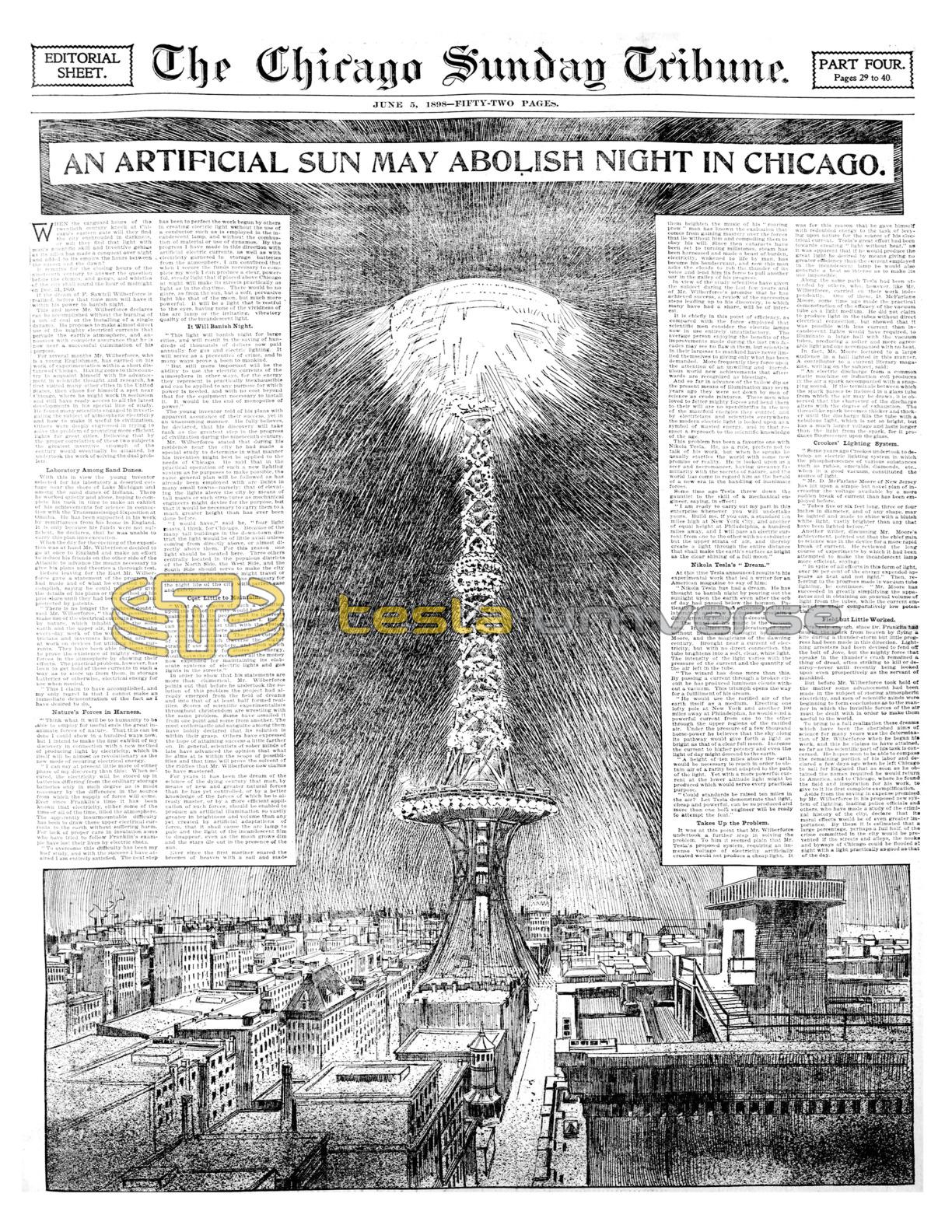
An Artificial Sun May Abolish Night in Chicago
When the vanguard hours of the twentieth century knock at Chicago's eastern gate will they find the city enshrouded in darkness, or will they find that light with man's scientific skill and inventive genius as its allies has made a conquest over night and added to its empire the hours between.. the sunset and the dawn?
It remains for the closing hours of the nineteenth century to answer the question before the chimes, and gongs, and whistles of the city shall sound the hour of midnight on Dec. 31, 1899.
If the dream of F. Sawtell Wilberforce is realized, before that time man will have it within his power to banish night.
This and more Mr. Wilberforce declares can be accomplished without the burning of a ton of coal or the installing of a single dynamo. He proposes to make almost direct use of the mighty electrical currents that pervade the earth's atmosphere, and announces with complete assurance that he is now near a successful culmination of his purpose.
For several months Mr. Wilberforce, who is a young Englishman, has carried on his work of experimentation within a short distance of Chicago. Having come to this country to acquaint himself with its advancement in scientific thought and research, he first visited many other cities in the United States, then chose for himself a spot near Chicago, where he might work in seclusion and still have ready access to all the latest developments in his special line of study. He found many scientists engaged in investigating the subject of atmospheric electricity and how to make it useful to civilization. Others were deeply engrossed in trying to solve the problem of providing more efficient lights for great cities. Believing that by the proper correlation of these two subjects the greatest inventive triumph of the century would eventually be attained, he undertook the work of solving the dual problem.
Laboratory Among Sand Dunes.
With this in view the young inventor selected for his laboratory a deserted cottage near the shore of Lake Michigan and among the sand dunes of Indiana. There he worked quietly and alone, hoping to complete his task in time to make an exhibit of his achievements for science in connection with the Transmississippi Exposition at Omaha. He has been supported in his work by remittances from his home in England. It is only because his funds were not sufficient, he declares, that he was unable to carry this plan into execution.
When the day for the opening of the exposition was at hand Mr. Wilberforce decided to go at once to England and make an effort to induce his friends on the other side of the Atlantic to advance the means necessary to give his plans and theories a thorough test.
Before leaving for the East Mr. Wilberforce gave a statement of the progress he had made and of what he expected to accomplish, saying he could not safely give the details of his plans or the method of his procedure until they had been perfected and protected by patents.
"There is no longer the slightest doubt," said Mr. Wilberforce," that it is possible to make use of the electrical currents generated by nature, which inhabit alike the solid earth and the upper air, in carrying on the every-day work of the world. Many electricians and inventors know this and are at work on devices for utilizing these currents. They have been able for some time to prove the existence of mighty electrical forces in the atmosphere by showing their effects. The practical problem, however, has been to get hold of these currents in such a way as to store up from them, in storage batteries or otherwise, electrical energy for use when needed.
"This I claim to have accomplished, and my only regret is that I cannot make an immediate demonstration of the fact as I have desired to do.
Nature's Forces in Harness.
Think what it will be to humanity to be able to employ for useful ends the great inanimate forces of nature. That this can be done I could show in a hundred ways now, but I intend to make the first exhibit of my discovery in connection with a new method of producing light by electricity, which in itself will be almost as revolutionary as the new mode of securing electrical energy.
"I can say at present little more of either phase of my discovery than this: When se cured, the electricity will be stored up in batteries differing from the ordinary storage batteries only in such degree as is made necessary by the difference in the source from which the supply of force will come. Ever since Franklin's time it has been known that electricity, either some of the time or all of the time, filled the atmosphere. The apparently insurmountable difficulty has been to draw these upper electrical currents to the earth without suffering harm. For lack of proper care in insulation some who have tried to follow Franklin's example have lost their lives by electric shots.
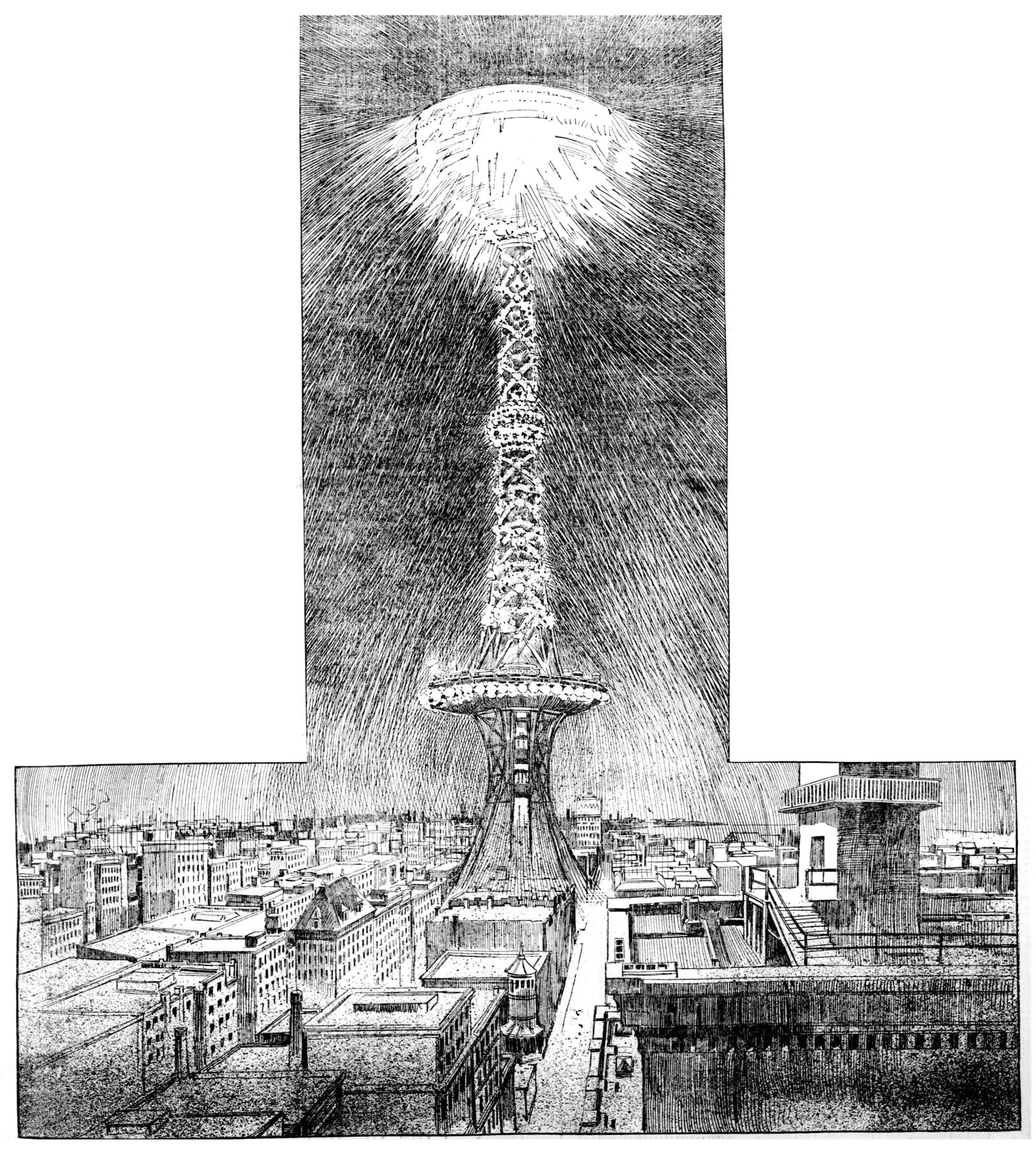
"To overcome this difficulty has been my chief study, and with the success I have attained I am entirely satisfied. The next step has been to perfect the work begun by others in creating electric light without the use of a conductor such as is employed in the incandescent lamp, and without the combustion of material or use of dynamos. By the progress I have made in this direction with artificial electric currents, as well as with electricity garnered in storage batteries from the atmosphere, I am convinced that when I secure the funds necessary to complete my work I can produce a clear, powerful, steady light that if placed above Chicago at night will make its streets practically as light as in the daytime. There would be no glare, as from the sun, but a soft, pervasive light like that of the moon, but much more powerful. It will be a light that is restful to the eyes, having none of the vividness of the arc lamp or the irritating, vibratory quality of the incandescent light.
It Will Banish Night.
"This light will banish night for large cities, and will result in the saving of hundreds of thousands of dollars now paid annually for gas and electric lighting. It will serve as a preventive of crime, and in many ways prove a boon to mankind.
"But still more important will be the ability to use the electric currents of the atmosphere in other ways, for the energy they represent is practically inexhaustible and can be applied to any purpose for which power is needed, and with no cost beyond that for the equipment necessary to Install it. It would be the end of monopolies of power."
The young inventor told of his plans with apparent assurance of their success, yet in an unassuming manner. He fully believes, he declared, that his discovery will take rank as the greatest step in the progress of civilization during the nineteenth century.
Mr. Wilberforce stated that during his residence near the city he had made special study to determine in what manner his invention might best be applied to the needs of Chicago. He said that in the practical operation of such a new lighting system as he purposes to make possible, the same general plan will be followed as has already been employed with are lights in many small towns — namely: that of elevating the lights above the city by means of tall masts or such structures as mechanical engineers might devise for the purpose, but that it would be necessary to carry them to a much greater height than has ever been done before.
"I would have," said he, "four light masts, I think, for Chicago. Because of the many tall buildings in the down-town district the light would be of little avail unless one coming from directly above, or almost directly above them. For this reason light should be located here. Three others. centrally located in the populous districts of the North Side, the West Side, and the South Side should serve to make the city at night so light that one might travel or carry on any of the operations necessary for the night life of the city with perfect ease and safety.
Cost Little to Maintain.
"What the effects of such a condition. upon the life of the city would be, those acquainted with its people and its interests are better qualified to say than I. But it can be said at least that with the system once established there would practically be no cost to maintain it. The great currents of electricity which traverse the higher strata of our atmosphere, and upon which I propose to draw for stores of energy, would save the city every year all the money now expended for maintaining its elaborate systems of electric lights and gas lights in the streets."
In order to show that his statements are more than chimerical, Mr. Wilberforce points out that before he undertook the solution of this problem the project had already emerged from the field of dreams and into that of at least half formed realities. Scores of scientific experimentalists throughout christendom are wrestling with the same problem. Some have assailed it from one point and some from another. The most enthusiastic and sanguine among them have boldly declared that its solution is within their grasp. Others have expressed the hope of attaining success a little farther on. In general, scientists of sober minds of late have advanced the opinion that what he aims at is within the scope of possibilities and that time will prove the solvent of the riddles that Mr. Wilberforce now claims to have mastered.
For years it has been the dream of the science of the dying century that man, by means of new and greater natural forces than he has yet controlled, or by a better. knowledge of the forces of which he is already master, or by a more efficient application of such forces, should be enabled to produce an artificial illumination so vastly greater in brightness and volume than any yet created by artificial adaptations of force, that it shall cause the arc lamp to pale and the light of the incandescent film to disappear, even as the moon grows dim and the stars die out in the presence of the sun.
Ever since the first mariner snared the breezes of heaven with a sail and made them heighten the music of his "roaring prow" man has known the exaltation that comes from gaining mastery over the forces that lie without him and compelling them to obey his will. Since then cataracts have been set to turning millstones, steam has been harnessed and made a beast of burden, electricity, wakened to life by man, has become his bondservant, and now this man asks the clouds to rob the thunder of its voice and lend him its force to pull another oar in the galley of his progress.
In view of the study scientists have given the subject during the last few years and of Mr. Wilberforce's promise that he has achieved success, a review of the successive steps leading up to his discovery, in which many have had a share, will be of interest.
It is chiefly in this point of efficiency, as compared with the force employed that scientific men consider the electric lamps now in use entirely unsatisfactory. The average person enjoying the benefits of the improvements made during the last two decades may see no flaw in them, but scientists in their largesse to mankind have never limited themselves to giving only what has been demanded. More frequently they force upon the attention of an unwilling and incredulous world new achievements that afterwards are recognized as blessings.
And so far in advance of the tallow dip as the present means of illumination may seem years ago they were set down by men of science as crude mixtures. These men who loved to fetter mighty forces and bend them to their will are no spendthrifts in the use of the manifold energies they control, and by electricians and scientists everywhere the modern electric light is looked upon as a symbol of wasted energy, and in that respect a reproach to the scientific knowledge of the age.
This problem has been a favorite one with Nikola Tesla. He, as a rule, prefers not to talk of his work, but when he speaks he usually startles the world with some new promise or reality. He is looked upon as a seer and necromancer, having uncanny familiarity with the secrets of nature, and the world has come to regard him as the herald of a new era in the handling of inanimate forces.
Some time ago Tesla threw down the gauntlet to the skill of a mechanical engineer, saying, in effect:
"I am ready to carry out my part in this enterprise whenever you will undertake yours. Bulld me, if you can, a standard ten miles high at New York City, and another of equal height at Philadelphia, a hundred miles away, and I will pass an electric current from one to the other with no conductor but the upper strata of air, and thereby create a light through the entire distance. that shall make the earth's surface as bright as the clear shining of a full moon."
Nikola Tesla's "Dream."
At this time Tesla announced results in his experimental work that led a writer for an American magazine to say of him:
"Nikola Tesla has had a dream. He has thought to banish night by pouring out the sunlight upon the earth even after the orb of day had passed below the horizon. Patiently for years he has experimented in his laboratory and now he dares to proclaim a dimly growing reality to his dream.
"The wand of his magic is the vacuum tube. It realizes the desideratum of iight without heat, eagerly sought by Edison, Moore, and the magicians of the dawning century. Brought near a current of electricity, but with no direct connection, the tube brightens into a soft, clear, white light. The intensity of the light varies with the pressure of the current and the quantity of the air left in the tube.
"The wizard has done more than this. By passing a current through a broken circuit he has produced luminous clouds without a vacuum. This triumph opens the way for a fulfillment of his dream.
"He would use the rarified air of the earth itself as a medium. Erecting one pole at New York and another 100 miles away at Philadelphia, he would send a powerful current from one to the other through the upper regions of the rarified air. Under the pressure of a few thousand horse-power he believes that the sky along its pathway would give forth a light as bright as that of a clear full moon. Increase the current to higher potency and even the light of day might descend to the earth.
"A height of ten miles above the earth would be necessary to reach in order to obtain air of a rarity best adapted to the path of the light. Yet with a more powerful current at the lower altitude light might be produced which would serve every practical purpose.
"Could standards be raised ten miles in the air? Let Tesla demonstrate that light, cheap and powerful, can be so produced and more than one bold engineer will be ready to attempt the feat."
Takes Up the Problem.
It was at this point that Mr. Wilberforce undertook a further step in solving the problem. To him it seemed plain that Mr. Tesla's proposed system, requiring an immense voltage of electricity artificially created would not produce a cheap light. It lofty was for this reason that he gave himself with redoubled energy to the task of levying upon nature for the source of his electrical current. Tesla's great effort had been towards creating "light without heat," as it was apparent that if he would produce the great light he desired by means giving no greater efficiency than the current employed in the incandescent lamp he would also generate a heat so intense as to make its use impossible.
Along the same path Tesla had been attended by others, who, however, like Mr. Wilberforce, carried on their work independently. One of these. D. McFarlane Moore, some time ago made the practical demonstration of the efficacy of the vacuum tube as a light medium. He did not claim to produce light in the tubes without direct electrical connection, but showed that it was possible with less current than incandescent lights would have required, to illuminate a large hall with the vacuum tubes, producing a softer and more agreeable light and one accompanied with no heat.
In fact, Mr. Moore lectured to a large audience in a hall lighted in this manner. A contributor to a current literary magazine, writing on the subject, said:
"An electric discharge from a common static machine or induction coil produces in the air a spark accompanied with a snapping sound. If the terminals between which the spark passes be inclosed in a glass tube from which the air may be drawn, it is observed that the character of the discharge alters with the degree of exhaustion. The threadlike spark becomes thicker and thicker until the discharge fills the tube with a nebulous light, which is not so bright, but has a much larger voltage and lasts longer than the light from the spark, for it produces fluorescence upon the glass.
Crookes' Lighting System.
"Some years ago Crookes undertook to develop an electric lighting system in which the phosphorescence of various substances such as rubies, emeralds, diamonds, etc., when in a good vacuum, constituted the source of light.
"Mr. D. McFarlane Moore of New Jersey has hit upon a simple but novel plan of increasing the voltage available by a more sudden break of current than has been employed before.
"Tubes five or six feet long, three or four inches in diameter, and of any shape, may be lighted and made to shine with a bluish white light, vastly brighter than any that have been lighted before."
Another writer, discussing Mr. Moore's achievement, pointed out that the chief gain to science was in the device for a more rapid break of current. He reviewed the long course of experiments by which it had been attempted to make the incandescent lamp more efficient, saying:
"In spite of all efforts in this form of light, over 90 per cent of the energy expended appears as heat and not light." Then, referring to the progress made in vacuum tube lighting, he continues: "Mr. Moore has succeeded in greatly simplifying the apparatus and in obtaining an unusual volume of light from the tubes, while the current employed is under comparatively low potential."
Field but Little Worked.
Strangely enough, since Dr. Franklin had caught the spark from heaven by flying a kite during a thunder-storm but little progress had been made in this direction. Lightning arresters had been devised to fend off the bolt of Jove, but the mighty force that speaks in the thunder's crash remained a thing of dread, often striking to kill or destroy — never until recently being looked upon even prospectively as the servant of mankind.
But before Mr. Wilberforce took hold of the matter some advancement had been made in the subject of storing atmospheric electricity, and men of scientific minds were beginning to form conclusions as to the manner in which the invisible forces of the air must be dealt with in order to make them useful to the world.
To bring to a full realization these dreams which have been the cherished aims of science for many years was the determination of Mr. Wilberforce when he began his work, and this he claims to have attained, so far as the scientific part of his task is concerned. He hopes soon to be able to compass the remaining portion of his labor and declared a few days ago when he left Chicago to sail for England that as soon as he obtained the names required he would return to America, and to Chicago, where he found the field and inspiration for his work, to give to it its first complete exemplification.
Aside from the saving in expense promised by Mr. Wilberforce in his proposed new system of lighting, leading police officials and others, who have made a study of the criminal history of the city, declare that its moral effects would be of even greater importance. By these It is estimated that a large percentage, perhaps a full half, of the crime committed in the city would be prevented if the streets and alleys, the nooks and byways of Chicago could be flooded at night with a light practically as good as that of the day.