Nikola Tesla Articles
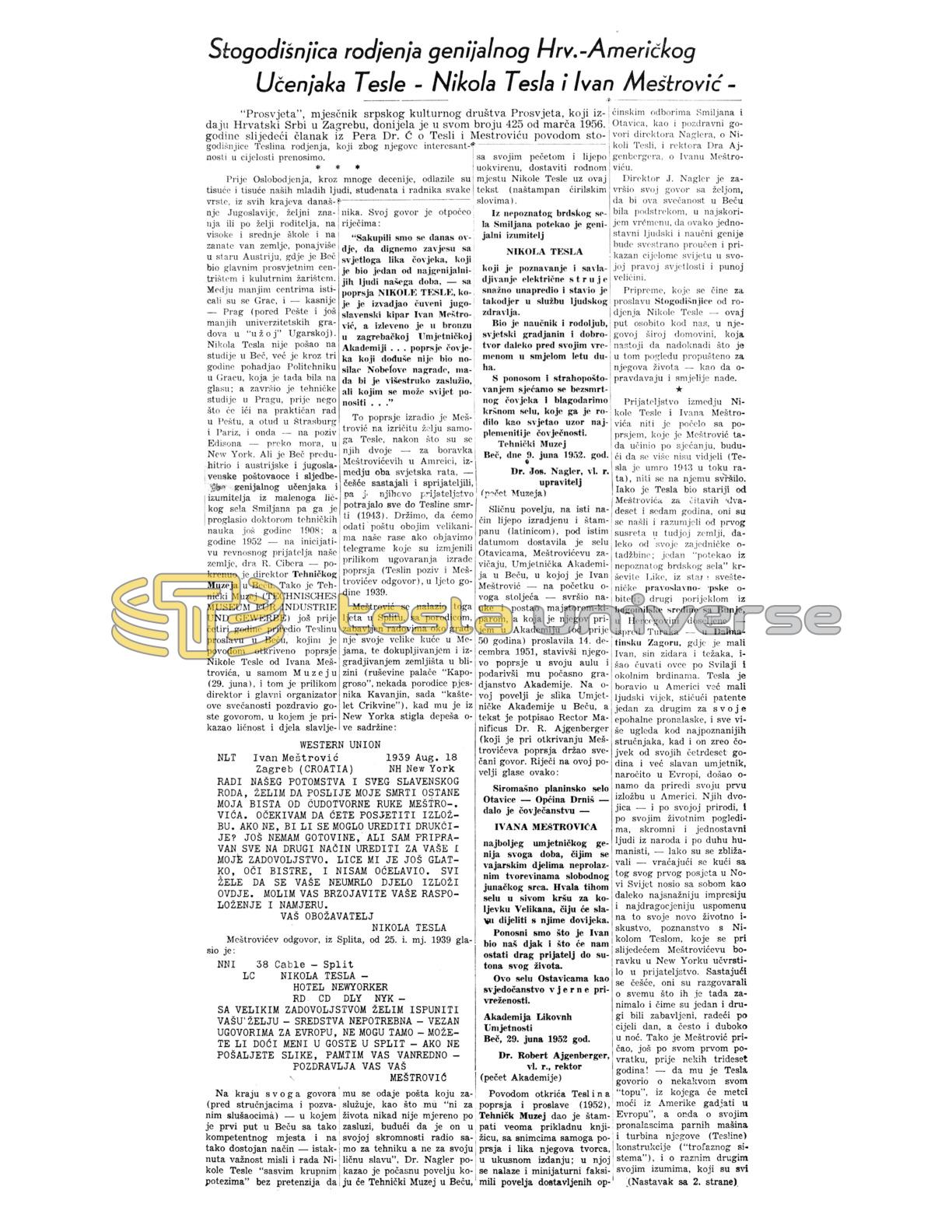
Centenary of the Birth of the Genius Croatian - American Scientist Tesla - Nikola Tesla and Ivan Meštrović
"Prosvjeta", the monthly of the Serbian cultural society Prosvjeta, which is published by Croatian Serbs in Zagreb, published in its issue No. 425 from March 1956 the following article by Dr. Ć about Tesla and Meštrović, on the occasion of the centenary of Tesla's birth, which we reproduce in full due to its interesting nature.
* * *
Before Liberation, for many decades, thousands upon thousands of our young people, students, and workers of all kinds, from all parts of present-day Yugoslavia, eager for knowledge or at their parents' request, went to high schools, secondary schools, and trades abroad, mostly to old Austria, where Vienna was the main educational center and cultural hub. Among the smaller centers, Graz stood out, and — later — Prague (besides Pest and other smaller university cities in "proper" Hungary). Nikola Tesla did not go to study in Vienna, but for three years attended the Polytechnic in Graz, which was then renowned; and he completed his technical studies in Prague before going for practical work in Pest, and from there to Strasbourg and Paris, and then — at Edison's invitation — across the sea to New York. But Vienna anticipated and honored him, before both Austrian and Yugoslav admirers and followers of the genius scholar and inventor from the small Lika village of Smiljan, and declared him a Doctor of Technical Sciences as early as 1908; and in 1952 — at the initiative of a devoted friend of our country, Dr. R. Ciber - the director of the Technical Museum in Vienna started a celebration of Tesla. Thus, the Technical Museum (TECHNISCHES MUSEUM FUR INDUSTRIE UND GEWERBE) organized a Tesla celebration in Vienna four years ago, on which occasion a bust of Nikola Tesla by Ivan Meštrović was unveiled in the Museum itself (June 29), and on this occasion, the director and chief organizer of the ceremony greeted the guests with a speech, in which he presented the personality and works of the celebrated figure. He began his speech with the words:
"We have gathered here today to lift the veil from the bright figure of a man who was one of the most brilliant people of our time - from the bust of NIKOLA TESLA, which was sculpted by the famous Yugoslav sculptor Ivan Meštrović, and cast in bronze at the Zagreb Academy of Fine Arts... a bust of a man who, though not a recipient of the Nobel Prize, certainly deserved it many times over, and of whom the world can be proud ..."
Meštrović made this bust at Tesla's explicit wish, after the two of them frequently met and befriended each other during Meštrović's stays in America between the two world wars, and their friendship lasted until Tesla's death (1943). We believe that we will pay tribute to both giants of our race if we publish the telegrams they exchanged when arranging for the creation of the bust (Tesla's invitation and Meštrović's reply), in the summer of 1939.
That summer, Meštrović was in Split with his family, busy with the construction of his large house in Meje, and with the acquisition and development of nearby land (the ruins of the "Kapogroso" palace, formerly owned by the poet Kavanjin's family, now "Crikvine Castle"), when a telegram with the following content arrived from New York:
WESTERN UNION
NLT Ivan Meštrović 1939 Aug. 18
Zagreb (CROATIA) NH New YorkFOR THE SAKE OF OUR POSTERITY AND ALL SLAVIC PEOPLE, I WISH THAT AFTER MY DEATH, MY BUST MADE BY THE WONDERFUL HAND OF MEŠTROVIĆ REMAINS. I EXPECT YOU WILL VISIT THE EXHIBITION. IF NOT, COULD IT BE ARRANGED DIFFERENTLY? I DO NOT HAVE CASH YET, BUT I AM PREPARED TO ARRANGE EVERYTHING IN ANOTHER WAY FOR YOUR AND MY SATISFACTION. MY FACE IS STILL SMOOTH, EYES ARE CLEAR, AND I HAVE NOT GONE BALD. EVERYONE WANTS YOUR IMMORTAL WORK TO BE EXHIBITED HERE. PLEASE TELEGRAPH YOUR DISPOSITION AND INTENTION.
YOUR ADMIRER
NIKOLA TESLA
Meštrović's reply, from Split, dated Aug 25, 1939, read:
NNI 38 Cable - Split
LC NIKOLA TESLA -
HOTEL NEWYORKER -
RD CD DLY NYK -WITH GREAT PLEASURE I WISH TO FULFILL YOUR WISH - FUNDS UNNECESSARY — BOUND BY CONTRACTS FOR EUROPE, I CANNOT GO THERE - CAN YOU COME TO VISIT ME IN SPLIT — IF NOT, SEND PICTURES, I REMEMBER YOU EXCEPTIONALLY WELL — GREETINGS
FROM YOURS TRULY
MEŠTROVIĆ
At the end of his speech (before experts and invited listeners) — in which for the first time in Vienna, from such a competent place and in such a dignified manner — the importance of importance of Nikola Tesla's thoughts and work was highlighted "with very broad strokes" and without pretensions that he be given the recognition he deserves, just as he "never in his life was measured by his merit, because he, in his modesty, worked only for technology and not for his own personal glory", Dr. Nagler showed an honorary charter which the Technical Museum in Vienna will, with its seal and beautifully framed, deliver to the birthplace of Nikola Tesla along with this text (printed in Cyrillic letters):
From the unknown mountain village of Smiljan came the ingenious inventor
NIKOLA TESLA
who greatly advanced the understanding and mastery of electric current and also put it at the service of human health.
He was a scientist and patriot, a world citizen and benefactor far ahead of his time in the bold flight of his spirit.
With pride and reverence, we remember the immortal man and are grateful to the rugged village that gave birth to him as a bright example of the noblest humanity.
Technical Museum
Vienna, June 9, 1952.
Dr. Jos. Nagler, (own signature) manager
(Seal of the Museum)
A similar charter, beautifully made and printed (in Latin script) in the same way, was delivered on the same date to the village of Otavice, Meštrović's native region, by the Academy of Fine Arts in Vienna, where Ivan Meštrović — at the beginning of this century — completed his studies and became a master sculptor, and which celebrated his admission to the Academy (more than 50 years ago) on December 14, 1951, by placing his bust in its hall and bestowing upon him honorary citizenship of the Academy. On this charter is a picture of the Academy of Fine Arts in Vienna, and the text was signed by Rector Magnificus Dr. R. Eigenberger (who gave a ceremonial speech at the unveiling of Meštrović's bust). The words on this charter are as follows:
The poor mountain village of Otavice — Drniš Municipality — gave humanity —
IVAN MEŠTROVIĆ
the best artistic genius of his time, whose sculptural works are timeless creations of a free heroic heart. Thanks to the quiet village in the grey karst for being the cradle of the Great Man, whose glory will be shared with him forever.
We are proud that Ivan was our student and that he will remain a dear friend to us until the twilight of his life.
To the village of Otavice as a testament of faithful devotion.
Academy of Fine Arts
Vienna, June 29, 1952
Dr. Robert Eigenberger,
(own signature), rector
(Seal of the Academy)
On the occasion of the unveiling of Tesla's bust and the celebration (1952), the Technical Museum had a very suitable booklet printed, with photographs of the bust itself and the likeness of its creator, in an elegant edition; it also contains miniature facsimiles of charters delivered to municipal councils of Smiljan and Otavice, as well as greeting speeches by Director Nagler, about Nikola Tesla, and by Rector Dr. Eigenberger, about Ivan Meštrović.
Director J. Nagler concluded his speech with the wish that this ceremony in Vienna would serve as an incentive for this simply human and scientific genius to be thoroughly studied and presented to the entire world in his true light and full greatness in the shortest possible time.
The preparations being made for the celebration of the Centenary of Nikola Tesla's birth — this time especially in our country, in his wider homeland, which strives to make up for what was missed in that regard during his lifetime — seem to justify even bolder hopes.
★
The friendship between Nikola Tesla and Ivan Meštrović neither began with the bust that Meštrović then made from memory, since they had not seen each other again (Tesla died in 1943 during the war), nor did it end with it. Although Tesla was twenty-seven years older than Meštrović, they met and understood each other from their first encounter in a foreign land, far from their shared homeland; one "came from an unknown mountain village" of the rugged Lika, from an old Serbian Orthodox priestly family; the other originated from a Bogomil community in Bunje, settled in Herzegovina — in front of the Turks — in the Dalmatian Zagora, where little Ivan, son of a bricklayer and laborer, used to herd sheep in Svilaja and the surrounding hills. Tesla had already spent a considerable part of his life in America, acquiring patents one after another for his epochal inventions, and gaining increasing respect among the most renowned experts, when he [Meštrović, ed.], a mature man of forty and already a famous artist, especially in Europe, came there to prepare his first exhibition in America. The two of them — both by their nature and by their life views, modest and simple people from the common folk, and humanists in spirit — easily became close — and upon returning home from his first visit to the New World, he carried with him as the by far most powerful impression and most precious memory this new life experience, his acquaintance with Nikola Tesla, which solidified into a friendship during Meštrović's next stay in New York. Meeting more often, they talked about everything that interested them and about what they were engaged with at the time, working all day, and often deep into the night. Thus Meštrović recounted, even after his first return, some thirty years ago! — that Tesla had told him about a certain "cannon" of his, from which projectiles would be able to hit Europe from America, and then about his inventions of steam engines and turbines of his (Tesla's) construction ("three-phase system"), and about various other inventions of his, all of which have been realized today, "patented" under his name, and for whose realization Tesla alone — or at least by far the greatest share of credit — belongs to. On the other hand, while organizing his exhibitions in the great cities of North America, Meštrović could not have permanent studios or workshops; instead — living in hotels, just like Tesla, who throughout his life moved from place to place, from workshop to workshop, from hotel to hotel — he completed his daily work, which was not insignificant (at least one good drawing in the absence of clay and stone!), in a hotel room, with minimal means and comfort for work... Yet they still found time for long walks and even longer conversations — not only about their work and problems, but also about the issues that move the world, and among these, not least — alongside art — literature, which was dear to both of them and which they had followed since youth, more as self-taught individuals than through formal schooling. Both admired poets — especially from among our own, alongside folk poetry - Gundulić, Njegoš, Mažuranić, and Zmaj [Jovan Jovanović Zmaj (Dragon), ed. note], whose poems and passages they knew by heart (and even competed with each other over “who could do it better”); but they were also well acquainted with world literature, especially German, and particularly Goethe. Tesla even translated German poets (Goethe and Heine into Serbian, and our Zmaj into German). In any case, alongside their daily work, books were their main relaxation and brought them even closer together. But no! Nikola Tesla, who gradually renounced all human weaknesses and bodily pleasures (even black coffee!), retained one passion throughout his life: a love for birds! Meštrović vividly remembered and enjoyed recounting how the two of them — returning home from walks or dinner — would encounter pigeons near Tesla's residence, flocking patiently as they waited for their guardian angel to arrive with a full bundle of seeds, greeting him by fluttering their wings... He worked for humanity, yet loved birds!
It is therefore not surprising that men of such noble and gentle character so quickly developed mutual affection: Tesla warmly inviting Meštrović to New York to sculpt his bust, and Meštrović responding in kind by inviting him to Split — each striving, in thought and expression, to show greater courtesy. At that time, Meštrović was bound by contracts for the construction of his large house in Meje and was negotiating the purchase and development of land where the former palace of the poet Kavanjin stood, which he wished to save from fragmentation; from its ruins he later created the "Kaštelet" ("Crikvine"), a chapel where he placed his unique gallery of wooden reliefs ("Sacred History"), a counterpart to Buvina’s Doors at St. Duje from six centuries earlier, and at the same time the finest testimony to the continuity of Dalmatian sculpture and artistic sensibility. What would Tesla have said, had he by some fortune survived the war and come to Split, and what words would he have used for the miraculous hands of his host! ...
Yet it seems likely that the memory of the close friendship of these two remarkable men will endure, precisely in the likeness shaped by one of the other's hand. Among the preparations for the celebration of Tesla's centenary is a proposal that Ivan Meštrović — besides a bust — also create a monument to Nikola Tesla, this time for Zagreb. The proposal was made by Meštrović himself, and we present it here so that it may be heard.
★
Donating his sculpture of "Ruđer" to the Ruđer Bošković Institute in Zagreb — created about twenty years earlier (in his large old studio in Zagreb, which has since burned to the ground) and was originally intended for Dubrovnik, the birthplace of the famous mathematician and astronomer. Ivan Meštrović wrote (in a letter to a friend):
“…I congratulate the Institute on its noble intention to honor "Ruđer." If only they would also place Tesla beside him, for the two of them are the most significant figures our "breed" has produced.” When the Institute enthusiastically accepted his proposal and asked him to create a “Tesla” - alongside “Ruđer” — for Zagreb, he replied:
“…if the Institute has the funds for casting (in bronze), and I have the strength and time, I would gladly do it — so that the "atheist" Nikola might see that his "homeland Croatia" proudly holds him in its embrace and is not troubled by his "Serbian origin...”
Here Meštrović alludes to Tesla's well-known statement, made while he was still a student in Graz, when some chauvinistically inclined classmates asked whether he felt himself a Serb or a Croat: "I am proud of my Serbian origin and my Croatian homeland." Recently, Meštrović again wrote that he stands by his promise and will create Tesla's monument for Zagreb — "if I am alive" — and donate it to the Institute, just as he did with "Ruđer." He even requested the dimensions of "Ruđer's" statue to begin the work. Knowing the pace of Meštrović' work, one might easily imagine that his "Tesla" could appear at the Institute site as early as this year, alongside "Ruđer," which has already been cast and is being finished at the Academy of Fine Arts foundry in Zagreb. Meanwhile, the "Nikola Tesla" Society in Belgrade has commissioned the sculptor Frano Kršinić, Meštrović’s colleague and professor at the Art Academy in Zagreb, to create a monument to Nikola Tesla for Belgrade, on the occasion of the centenary celebration.
Thus, this celebration seems likely to overshadow all previous commemorations and manifestations held in honor of our great minds, bringing together three of the greatest among them: Ruđer leading the way, beside him his worthy successor Tesla, and with them the living Meštrović, who builds monuments to both and is the first among us to light the torch in their honor. Alongside Zagreb and Belgrade, the entire country and all our regions will join in this celebration, from the small village of Smiljan in Lika, where the great inventor was born, to Maribor in the north, where as a free academic citizen he earned his first money, and to Vojvodina and Novi Sad, where his first professional lecture ("On Capillary Tubes") was printed and where he could meet his beloved poet Zmaj, whom he "raised to the stars" (literally, by making Zmaj's name glow among those of the most famous scientists during a famous experiment at the Chicago exhibition in 1893).
In our homeland — which during Tesla's lifetime stood at the crossroads between East and West and constantly struggled for survival — circumstances were such that it was forced to send its best sons into the distant world, especially those naturally gifted and eager for knowledge and creation, so they could contribute to the discovery of new cultural values, for which there were not enough means at home. Yet even the greatest among them, the most brilliant minds abroad, remained faithful to their homeland, proud of their "old country," which recognizes their sacrifice and values their achievements, wishing to repay them with lasting memory and eternal gratitude. — Ć.
★
We have gladly presented this article to show our readers how these two great men — ours, and not only ours but belonging to the whole world - were bound by sincere friendship. Among all scientists in the field of electrical engineering, Tesla is surely the greatest, just as Meštrović is the greatest in the field of visual arts. Croats and Croatian Serbs alike have the right to be proud of both, as both were born on Croatian soil and both were proud of their homeland, Croatia. However, great men do not belong only to their own people, but to all humanity - and so it is with Tesla and Meštrović.
But while presenting this article, we cannot fail to mention with regret the following: If we are well informed, there are plans in Belgrade to establish a Tesla museum, where his writings and belongings would be kept. Tesla was proud of his homeland Croatia, as he repeatedly stated. Although he was of the Orthodox faith and thus, according to modern understanding, of Serbian origin, he took pride in his Croatia, and therefore the rightful place for his museum is Zagreb and nowhere else. Those who hold power in Yugoslavia should understand this and establish the museum in Zagreb, for otherwise Croats will never forgive it. Tesla himself would have asked for this had he been alive, and would have left it in writing, had he been able to foresee such a situation. We repeat once again, he was proud of his Croatian homeland, and his legacy belongs to it alone.