Nikola Tesla Articles
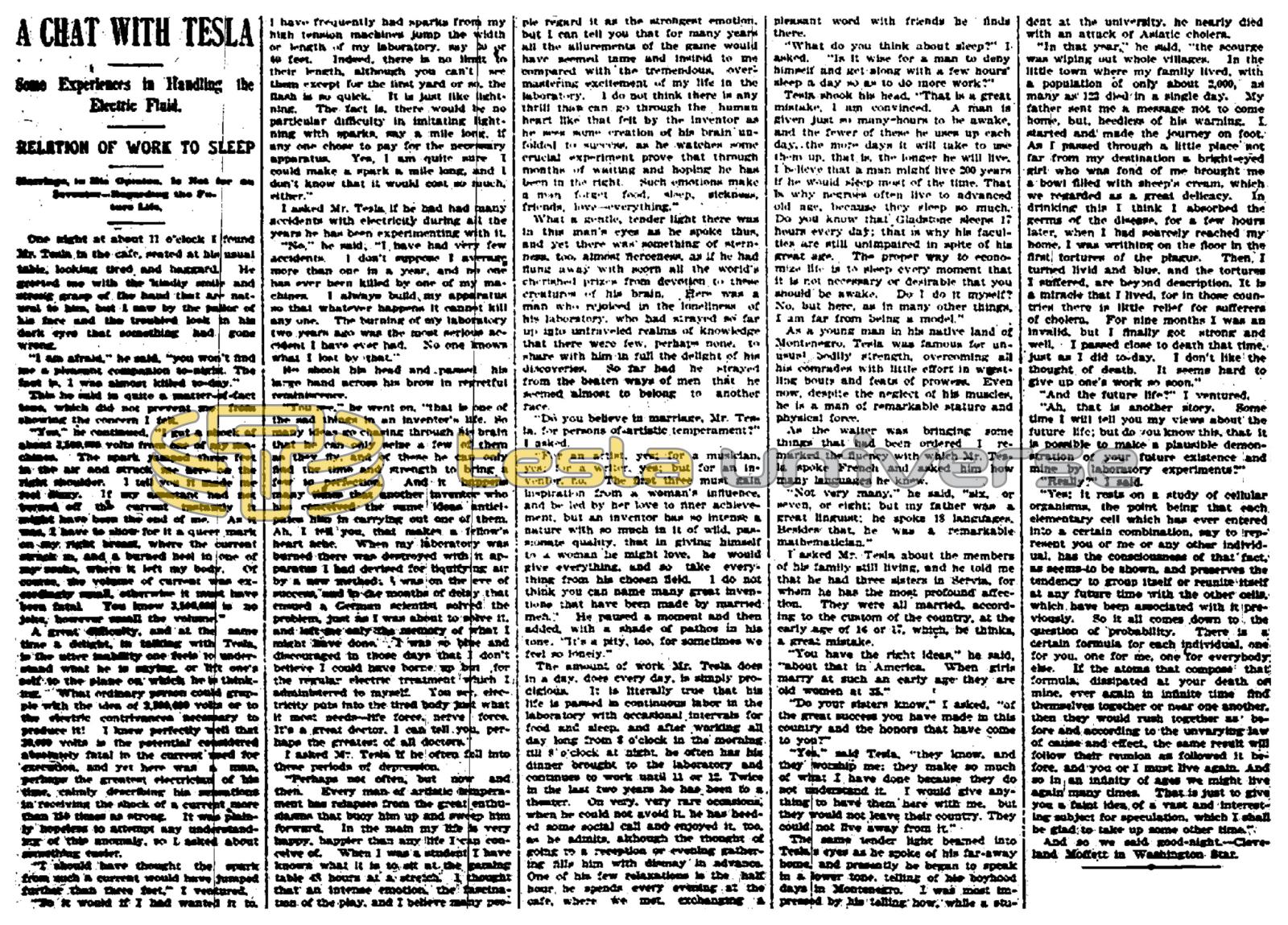
A Chat with Tesla
Some Experiences in Handling the Electric Fluid.
RELATION OF WORK TO SLEEP
Marriage, in His Opinion, Is Not for an Inventor — Regarding the Future Life.
One night at about 11 o’clock I found Mr. Tesla in the café, seated at his usual table, looking tired and haggard. He greeted me with the kindly smile and strong grasp of the hand that are natural to him, but I saw by the pallor of his face and the troubled look in his dark eyes that something had gone wrong.
“I am afraid,” he said, “you won’t find me a pleasant companion to-night. The fact is, I was almost killed to-day.”
This he said in quite a matter-of-fact tone, which did not prevent me from showing the concern I felt.
“Yes,” he continued, “I got a shock of about 3,500,000 volts from one of my machines. The spark jumped three feet in the air and struck me here on the right shoulder. I tell you it made me feel dizzy. If my assistant had not turned off the current instantly it might have been the end of me. As it was, I have to show for it a queer mark on my right breast, where the current struck me, and a burned hole in one of my socks, where it left my body. Of course, the volume of current was exceedingly small, otherwise it must have been fatal. You know 3,500,000 is no joke, however small the volume.”
A great difficulty, and at the same time a delight, in talking with Tesla, is the utter inability one feels to understand what he is saying, or lift one’s self to the plane on which he is thinking. What ordinary person could grasp the idea of 3,500,000 volts or the electric contrivances necessary to produce it? I knew perfectly well that 2,000 volts is the potential considered absolutely fatal in the current used for execution, and yet here was a man, perhaps the greatest electrician of his time, calmly describing his sensations in receiving the shock of a current more than 150 times as strong. It was plainly hopeless to attempt any understanding of this anomaly, so I asked about something easier.
“I should have thought the spark from such a current would have jumped further than three feet,” I ventured.
“So it would if I had wanted it to. I have frequently had sparks from my high tension machines jump the width or length of my laboratory, say 30 or 40 feet. Indeed, there is no limit to their length, although you can’t see them except for the first yard or so, the flash is so quick. It is just like lightning. The fact is, there would be no particular difficulty in imitating lightning with sparks, say a mile long, if any one chose to pay for the necessary apparatus. Yes, I am quite sure I could make a spark a mile long, and I don’t know that it would cost so much, either.”
I asked Mr. Tesla if he had had many accidents with electricity during all the years he has been experimenting with it.
“No,” he said, “I have had very few accidents. I don’t suppose I average more than one in a year, and no one has ever been killed by one of my machines. I always build my apparatus so that whatever happens it cannot kill any one. The burning of my laboratory two years ago was the most serious accident I have ever had. No one knows what I lost by that.”
He shook his head and passed his large hand across his brow in regretful remembrance.
“True,” he went on, “that is one of the sad things in an inventor’s life. So many ideas go chasing through his brain that he can only seize a few of them as they fly, and of these he can only find the time and strength to bring a few to perfection. And it happens many times that another inventor who has conceived the same ideas anticipates him in carrying out one of them. Ah, I tell you, that makes a fellow’s heart ache. When my laboratory was burned there was destroyed with it apparatus I had devised for liquefying air by a new method; I was on the eve of success, and in the months of delay that ensued a German scientist solved the problem, just as I was about to solve it, and left me only the memory of what I might have done. I was so blue and discouraged in those days that I don’t believe I could have borne up but for the regular electric treatment which I administered to myself. You see, electricity puts into the tired body just what it most needs — life force, nerve force. It’s a great doctor. I can tell you, perhaps the greatest of all doctors.”
I asked Mr. Tesla if he often fell into these periods of depression.
“Perhaps not often, but now and then. Every man of artistic temperament has relapses from the great enthusiasm that buoy him up and sweep him forward. In the main my life is very happy, happier than any life I can conceive of. When I was a student I have known what it is to sit at the gaming table 40 hours at a stretch. I thought that an intense emotion, the fascination of the play, and I believe many people regard it as the strongest emotion, but I can tell you that for many years all the allurements of the game would have seemed tame and insipid to me compared with the tremendous, overmastering excitement of my life in the laboratory. I do not think there is any thrill that can go through the human heart like that felt by the inventor as he sees some creation of his brain unfolded to success, as he watches some crucial experiment prove that through months of waiting and hoping he has been in the right. Such emotions make a man forget food, sleep, sickness, friends, love — everything.”
What a gentle, tender light there was in this man’s eyes as he spoke thus, and yet there was something of sternness, too, almost fierceness, as if he had flung away with scorn all the world’s cherished prizes from devotion to these creatures of his brain. Here was a man who rejoiced in the loneliness of his laboratory, who had strayed so far up into untraveled realms of knowledge that there were few, perhaps none, to share with him in full the delight of his discoveries. So far had he strayed from the beaten ways of men that he seemed almost to belong to another race.
“Do you believe in marriage, Mr. Tesla, for persons of artistic temperament?” I asked.
“For an artist, yes; for a musician, yes; for a writer, yes; but for an inventor, no. The first three must gain inspiration from a woman’s influence, and be led by her love to finer achievement, but an inventor has so intense a nature with so much in it of wild, passionate quality, that in giving himself to a woman he might love, he would give everything, and so take everything from his chosen field. I do not think you can name many great inventions that have been made by married men.” He paused a moment and then added, with a shade of pathos in his tone: “It’s a pity, too, for sometimes we feel so lonely.”
The amount of work Mr. Tesla does in a day, does every day, is simply prodigious. It is literally true that his life is passed in continuous labor in the laboratory with occasional intervals for food and sleep, and after working all day long from 8 o’clock in the morning till 8 o’clock at night, he often has his dinner brought to the laboratory and continues to work until 11 or 12. Twice in the last two years he has been to a theater. On very, very rare occasions, when he could not avoid it, he has heeded some social call and enjoyed it, too, as he admits, although the thought of going to a reception or evening gathering fills him with dismay in advance. One of his few relaxations is the half hour he spends every evening at the café, where we met, exchanging a pleasant word with friends he finds there.
“What do you think about sleep?” I asked. “Is it wise for a man to deny himself and get along with a few hours’ sleep a day so as to do more work?”
Tesla shook his head. “That is a great mistake, I am convinced. A man is given just so many hours to be awake, and the fewer of these he uses up each day, the more days it will take to use them up, that is, the longer he will live. I believe that a man might live 200 years if he would sleep most of the time. That is why negroes often live to advanced old age, because they sleep so much. Do you know that Gladstone sleeps 17 hours every day; that is why his faculties are still unimpaired in spite of his great age. The proper way to economize life is to sleep every moment that it is not necessary or desirable that you should be awake. Do I do it myself? No, but here, as in many other things, I am far from being a model.”
As a young man in his native land of Montenegro, Tesla was famous for unusual bodily strength, overcoming all his comrades with little effort in wrestling bouts and feats of prowess. Even now, despite the neglect of his muscles, he is a man of remarkable stature and physical force.
As the waiter was bringing some things that had been ordered I remarked the fluency with which Mr. Tesla spoke French and asked him how many languages he knew.
“Not very many,” he said, “six, or seven, or eight; but my father was a great linguist; he spoke 18 languages. Besides that, he was a remarkable mathematician.”
I asked Mr. Tesla about the members of his family still living, and he told me that he had three sisters in Serbia, for whom he has the most profound affection. They were all married, according to the custom of the country, at the early age of 16 or 17, which, he thinks, a great mistake.
“You have the right idea,” he said, “about that in America. When girls marry at such an early age they are old women at 35.”
“Do your sisters know,” I asked, “of the great success you have made in this country and the honors that have come to you?”
“Yes,” said Tesla, “they know, and they worship me; they make so much of what I have done because they do not understand it. I would give anything to have them here with me, but they would not leave their country. They could not live away from it.”
The same tender light beamed into Tesla’s eyes as he spoke of his far-away home, and presently he began to speak in a lower tone, telling of his boyhood days in Montenegro. I was most impressed by his telling how, while a student at the university, he nearly died with an attack of Asiatic cholera.
“In that year,” he said, “the scourge was wiping out whole villages. In the little town where my family lived, with a population of only about 2,000, as many as 123 died in a single day. My father sent me a message not to come home, but, heedless of his warning, I started and made the journey on foot. As I passed through a little place not far from my destination a bright-eyed girl who was fond of me brought me a bowl filled with sheep’s cream, which we regarded as a great delicacy. In drinking this I think I absorbed the germs of the disease, for a few hours later, when I had scarcely reached my home, I was writhing on the floor in the first tortures of the plague. Then I turned livid and blue, and the tortures I suffered are beyond description. It is a miracle that I lived, for in those countries there is little relief for sufferers of cholera. For nine months I was an invalid, but I finally got strong and well. I passed close to death that time, just as I did to-day. I don’t like the thought of death. It seems hard to give up one’s work so soon.”
“And the future life?” I ventured.
“Ah, that is another story. Some time I will tell you my views about the future life; but do you know this, that it is possible to make a plausible demonstration of your future existence and mine by laboratory experiments?”
“Really?” I said.
“Yes; it rests on a study of cellular organisms, the point being that each elementary cell which has ever entered into a certain combination, say to represent you or me or any other individual, has the consciousness of that fact, as seems to be shown, and preserves the tendency to group itself or reunite itself at any future time with the other cells which have been associated with it previously. So it all comes down to the question of probability. There is a certain formula for each individual, one for you, one for me, one for everybody else. If the atoms that compose that formula, dissipated at your death or mine, ever again in infinite time find themselves together or near one another, then they would rush together as before and according to the unvarying law of cause and effect, the same result will follow their reunion as followed it before, and you or I must live again. And so in an infinity of ages we might live again many times. That is just to give you a faint idea of a vast and interesting subject for speculation, which I shall be glad to take up some other time.”
And so we said good-night. — Cleveland Moffett in Washington Star.