Nikola Tesla Articles
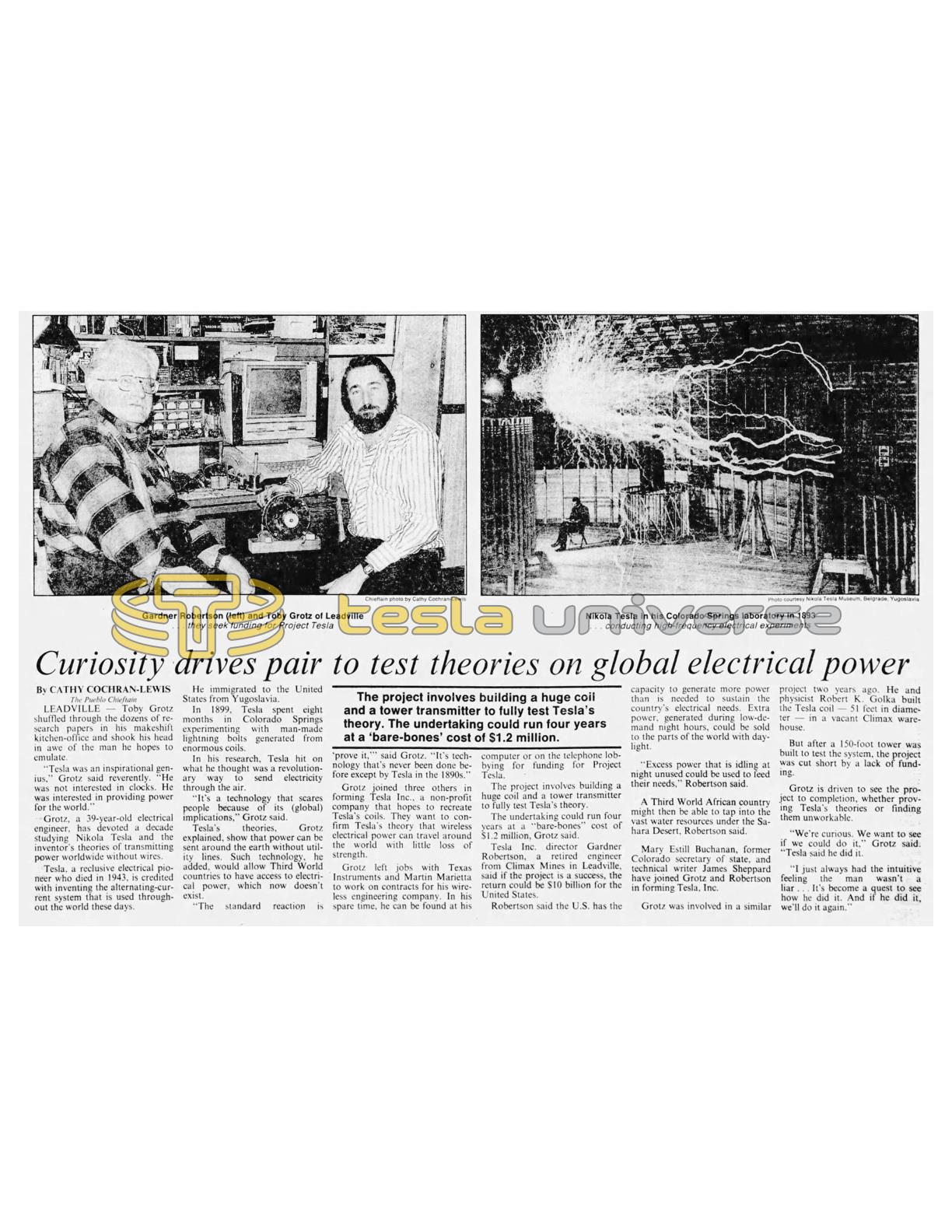
Curiosity Drives Pair to Test Theories on Global Electrical Power
By CATHY COCHRAN-LEWIS
The Pueblo Chieftain
LEADVILLE — Toby Grotz shuffled through the dozens of research papers in his makeshift kitchen-office and shook his head in awe of the man he hopes to emulate.
"Tesla was an inspirational genius," Grotz said reverently. "He was not interested in clocks. He was interested in providing power for the world."
Grotz, a 39-year-old electrical engineer, has devoted a decade studying Nikola Tesla and the inventor's theories of transmitting power worldwide without wires.
Tesla, a reclusive electrical pioneer who died in 1943, is credited with inventing the alternating-current system that is used throughout the world these days.
He immigrated to the United States from Yugoslavia.
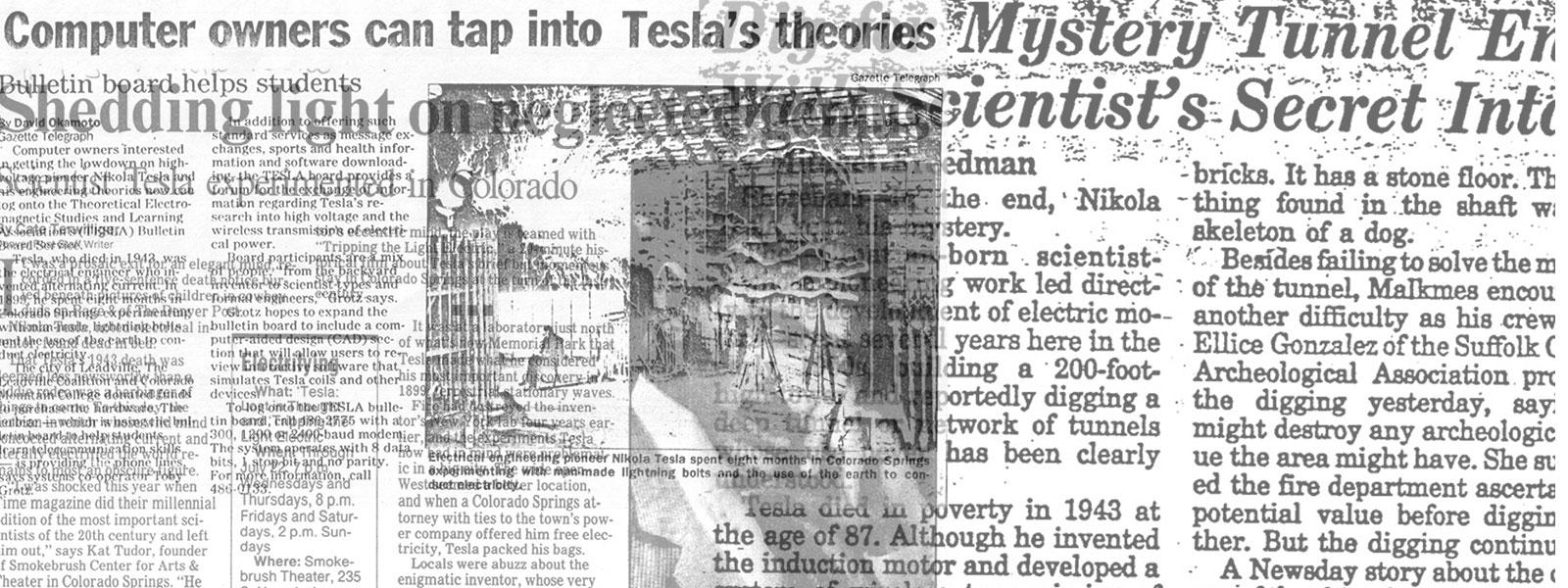
In 1899, Tesla spent eight months in Colorado Springs experimenting with man-made lightning bolts generated from enormous coils.
In his research, Tesla hit on what he thought was a revolutionary way to send electricity through the air.
"It's a technology that scares people because of its (global) implications," Grotz said.
Tesla's theories, Grotz explained, show that power can be sent around the earth without utility lines. Such technology, he added, would allow Third World countries to have access to electrical power, which now doesn't exist.
The project involves building a huge coil and a tower transmitter to fully test Tesla's theory. The undertaking could run four years at a 'bare-bones' cost of $1.2 million.
"The standard reaction is 'prove it,'" said Grotz. "It's technology that's never been done before except by Tesla in the 1890s."
Grotz joined three others in forming Tesla Inc., a non-profit company that hopes to recreate Tesla's coils. They want to confirm Tesla's theory that wireless electrical power can travel around the world with little loss of strength.
Grotz left jobs with Texas Instruments and Martin Marietta to work on contracts for his wireless engineering company. In his spare time, he can be found at his computer or on the telephone lobbying for funding for Project Tesla.
The project involves building a huge coil and a tower transmitter to fully test Tesla's theory.
The undertaking could run four years at a "bare-bones" cost of $1.2 million, Grotz said.
Tesla Inc. director Gardner Robertson, a retired engineer from Climax Mines in Leadville, said if the project is a success, the return could be $10 billion for the United States.
Robertson said the U.S. has the capacity to generate more power than is needed to sustain the country's electrical needs. Extra power, generated during low-demand night hours, could be sold to the parts of the world with daylight.
"Excess power that is idling at night unused could be used to feed their needs," Robertson said.
A Third World African country might then be able to tap into the vast water resources under the Sahara Desert, Robertson said.
Mary Estill Buchanan, former Colorado secretary of state, and technical writer James Sheppard have joined Grotz and Robertson in forming Tesla, Inc.
Grotz was involved in a similar project two years ago. He and physicist Robert K. Golka built the Tesla coil — 51 feet in diameter — in a vacant Climax warehouse.
But after a 150-foot tower was built to test the system, the project was cut short by a lack of funding.
Grotz is driven to see the project to completion, whether proving Tesla's theories or finding them unworkable.
"We're curious. We want to see if we could do it," Grotz said. "Tesla said he did it.
"I just always had the intuitive feeling the man wasn't a liar... It's become a quest to see how he did it. And if he did it, we'll do it again."