Nikola Tesla Articles
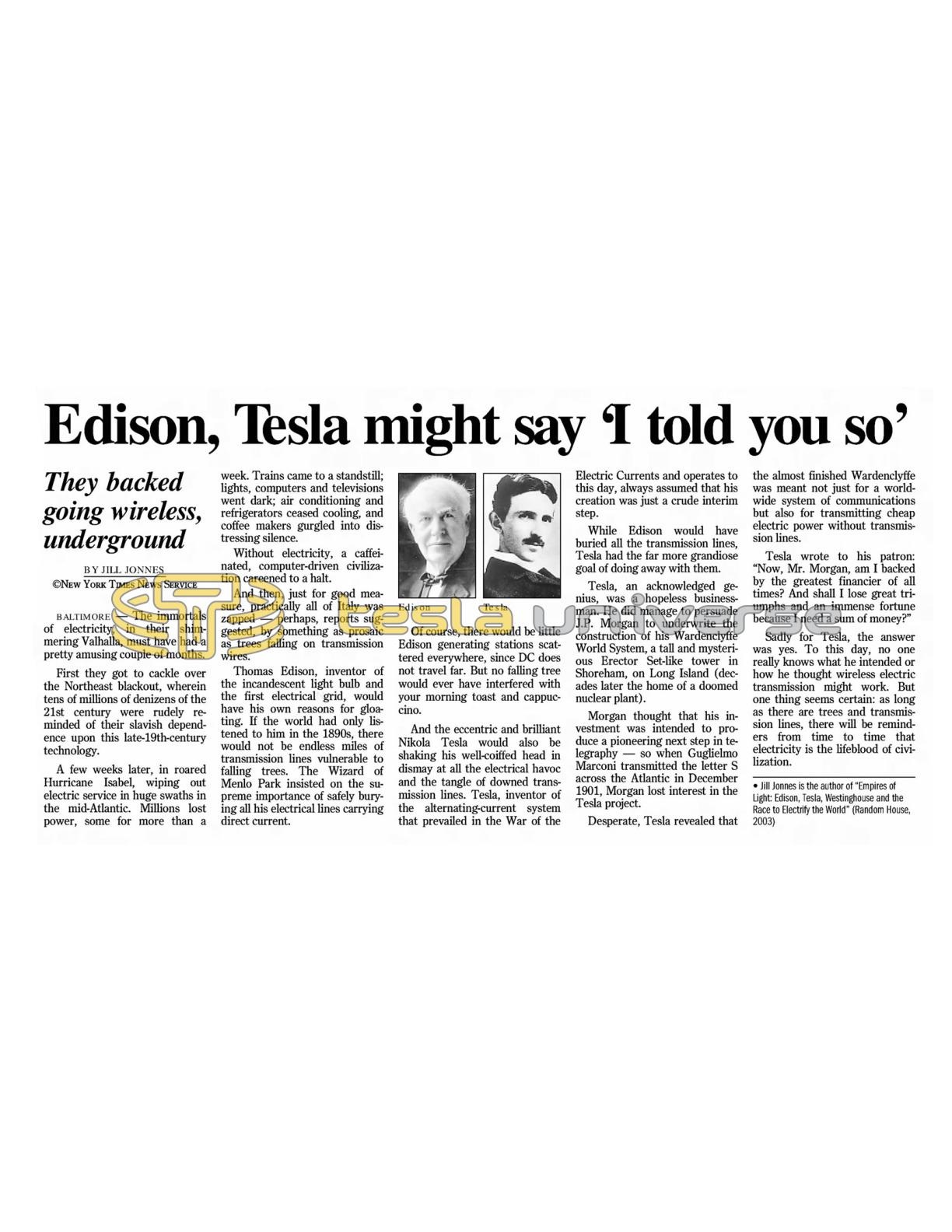
Edison, Tesla Might Say, "I Told You So"
They backed going wireless, underground
BY JILL JONNES
NEW YORK TIMES NEWS SERVICE
BALTIMORE — The immortals of electricity, in their shimmering Valhalla, must have had a pretty amusing couple of months.
First they got to cackle over the Northeast blackout, wherein tens of millions of denizens of the 21st century were rudely reminded of their slavish dependence upon this late-19th-century technology.
A few weeks later, in roared Hurricane Isabel, wiping out electric service in huge swaths in the mid-Atlantic. Millions lost power, some for more than a week. Trains came to a standstill; lights, computers and televisions went dark; air conditioning and refrigerators ceased cooling, and coffee makers gurgled into distressing silence.
Without electricity, a caffeinated, computer-driven civilization careened to a halt.
And then, just for good measure, practically all of Italy was zapped perhaps, reports suggested, by something as prosaic as trees falling on transmission wires.
Thomas Edison, inventor of the incandescent light bulb and the first electrical grid, would have his own reasons for gloating. If the world had only listened to him in the 1890s, there would not be endless miles of transmission lines vulnerable to falling trees. The Wizard of Menlo Park insisted on the supreme importance of safely burying all his electrical lines carrying direct current.
Of course, there would be little Edison generating stations scattered everywhere, since DC does not travel far. But no falling tree would ever have interfered with your morning toast and cappuccino.
And the eccentric and brilliant Nikola Tesla would also be shaking his well-coiffed head in dismay at all the electrical havoc and the tangle of downed transmission lines. Tesla, inventor of the alternating-current system that prevailed in the War of the Electric Currents and operates to this day, always assumed that his creation was just a crude interim step.
While Edison would have buried all the transmission lines, Tesla had the far more grandiose goal of doing away with them.
Tesla, an acknowledged genius, was a hopeless businessman. He did manage to persuade J.P. Morgan to underwrite the construction of his Wardenclyffe World System, a tall and mysterious Erector Set-like tower in Shoreham, on Long Island (decades later the home of a doomed nuclear plant).
Morgan thought that his investment was intended to produce a pioneering next step in telegraphy — so when Guglielmo Marconi transmitted the letter S across the Atlantic in December 1901, Morgan lost interest in the Tesla project.
Desperate, Tesla revealed that the almost finished Wardenclyffe was meant not just for a worldwide system of communications but also for transmitting cheap electric power without transmission lines.
Tesla wrote to his patron: "Now, Mr. Morgan, am I backed by the greatest financier of all times? And shall I lose great triumphs and an immense fortune because I need a sum of money?"
Sadly for Tesla, the answer was yes. To this day, no one really knows what he intended or how he thought wireless electric transmission might work. But one thing seems certain: as long as there are trees and transmission lines, there will be reminders from time to time that electricity is the lifeblood of civilization.
Jill Jonnes is the author of "Empires of Light: Edison, Tesla, Westinghouse and the Race to Electrify the World" (Random House, 2003)