Nikola Tesla Articles
Electric Propulsion of Canal Boats
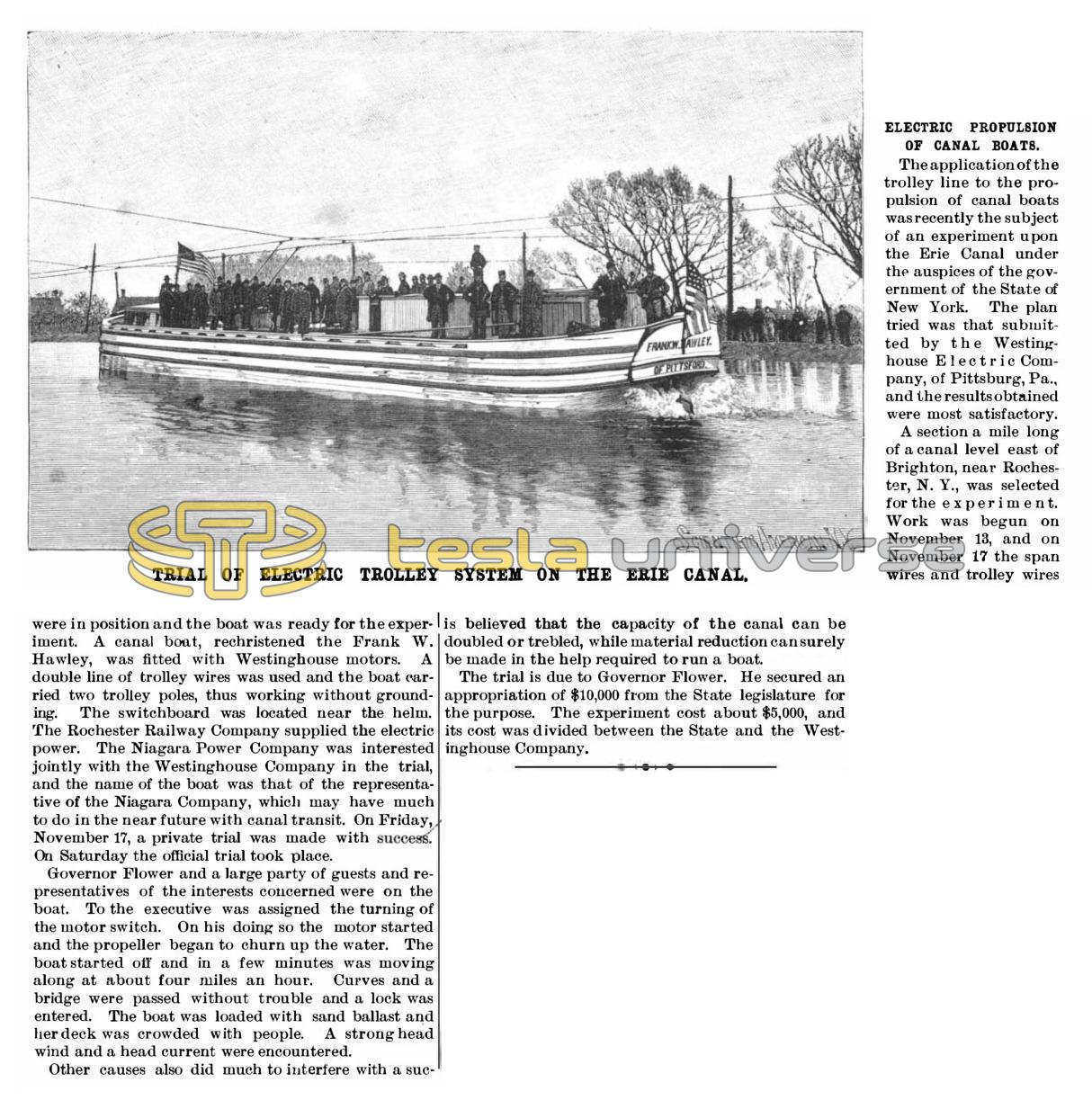
The application of the trolley line to the propulsion of canal boats was recently the subject of an experiment upon the Erie Canal under the auspices of the government of the State of New York. The plan tried was that submitted by the Westinghouse Electric Company, of Pittsburg, Pa., and the results obtained were most satisfactory.
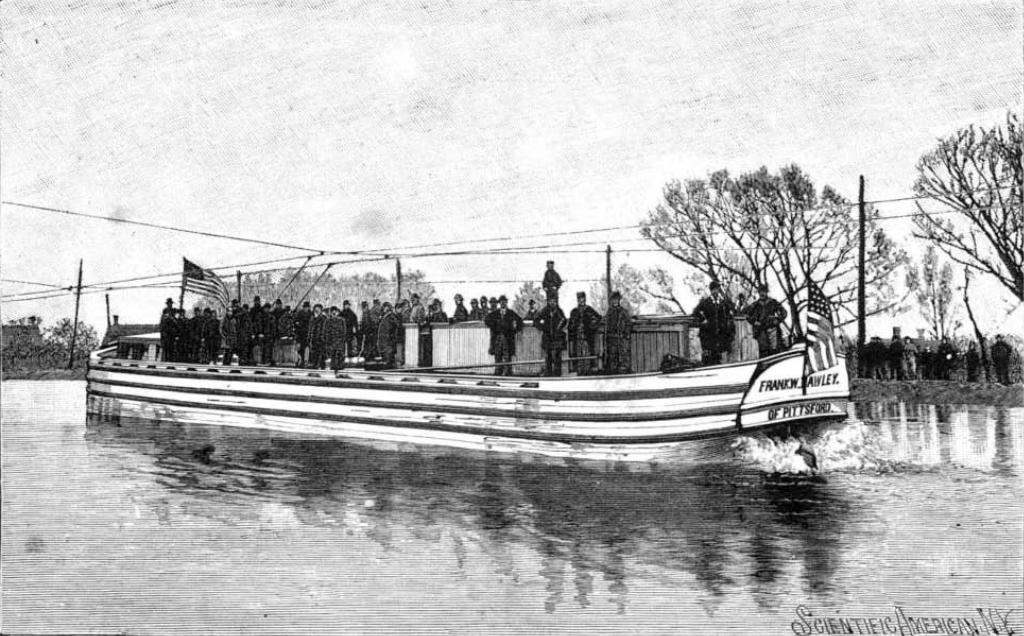
A section a mile long of a canal level east of Brighton, near Rochester, N. Y., was selected for the experiment. Work was begun on November 13, and on November 17 the span wires and trolley wires were in position and the boat was ready for the experiment. A canal boat, rechristened the Frank W. Hawley, was fitted with Westinghouse motors. A double line of trolley wires was used and the boat carried two trolley poles, thus working without grounding. The switchboard was located near the helm. The Rochester Railway Company supplied the electric power. The Niagara Power Company was interested jointly with the Westinghouse Company in the trial, and the name of the boat was that of the representative of the Niagara Company, which may have much to do in the near future with canal transit. On Friday, November 17, a private trial was made with success. On Saturday the official trial took place.
Governor Flower and a large party of guests and representatives of the interests concerned were on the boat. To the executive was assigned the turning of the motor switch. On his doing so the motor started and the propeller began to churn up the water. The boat started off and in a few minutes was moving along at about four miles an hour. Curves and a bridge were passed without trouble and a lock was entered. The boat was loaded with sand ballast and her deck was crowded with people. A strong head wind and a head current were encountered.
Other causes also did much to interfere with a successful trial, but it is believed that the capacity of the canal can be doubled or trebled, while material reduction can surely be made in the help required to run a boat.
The trial is due to Governor Flower. He secured an appropriation of $10,000 from the State legislature for the purpose. The experiment cost about $5,000, and its cost was divided between the State and the Westinghouse Company.