Nikola Tesla Articles
Energy for the Whole World
On the possibilities of a global system for the production and transmission of electrical energy
Today, a range of possibilities are being considered for ensuring the necessary quantities of electrical energy in the long term, and a global system for its production and transmission. By positioning three large artificial satellites at 38,000 km from Earth, which would be relatively stationary in relation to the Earth, platforms in space would be obtained. On these, in two phases for the near and distant future, stations of enormous power would be built for supplying the entire world with electrical energy. In the first phase, magnetohydrodynamic generators could be used for direct generation of electrical energy from heat, and in the second phase, these would be replaced by devices for controlled thermonuclear fusion. From these stations, energy would be directed to specific points on Earth using masers and lasers, where it would be converted and distributed to all points on Earth.
The problem of sufficient and inexpensive quantities of energy, primarily electrical energy, which could be transported to all points on Earth and made available under the same conditions to all people in the world, has become, and will be even more indispensable in the future, not only for the development of humankind but also a vital issue for the sustenance of civilization and the survival of people. The oil crisis in recent years has shown the potential consequences of energy shortages for the economy and the standard of living of people worldwide.
Conventional sources for the production and transmission of energy, which are currently in use or will be available for the next 20-30 years, no longer provide opportunities nor open the perspective for a real technical solution for producing electrical energy at a significantly lower cost than the current one, and in quantities tens and hundreds of times greater, in the distant future, for the next century and beyond.
Furthermore, current systems for transmitting electrical energy with alternating currents do not allow for the transmission of energy over thousands or tens of thousands of kilometers via long-distance lines due to known stability reasons, thereby precluding the possibility of intercontinental transmission of electrical energy. Moreover, even direct current transmission systems at very high voltages (which are still in the experimental phase), due to technical problems and cost, do not offer hope that this is the right solution, especially for the distant future.
As existing known sources for electricity generation (including atomic energy) cannot meet the needs for the near and distant future, it is necessary to seek new ways and opportunities to address this problem of humanity.
According to the current state of science and technology and the foreseeable outlook regarding the main sources for future electricity generation, the following would be considered:
a) controlled thermonuclear fusion of hydrogen isotopes into helium
b) direct utilization of solar energy, while other possibilities and sources would be marginal and local.
Regarding the production of electrical energy, a new quality in this field of technology would involve overcoming the indirect cycle for electricity generation, which is currently applied in production from solid, liquid, and gaseous fuels, and introducing procedures for direct generation of electrical energy from heat, thereby increasing the efficiency from the current approximately 40 percent (in modern power plants) to about 90 percent or more in the long term with direct processes.
Now it is more probable, unless something unforeseen and revolutionary happens in the meantime, that in the first phase, in the near future, a magnetohydrodynamic system for direct conversion of electrical energy will be applied for these purposes, and in the second phase, in the distant future, controlled thermonuclear fusion will be technically implemented. This should become one of the two main sources for direct electrical energy generation, and with a new system for electrical energy transmission, a solution to the problem will be obtained for the distant future for obtaining and transmitting electrical energy on Earth.
The transmission of electrical energy in such enormous quantities to every point on Earth will also be possible in the future in a completely new way. It will be wireless (the main energy conduits), and it will be achieved either by lasers or masers, or by highly concentrated electron beams of very high voltage to specific points on Earth (main distribution centers), from where local (terrestrial) distribution of electrical energy would be provided.
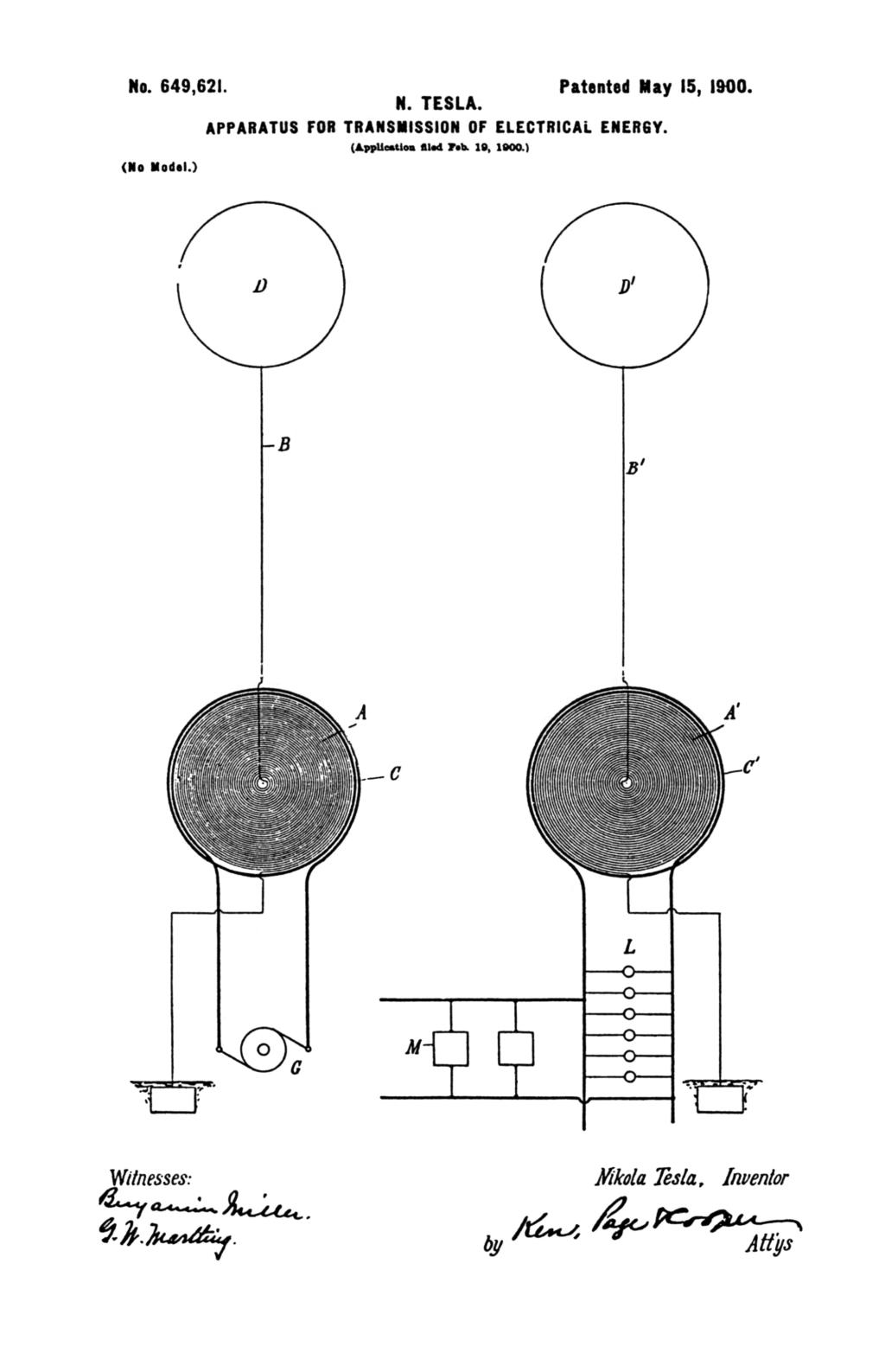
Such high demands in terms of quantities, technical level, economy, and technology of electrical energy transmission, as well as ecological conditions in the environment, require, in accordance with the presented, a new approach to the location and functioning of this future system for the production and transmission of electrical energy.
The total global amount of electrical energy for the entire world would be produced in three giant cosmic centers located on artificial satellite platforms at an altitude of 38,000 km. They would move at the same speed, but in the opposite direction from the Earth, and thus be stationary relative to it, and at the same time, with their position, cover all points on Earth.
The energy produced in these centers, by laser or maser beams, would be transported to specific receiving stations on Earth, where it would be converted into alternating currents of industrial or very high frequency, or direct currents, and then distributed to consumers by conventional means through waveguides.
The most suitable fuel for controlled thermonuclear fusion is a mixture of hydrogen isotopes deuterium and tritium. Deuterium is found in ordinary hydrogen at 0.015 percent, while tritium is currently obtained from water circulating in atomic reactors. While in conventional chemical combustion processes about 10-7 percent of mass is converted, and in fission, i.e., the splitting of heavy nuclei, it does not exceed 0.1 percent of mass, the conversion of mass into energy reaches 1 percent in controlled thermonuclear fusion.
However, for a spontaneous fusion process, as is known, extremely high temperatures of the order of 108 °C are necessary. Laboratories have today significantly approached this limit. It should be expected that all problems of controlled thermonuclear fusion will be solved by the end of this century in laboratories, while by the mid-21st century, technical application within broad frameworks could be realized, as it is first necessary to solve a series of scientific and technical problems in order to obtain new powerful and inexpensive systems for the production and transmission of electrical energy.
Another advantage of thermonuclear fusion energy sources is their cleanliness. There are no organic pollutants at all, while potential radioactive pollutants are significantly less dangerous and present to a much lesser extent than in fission (atomic) nuclear power plants.
Generators and other electrical machines and devices for converting electrical energy into mechanical energy and vice versa in these space stations, under conditions of almost absolute vacuum and absolute temperature, could be built much more economically, using the mechanical force of the mutual action of an electric field instead of the mechanical force of the mutual action of a magnetic field, which is exclusively used now.
Pavle JOVANOVIĆ,
Faculty of Electrical Engineering,
Sarajevo