Nikola Tesla Articles
Experiments with Alternating Currents of High Frequency - Lecture Abstract - Part 1
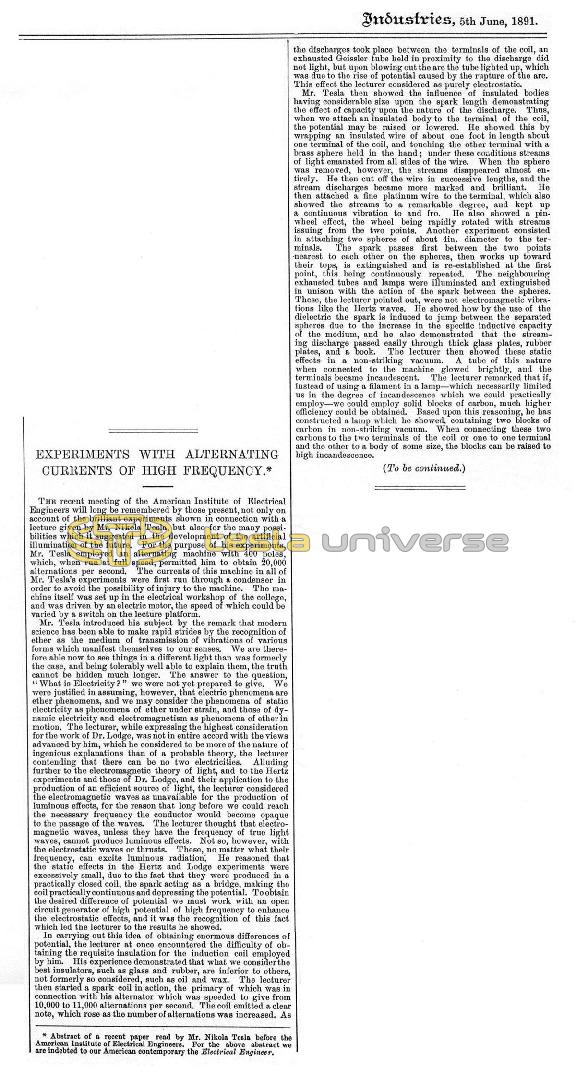
The recent meeting of the American Institute of Electrical Engineers will long be remembered by those present, not only on account of the brilliant experiments shown in connection with a lecture given by Mr. Nikola Tesla, but also for the many possibilities which it suggested in the development of the artificial illumination of the future. For the purpose of his experiments, Mr. Tesla employed an alternating machine with 400 poles, which, when run at full speed, permitted him to obtain 20,000 alternations per second. The currents of this machine in all of Mr. Tesla's experiments were first run through a condenser in order to avoid the possibility of injury to the machine. The machine itself was set up in the electrical workshop of the college, and was driven by an electric motor, the speed of which could be varied by a switch on the lecture platform.
Mr. Tesla introduced his subject by the remark that modern science has been able to make rapid strides by the recognition of ether as the medium of transmission of vibrations of various forms which manifest themselves to our senses. We are therefore able now to see things in a different light than was formerly the case, and being tolerably well able to explain them, the truth cannot be hidden much longer. The answer to the question, "What is Electricity?" we were not yet prepared to give. We were justified in assuming, however, that electric phenomena are ether phenomena, and we may consider the phenomena of static electricity as phenomena of ether under strain, and those of dynamic electricity and electromagnetism as phenomena of ether in motion. The lecturer, while expressing the highest consideration for the work of Dr. Lodge, was not in entire accord with the views advanced by him, which he considered to be more of the nature of ingenious explanations than of a probable theory, the lecturer contending that there can be no two electricities. Alluding further to the electromagnetic theory of light, and to the Hertz experiments and those of Dr. Lodge, and their application to the production of an efficient source of light, the lecturer considered the electromagnetic waves as unavailable for the production of luminous effects, for the reason that long before we could reach the necessary frequency the conductor would become opaque to the passage of the waves. The lecturer thought that electromagnetic waves, unless they have the frequency of true light waves, cannot produce luminous effects. Not so, however, with the electrostatic waves or thrusts. These, no matter what their frequency, can excite luminous radiation. He reasoned that the static effects in the Hertz and Lodge experiments were excessively small, due to the fact that they were produced in a practically closed coil, the spark acting as a bridge, making the coil practically continuous and depressing the potential. To obtain the desired difference of potential we must work with an open circuit generator of high potential of high frequency to enhance the electrostatic effects, and it was the recognition of this fact which led the lecturer to the results he showed.
In carrying out this idea of obtaining enormous differences of potential, the lecturer at once encountered the difficulty of obtaining the requisite insulation for the induction coil employed by him. His experience demonstrated that what we consider the best insulators, such as glass and rubber, are inferior to others, not formerly so considered, such as oil and wax. The lecturer then started a spark coil in action, the primary of which was in connection with his alternator which was speeded to give from 10,000 to 11,000 alternations per second. The coil emitted a clear note, which rose as the number of alternations was increased. As the discharges took place between the terminals of the coil, an exhausted Geissler tube held in proximity to the discharge did not light, but upon blowing out the arc the tube lighted up, which was due to the rise of potential caused by the rupture of the arc. This effect the lecturer considered as purely electrostatic.
Mr. Tesla then showed the influence of insulated bodies having considerable size upon the spark length demonstrating the effect of capacity upon the nature of the discharge. Thus, when we attach an insulated body to the terminal of the coil, the potential may be raised or lowered. He showed this by wrapping an insulated wire of about one foot in length about one terminal of the coil, and touching the other terminal with a brass sphere held in the hand; under these conditions streams of light emanated from all sides of the wire. When the sphere was removed, however, the streams disappeared almost entirely. He then cut off the wire in successive lengths, and the stream discharges became more marked and brilliant. He then attached a fine platinum wire to the terminal, which also showed the streams to a remarkable degree, and kept up a continuous vibration to and fro. He also showed a pinwheel effect, the wheel being rapidly rotated with streams issuing from the two points. Another experiment consisted in attaching two spheres of about 4in. diameter to the terminals. The spark passes first between the two points nearest to each other on the spheres, then works up toward their tops, is extinguished and is re-established at the first point, this being continuously repeated. The neighbouring exhausted tubes and lamps were illuminated and extinguished in unison with the action of the spark between the spheres. These, the lecturer pointed out, were not electromagnetic vibrations like the Hertz waves. He showed how by the use of the dielectric the spark is induced to jump between the separated spheres due to the increase in the specific inductive capacity of the medium, and he also demonstrated that the streaming discharge passed easily through thick glass plates, rubber plates, and a book. The lecturer then showed these static effects in a non-striking vacuum. A tube of this nature when connected to the machine glowed brightly, and the terminals became incandescent. The lecturer remarked that if, instead of using a filament in a lamp - which necessarily limited us in the degree of incandescence which we could practically employ - we could employ solid blocks of carbon, much higher efficiency could be obtained. Based upon this reasoning, he has constructed a lamp which he showed, containing two blocks of carbon in non-striking vacuum. When connecting these two carbons to the two terminals of the coil or one to one terminal and the other to a body of some size, the blocks can be raised to high incandescence.
(To be continued.)
*Abstract of a recent paper read by Mr. Nikola Tesla before the American Institute of Electrical Engineers. For the above abstract we are indebted to our American contemporary the Electrical Engineer.