Nikola Tesla Articles
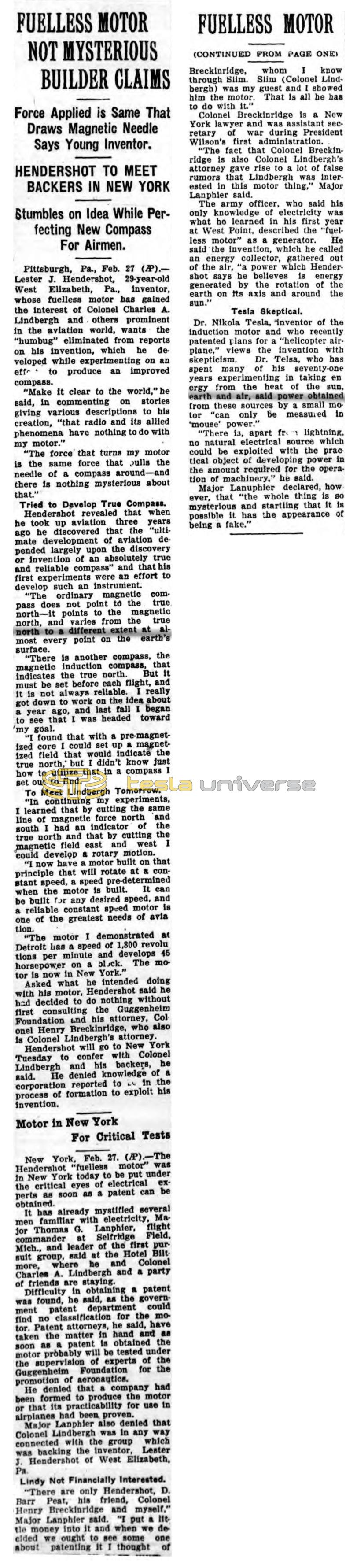
Fulless Motor Not Mysterious Builder Claims
Force Applied is Same That Draws Magnetic Needle Says Young Inventor.
HENDERSHOT TO MEET BACKERS IN NEW YORK
Stumbles on Idea While Perfecting New Compass For Airmen.
Pittsburgh, Pa., Feb. 27 (AP). — Lester J. Hendershot, 29-year-old West Elizabeth, Pa., inventor, whose fuelless motor has gained the interest of Colonel Charles A. Lindbergh and others prominent in the aviation world, wants the "humbug" eliminated from reports on his invention, which he developed while experimenting on an effort to produce an improved compass.
"Make it clear to the world," he said, in commenting on stories giving various descriptions to his creation, "that radio and its allied phenomena have nothing to do with my motor."
"The force that turns my motor is the same force that pulls the needle of a compass around — and there is nothing mysterious about that."
Tried to Develop True Compass.
Hendershot revealed that when he took up aviation three years ago he discovered that the "ultimate development of aviation depended largely upon the discovery or invention of an absolutely true and reliable compass" and that his first experiments were an effort to develop such an instrument.
"The ordinary magnetic compass does not point to the true north — it points to the magnetic north, and varies from the true north to a different extent at almost every point on the earth's surface.
"There is another compass, the magnetic induction compass, that indicates the true north. But it must be set before each flight, and it is not always reliable. I really got down to work on the idea about a year ago, and last fall I began to see that I was headed toward my goal.
"I found that with a pre-magnetized core I could set up a magnetized field that would indicate the true north, but I didn't know just how to utilize that in a compass I set out to find.
To Meet Lindbergh Tomorrow.
"In continuing my experiments, I learned that by cutting the same line of magnetic force north and south I had an indicator of the true north and that by cutting the magnetic field east and west I could develop a rotary motion.
"I now have a motor built on that principle that will rotate at a con- stant speed, a speed predetermined when the motor is built. It can be built for any desired speed, and a reliable constant speed motor is one of the greatest needs of aviation.
"The motor I demonstrated at Detroit has a speed of 1,800 revolutions per minute and develops 45 horsepower on a block. The motor is now in New York."
Asked what he intended doing with his motor, Hendershot said he had decided to do nothing without first consulting the Guggenheim Foundation and his attorney, Colonel Henry Breckinridge, who also is Colonel Lindbergh's attorney.
Hendershot will go to New York Tuesday to confer with Colonel Lindbergh and his backers, he said. He denied knowledge of a corporation reported to in the process of formation to exploit his invention.
Motor in New York For Critical Tests
New York, Feb. 27. (AP). — The Hendershot "fuelless motor" was in New York today to be put under the critical eyes of electrical experts as soon as a patent can be obtained.
It has already mystified several men familiar with electricity, Major Thomas G. Lanphier, flight commander at Selfridge Field, Mich., and leader of the first pursuit group, said at the Hotel Bilt- more, where he and Colonel Charles A. Lindbergh and a party of friends are staying.
Difficulty in obtaining a patent was found, he said, as the government patent department could find no classification for the motor. Patent attorneys, he said, have taken the matter in hand and as soon as a patent is obtained the motor probably will be tested under the supervision of experts of the Guggenheim Foundation for the promotion of aeronautics.
He denied that a company had been formed to produce the motor or that its practicability for use in airplanes had been proven.
Major Lanphier also denied that Colonel Lindbergh was in any way connected with the group which was backing the inventor, Lester J. Hendershot of West Elizabeth, Pa.
Lindy Not Financially Interested.
"There are only Hendershot, D. Barr Peat, his friend, Colonel Henry Breckinridge and myself," Major Lanphier said. "I put a little money into it and when we decided we ought to see some one about patenting it I thought of Breckinridge, whom I know through Slim. Slim (Colonel Lind- bergh) was my guest and I showed him the motor. That is all he has to do with it."
Colonel Breckinridge is a New York lawyer and was assistant secretary of war during President Wilson's first administration.
"The fact that Colonel Breckinridge is also Colonel Lindbergh's attorney gave rise to a lot of false rumors that Lindbergh was interested in this motor thing," Major Lanphier said. The army officer, who said his only knowledge of electricity was what he learned in his first year at West Point, described the "fuelless motor" as a generator. He said the invention, which he called an energy collector, gathered out of the air, "a power which Hendershot says he believes is energy generated by the rotation of the earth on its axis and around the sun."
Tesla Skeptical.
Dr. Nikola Tesla, inventor of the induction motor and who recently patented plans for a "helicopter airplane," views the invention with skepticism. Dr. Tesla, who has spent many of his seventy-one years experimenting in taking en- ergy from the heat of the sun, earth and air, said power obtained from these sources by a small motor "can only be measured in 'mouse' power."
"There is, apart from lightning, no natural electrical source which could be exploited with the practical object of developing power in the amount required for the operation of machinery," he said.
Major Lanuphier declared, however, that "the whole thing is so mysterious and startling that it is possible it has the appearance of being a fake."
Reprints
- Los Angeles on Unheralded Non-Stop Trip to PanamaEvening Leader — February 27th, 1928