
Nikola Tesla Articles
Harnessing the Lightning - Tesla's Latest Marvel
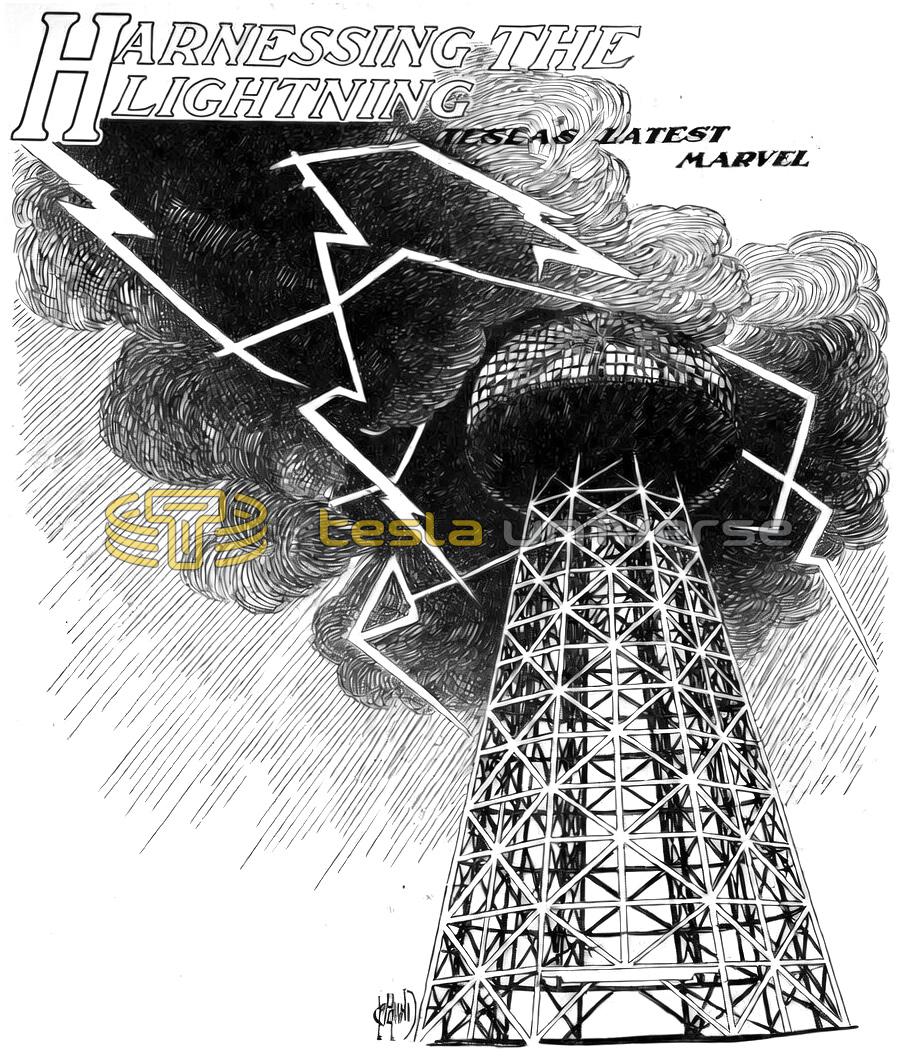
Nikola Tesla, in recent conversations with the writer, recounted many marvelous things he was about to perform. In discussing possible electrical achievements, he pointed out many other things which would surely follow the putting into operation of the great plant that he is now building at Wardenclyffe, L. I., that is designed to send telegraph and telephone messages as well as power to all parts of the world.
These statements were so startling that they come from another source, one would naturally consider them the vaporings of a wandering mind. If he can accomplish what he is undertaking, his work will in future centuries overshadow the greatest names of the past.
Naturally the question arises, is he on the right track, or is he the one who is mistaken in his conceptions and merely believes that he can accomplish impossibilities? His early achievements are such as to command respect for his judgment.
In recent years, by some, he has been denounced as visionary in the public press and as one who has made promises he cannot fulfill. However, the attacks of incompetent critics who know but little of the subject are not sufficient to discredit a man of Tesla's attainments.
In recent years, by some, he has been known as visionary in the public press and as one who has made promises he cannot fulfill. However, the press is full of incompetent critics who are willing to pass judgment on, but who lack technical knowledge sufficient to discredit such a man as Tesla.
A recent number of the Electrical Engineer, appears a communication from his pen, making public, for the first time, the great work in which he is engaged. In the same paper he has given a number of strong hints at the uncovered data and the line of research which have led him to his present conclusions. The facts he has given enable one to connect his present work with his earlier published statements and experiments, and to form a reasonable estimate as to his probable success. This is as such an end in view.
This his communication is an illustration of the great tower 180 feet high, with a nearly a hundred feet in diameter, which is erecting on Long Island for the purpose of sending telegraph and telephone messages to all parts of the world, even to a small way, or of transmitting power to any point in the world. To build such a plant calls for great expenditure of labor and money, and it is not certain that with a plant of this nature completed, much time should pass before the promises could be fulfilled. He is confident that he will be able to have this completed and in operation next year. In his article he says he is indebted to the noble generosity of Mr. J. Pierpont Morgan for the financial assistance that has enabled him to do this and, further, that the Canadian Niagara Power Company is furnishing the facilities to put in operation a generating plant of 100,000 horse power, which under contract is now enabled to produce current with safety. He says:
"Energy will be collected all over the globe, preferably in small amounts, representing a fraction of one to a few horsepower." One of its chief uses will be the illumination of isolated houses. It takes very little power to light a dwelling with vacuum tubes operated by high frequency currents, and in each instance a terminal a little above the roof will be sufficient. Another valuable application will be the driving of clocks and such other apparatus. These clocks will be exceedingly simple, will require absolutely no attention, and will indicate rigorously correct time. The idea of impressing upon the earth American time is fascinating and very likely to become popular. There are innumerable devices of all kinds which are either now employed or can be supplied, and by operating them in this manner I may be able to offer a great convenience to the whole world, with a plant of no more than 10,000 horse-power. The introduction of this system will give opportunities for invention and manufacture such as have never presented themselves before. I am hopeful that these great realizations are not far off, and I know that when this first work is completed they will follow with mathematical certitude.
"When the great truth accidentally revealed and experimentally confirmed is fully recognized, that this planet, with all its appalling immensity, is to electric currents virtually no more than a small metal ball, and that, by virtue of this fact, many possibilities, each baffling imagination and of incalculable consequence, are rendered absolutely sure of accomplishment; when the first plant is inaugurated and it is shown that a telegraphic message, almost as secret and noninterferable as thought, can be transmitted to any terrestrial distance, the sound of the human voice, with all its intonations and inflections, faithfully and instantly reproduced at any other part of the globe, the energy of a waterfall made available for supplying light, heat, or motive power, anywhere — on sea, on land, or high in the air — humanity will be like an ant heap stirred up with a stick. See the excitement coming!"
In other parts of his article he says that his "system involves the employ- ment of a number of plants like the one which he is now erecting, all of which are capable of transmitting individualized signals to the uttermost confines of the earth. Each of them will be preferably located near some important center of civilization, and the news it receives through any channel will be flashed to all points of the globe. A cheap and simple device, which might be carried in one's pocket, may then be set up anywhere on sea or land, and it will record the world's news, or such special messages as may be intended for it. Thus the entire earth will be converted into a huge brain, as it were, capable of response in every one of its parts. Since a single plant of but 100 horse-power can operate hundreds of millions of instruments the system will have a virtually indefinite working capacity, and it must needs immensely facilitate and cheapen the transmission of intelligence."
Can he do this? What evidence is there that he knows whereof he speaks? Let us study him and from his past statements and accomplishments see if it is probable.
Personally, he is a charming man to meet; high in his ideals, and one who carries with him conviction as to his sincerity of purpose and honesty of opinion. He has passed forty years of age. He was born in Austria-Hungary, east of the Adriatic Sea, not far from Turkey. Нe entered college with the intent of becoming a mathematical physicist. He completed an engineering course. He afterwards studied languages and philosophy at Prague and Budapest. He holds degrees of Doctor of Law and Master of Arts from Columbia and Yale. He has been repeatedly decorated in foreign countries. He has been a co-worker with Edison. He invented what is termed in electrical parlance the principle of the rotary magnetic field, upon which is de- pendent all the present systems of long distance transmission of power by electricity, involving hundreds of millions of invested capital. During the eighties he was engaged in designing for the Westinghouse Company their modern types of alternating current machinery, and much of the success of that great company was dependent upon his work. About 1889 he began laboratory work on his own behalf, and shortly thereafter he evolved a wonderful instrument which he called an electric oscillator. It enabled him to send millions of powerful pulsations of electricity backward forward through a wire in a second's time. With this instrument at his and command, he was enabled to perform feats with electricity that were almost undreamed of by other electricians. It has developed into what he now designates "a high potential magnifying transmitter." He delivered lectures in 1892 and 1893 before various scientific bodies, and performed many wonderful experiments. Without a return circuit, from the end of a single wire, he caused incandescent lights to glow, metals to melt, electric motors to operate, vacuum tubes to give off light, and phosphorescent bodies to emanate remarkable glows. He even caused metallic masses to remain suspended in mid-air, through electric forces, and not magnetic. He made streams of light to flow from his body while a current propelled by 200,000 volts of electric pressure and alternating one million times a second was passing through his body, and he thus proved that currents of this nature were harmless, at a time when other electricians would have pronounced them deadly. At that time, in the popular press, he was called a wizard, and he might equally well have been called a prophet, for the writer finds in Tesla's published lecture of February 24, 1893, before the Franklin Institute, the following language referring to wireless telegraphy, then unknown to the world:
"My conviction has grown so strong that I no longer look upon this plan of intelligence transmission as a mere theoretical possibility, but as a serious problem in electrical engineering which some day must be carried out. The idea of transmitting intelligence without wires is the natural outcome of the most recent results of electrical investigation."
Preceding this statement, he said he knew full well that the great majority of scientific men would not believe that such results could be practically realized."
In the same lecture Tesla, in effect, suggests that if, as he had demonstrated light, heat, and power could be taken off from the end of a single conductor, without a return circuit, why might not the earth be that conductor? His statement was not then considered visionary. In one aspect Tesla, and all electricians, view electricity as an incompressible fluid, and all electrical conductors have definite capacities for this fluid, just as a tumbler and a hollow globe have definite capacities for water. In connection with his suggestion to use the earth as a conductor, in February, 1893, Tesla published, in effect, that it was necessary to know the capacity of the earth for electricity before the problem could be attacked intelligently. Referring to this, quoting him literally, he says:
"It is difficult to say whether we shall ever acquire this necessary knowledge, but there is hope that we may, and that is by means of electrical resonance. If ever we can ascertain at what period the earth's charge, when disturbed, oscillates with relation to an oppositely electrified system or known circuit, we shall know a fact possibly of the greatest importance to the welfare of the human race."
This statement is somewhat as if a mechanical engineer were saying: "If I know the strength of a steel wire I can calculate the span of a safe bridge which can be constructed with such wire. It merely means that to produce definite results it was necessary to know the earth's capacity and its natural period of electric vibration in order to adjust the impulses of electric fluid from his oscillator to the same and design them of the proper magnitude or volume. To cause a boy's swing to swing it must be pushed at just the right periods of time, and the magnitude of the push must be adjusted to the size of the swing. Then each succeeding push gives to the swing a longer sweep. In Tesla's idea the world's electric charge is his swing, and his oscillator is the boy first pulling then pushing it.
Now, eleven years later, in his article just published, he says, referring to his work at Colorado Springs in 1899:
"It was on the third day of July — the date I shall never forget — when I obtained the first decisive experimental evidence of a truth of overwhelming importance for the advancement of humanity. A dense mass of strongly charged clouds gathered in the west, and towards evening a violent storm broke loose which, after spending much of its fury in the mountains, was driven away with great velocity over the plains. Heavy and long persisting arcs (lightning flashes) formed almost at regular intervals of time. My observations were now greatly facilitated and rendered more accurate by the experiences already gained. I was able to handle my instruments quickly, and I was prepared, the recording apparatus being properly adjusted." (He had instruments adjusted to observe movements of electricity in the earth.) "Its indications became fainter and fainter with the increasing distance of the storm until they ceased altogether. I was watching in eager expectation. Surely enough, in a little while the indications again began, grew stronger and stronger, and after passing through a maximum, gradually decreased and ceased once more. Many times in regularly recurring intervals, the same actions were repeated until the storm which, as evident, from simple calculation, was moving with nearly constant speed, had retreated to a distance of about 300 kilometers," (186 miles) "nor did these strange actions stop them, but continued to manifest themselves with undiminished force. No doubt whatever remained. I was observing stationary waves.
"As the source of disturbance moved away, the receiving circuit came successively upon their nodes and loops. Impossible as it seemed, this planet, despite its vast extent, behaved like a conductor of limited dimensions. The tremendous significance of this fact, in the transmission of energy by my system, had already become quite clear to me. Not only was it practicable to send telegraphic messages to any distance without wires, as I recognized long ago, but also to impress upon the entire globe the faint modulations of the human voice, far more, still, to transmit power in unlimited amounts, to any terrestrial distance and almost without any loss."
In these words he has told us, who have been uninitiated, where he has caught the link that was missing in 1893. The passing thunder storm gave him a measure of the period of the electric vibration through the globe and showed him the comparative smallness of the push required. In popular language, he has told the public, in former publications, that he had detected what might be called an electric echo from the far side of the globe. This language seems so absurd that it is not surprising he should have been thought chimerical.
In his lecture before the Franklin Institute, in 1893, he made the following statement, without any equivocation:
"I think that beyond doubt it is possible to operate electrical devices in a city (without wires) through the ground or pipe system by resonance from an electrical oscillator located at a central point."
In 1899, at Colorado Springs, he accomplished this in a very marked degree. About his laboratory he placed incandescent lamps merely connected by single wires with the ground, and through his oscillator, located at a distance, he lighted these, thus making good his forecast.
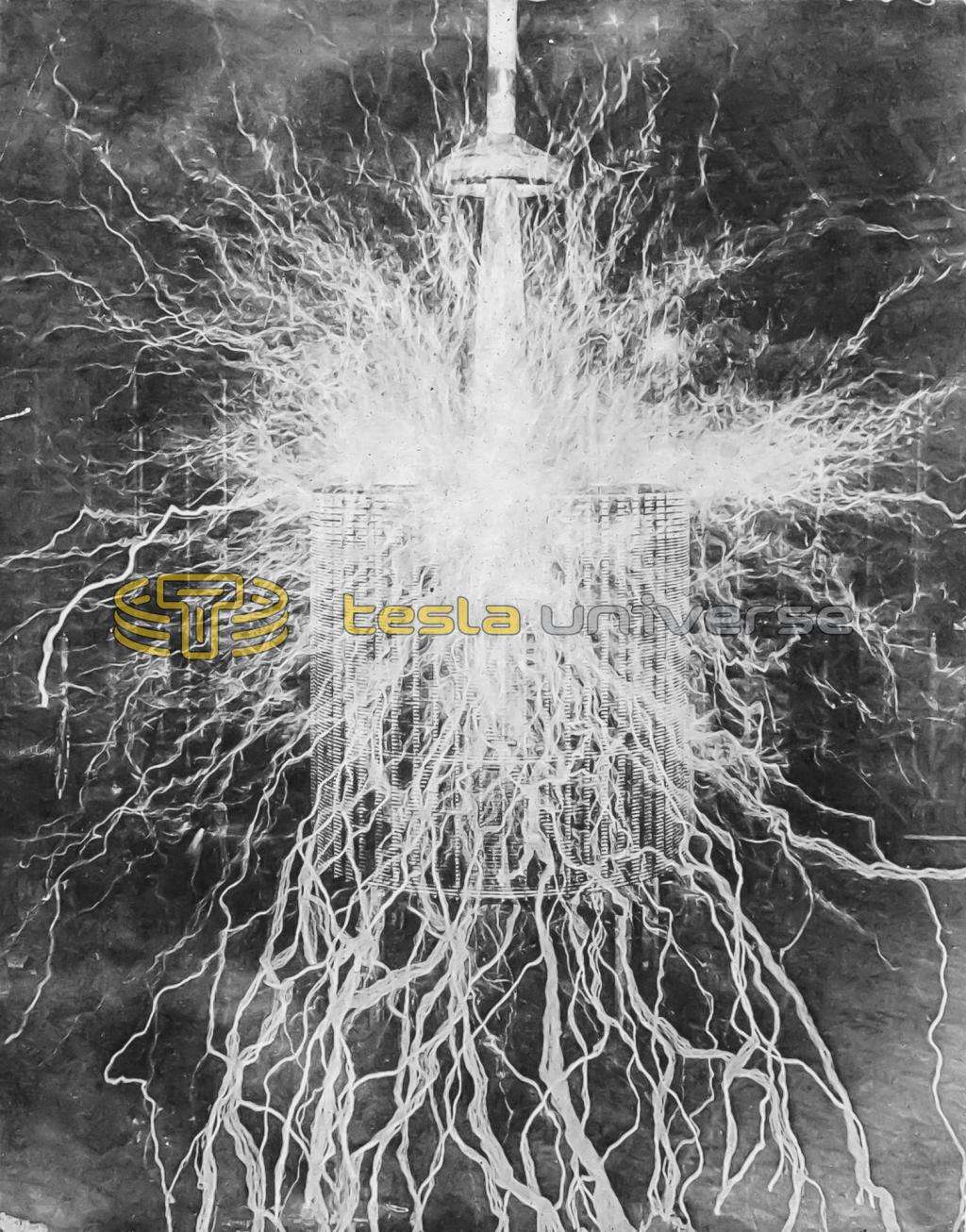
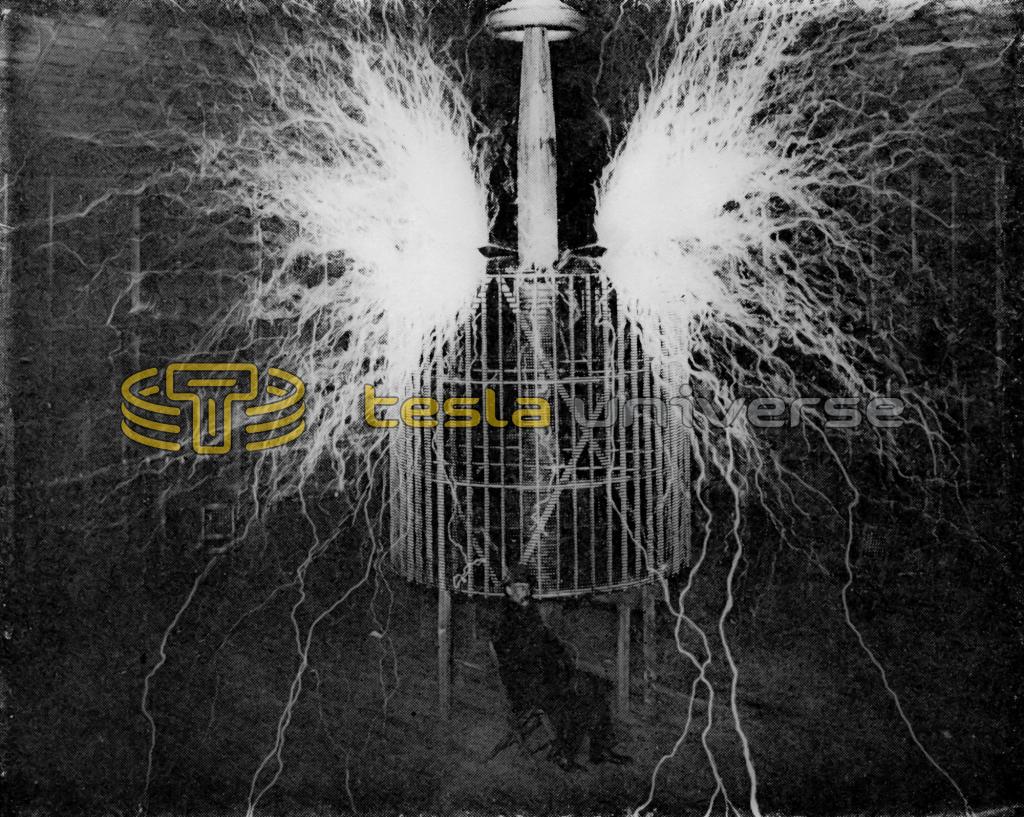
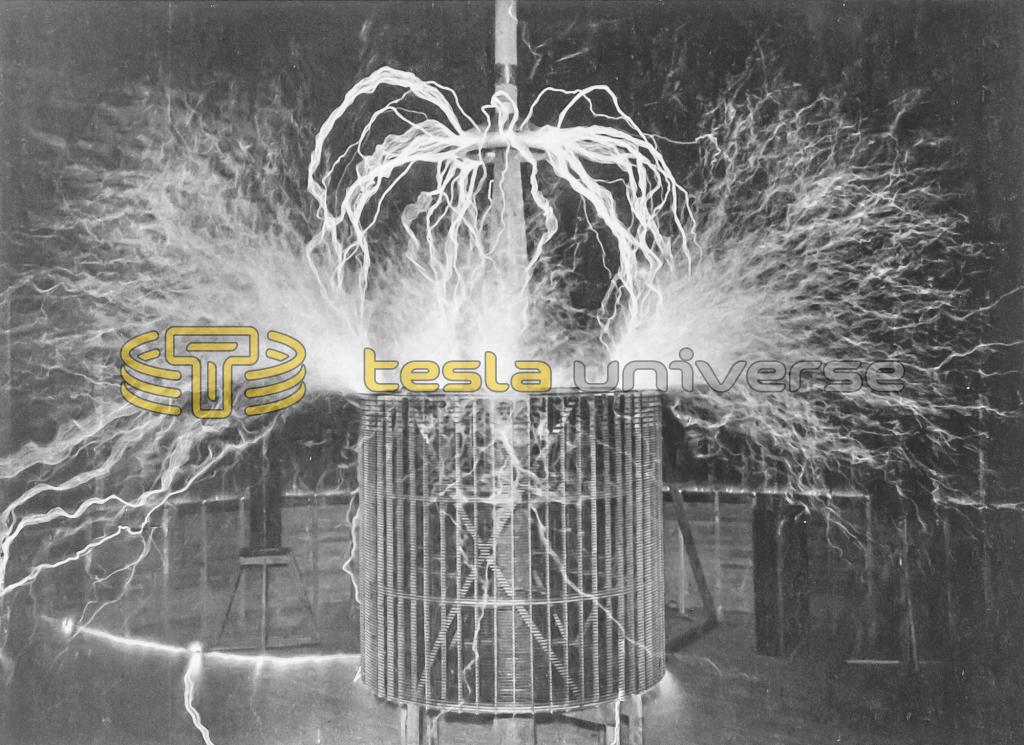
At this time, in 1899, he had so far developed his electric oscillator that he could produce, with its aid, very respectable flashes of lightning. He produced electrical discharges whose paths were fully 100 feet long, and in his description of them he stated that it would not be difficult, with greater power, to produce them 10,000 feet long.
In the June number of the Century Magazine for 1900 are illustrated masses of electric flame produced by him, sixty-five feet across their base, and nearly of equal height. These were secured by the aid of one of his electric oscillators giving him pulsating currents of 12,000,000 of volts, the electric pressure alternating from end to end of his wire 100,000 times a second. At this time he jumped sparks into a large electrical receiver over a distance of twenty-two feet, backward and forward, at the rate of 100,000 oscillations a second, so fast that they appeared continuous. These discharges escaped with a deafening noise and created such a commotion of the electricity which always charges the earth that sparks an inch long could be drawn from a water main at a distance of 300 feet from his laboratory. His electrical oscillations at this time would deliver energy at the rate of 75,000 horsepower during the infinitesimal time of each single pulsation. In other words, he stores up energy between these pulsations and in effect, during each pulsation he shoots it through his conductor or into the earth. Referring to these electric discharges of energy at Colorado Springs, Tesla states, in his Century article:
"The explosion of dynamite is only the breath of a consumptive as compared with its discharge." This acts as a single push against the world's electric charge, in Tesla's swing.
In the plant he is building at Long Island, he now informs us, his facilities will enable him to deliver energy, during the short time of one of these oscillations, at the rate of 10,000,000 of horsepower. This is 133 times greater than he was able to do at Colorado Springs, and he informs us that he can now control currents of 100,000,000 volts, which is 8.3 times greater electric pressure than he employed at Colorado Springs. This indicates that instead of producing arcs whose paths are 100 feet long, he can now produce them with paths 833 feet long, and the other Colorado Springs manifestations can all be correspondingly magnified. It will not be surprising if these displays should stir up the ant hill of Manhattan Island, and those who follow this subject, as the writer is doing, may look with interest for the outcome.
If Tesla can control and impress upon the world's electric charge, quivering energy designed to affect instruments adjusted to respond to quivers of particular periods of vibration, and if he finds the world acts electrically as though it were a comparatively small metal ball attached to the end of a wire, why may he not perform, from its surface, the same experiments, refined and magnified, with which he startled his audiences in the nineties? The world as his conductor will be of such low resistance that losses in the same, due to heating, will be zero, and his transmission of energy, for all terrestrial distances, would be through a conductor or medium which is perfect.
In the early 70's, it called for such minds as Charles F. Brush, Sir William Thompson, or Thomas A. Edison, even faintly to outline what would be accomplished in electrical science and arts, before the close of the nineteenth century. Now, at the dawn of the twentieth century, it is equally true that the future achievements in electrical science can only be faintly forecasted by brilliant, inventive minds that occupy pinnacled positions as to present knowledge. The education, training, and achievements of Nikola Tesla prove him to occupy such a position, hence it behooves his critics who do not occupy the same vantage ground to allow reasonable time for demonstration, before stating that Tesla's point of view has led to his seeing distorted images.
Even approximately correct forecasts, based on broad knowledge, give proper directive force to humanity's inventive ability, and while such forecasts may appear chimerical when made, they are of the greatest value in stimulating endeavor in proper directions.
Tesla informs the writer that he has "gained a profound conviction that a great principle has shaped this world just so that men might perform wonders now inconceivable, for if the world were but a trifle different even the few marvels," seen by him, "would be impossible."
May not this be so? Through the process of evolution, humanity has been placed in adjustment to the laws of Nature? Were the one simple fact in Nature that water attains its maximum density at 39 degrees Fahrenheit, different (a case where nature seems to overstep its ordinary chemical rules), and were the maximum density of water at water's freezing point, as one would naturally expect, all the fresh water bodies of our temperate zones would freeze in winter to their bottoms. Then the configuration of the globe would have been altered, and even the possibility of human life would have been absent from the history of this world. Real inventions are only possible when the mental creation of the inventor proves to be in harmony with natural law, and such inventions, when they are necessities, are in themselves a part of the evolutionary process, where development is an adjustment to environment.
ALFRED H. COWLES.
