Nikola Tesla Articles
How Tesla Evolved Epoch-Making Discoveries
Electrical Genius Intends to Revive Plan for World-Wide Distribution of Wireless Power Halted by War — Has Made Millions Only for Purpose of Spending Them on Working Out His Monumental Scientific Triumphs
By Kenneth M. Swezey
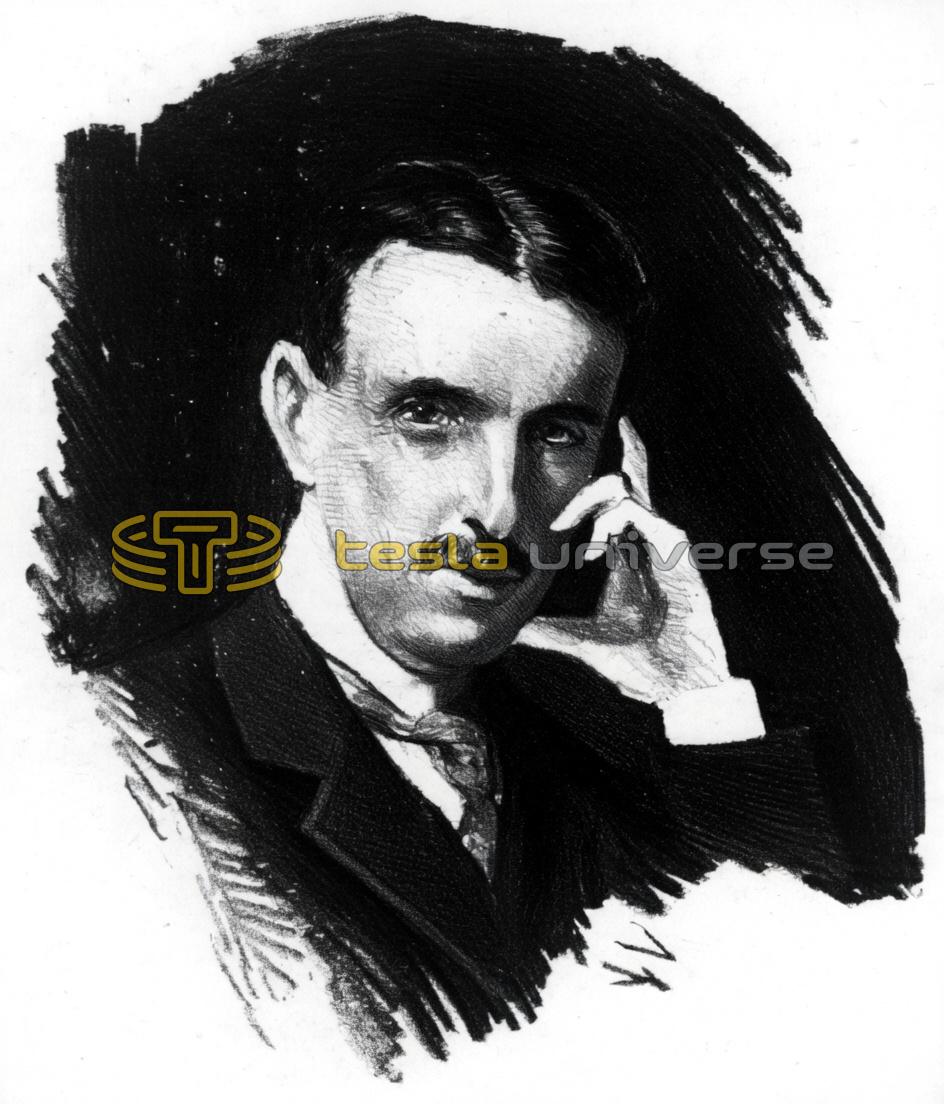
Protecting himself from the multitude simply by losing himself in the heart of the biggest city in the world, a person much misunderstood — yet considered by many capable minds as the greatest inventor of all time — still plunges courageously through the vast uncharted realms of the science of a century hence. I speak of Nikola Tesla, who has been conceded the most prolific inventor of original theories and applications that the annals of the world have ever recorded.
Perhaps Tesla's name is not today the household byword it is twenty years ago, because his most important inventions are grounded so deeply in the technicalities of fundamental principles. It is difficult to realize that his induction motors and systems of power transmission alone represent an investment of over $50,000,000,000 throughout the world; and that radio broadcasting, the harnessing of water power on the tremendous scale that it is being done at Niagara, subways, electric railways, electric battleship drive, high-frequency electro-therapeutics and wireless telautomata were made possible and practical by his basic researches. If you happen to be the proud owner of one of the eighteen or twenty highest class motorcars that are made, you will meet an example of the versatile Tesla in the Waltham speedometer, which is the only one of its type in the world.
To go from the abstract to the personal, let us visit this man whose genius has already become classic and get better acquainted.
We meet a tall, angular gentleman — as spry and alert as a man of forty, despite his sixty-nine winters — with deep-set brown eyes and an unmistakably European graciousness. Upon shaking hands the formerly distant Tesla becomes at once cordial and friendly and conversation proceeds thenceforth spontaneously and often vehemently, modulated to suit the occasion by accent and gesture.
Soon we recognize we have met with a perfectly human man with extraordinary capabilities. We talk of Einstein, the wireless transmission of electrical power, of philosophy, psychology; the possibilities of communication with Mars, of genius. Then conversation turns to simpler things — diet, exercise, fashion or the latest movie. There is seriousness coupled with a much here and there of keen humor; and, most astonishing of all, we discriminate the seemingly paradoxical interweaving of scientific learning and precision with the imagination and intuition of an artist. We have the dreamer and doer blended into a single harmonious whole.
Tesla is an absolute celibate, as were Newton, Michelangelo and a host of other eligibles to a peculiar universality of thought. He believes, as Sir Francis Bacon did, that the most enduring works of achievement have come from childless men who have devoted their lives to posterity and endowed it with the offspring of their minds. The measure in which he has thus far personally succeeded was intimated by the late Lord Kelvin, who once said that Tesla had contributed more to electrical science than any man up to his time.
In the early days the going was rough and thorny. As a boy, in Smiljan, Serbia, Tesla was unusually vacillating. His will was weak and all his good resolves were broken as easily as they were made. Fear and natural superstition played havoc with his peace of mind. Death from illness and accident, came desperately close to him on several occasions.
But finally, while still in his early youth, a tremendous reaction came. I believe the change hinged around the reading of an inspiring book. But whatever was the cause, the boy Tesla completely mastered himself and re-ordered his life. He built up his body, strengthened his will, and cut out, one by one, every single thing that would confuse his mind or drag on his vitality. His black coffee and boyhood cigars, most of his diversions, and much friendly intercourse were abruptly discarded. By diet and exercise — particularly walking — he so ordered his physical system that it functioned almost entirely automatically, leaving his mind entirely free to devote to his higher aspirations.
After having graduated in mechanical engineering from a university in Prague, and possessing as a sideline a broad background of art and literature and a working knowledge of sixteen languages, Tesla came to America design some motors for Edison. However, his genius soon broke loose, and, leaving Edison, he started on the creation and perfection of the principles and apparatus which will preserve his name for all time.
The induction motor and systems of alternating current distribution having been developed, the late George Westinghouse was so impressed with the young inventor that he offered him a third interest in his great company in addition to a salary of $50,000 a year, if he would work for him. But Tesla felt that for remarkable revenue from commercial pressure, and he did not accept.
Then he turned his mind to wireless communication and the wireless transmission of power. First he tried to send currents by using the ground as one wire and the upper rarefied air as a return. In developing appa- ratus to produce the high voltages necessary for efficient operation, he invented the resonance transformer, or Tesla coil. And in getting this to work properly he evolved the four tuned circuits which all radio apparatus has used to this day.
This system of power transmission worked, but was by no means an ultimate, and the inventor was not satisfied. He could not fall back on Hertzian waves because they were extravagant wasters of energy. Even when Marconi seemed later to get results between two nearby points, he yet believed the theory to be misleading.
In 1897 he launched a model vessel that could be completely controlled by any form of radiant energy wave that is known today. It could be operated from anywhere and was absolutely interference-proof — sparks seven feet long jumping directly to the hull without in the least affecting the waves that were intended for its control. This was the beginning of the science of radiodynamics, and though this ship has been imitated it has never been surpassed.
A few years later Tesla announced that he had invented a new system and that he had actually sent currents sufficient to light two hundred incandescent lamps without connecting wires around the entire globe. The lay public marvelled, but science only put on a sarcastic smile. “Why don’t this young inventor be rational and try things first on a smaller scale, such as, say, across the Atlantic ocean, before he tries to send impulses around the world? was the note the scientific papers were voicing.
However, Tesla knew what he was about; he had developed a theory and equipment that was a radical departure from any systems before used or even suggested. It forgot entirely distance — and — strangely enough in those days — it had no particular receiving station. The impulses were to be broadcast, in the true sense of the term, and receiving stations were to be located at any portion of the earth at which they were needed.
He felt keenly, though, the sting of comment, and he decided for all time that he would avoid prophetic publicity and that he would talk publicly about an invention only after it had met with success in practical use. So for about ten or a dozen years he dropped almost completely from public attention. For twelve years the drawings and specifications of his greatest invention lay in the sanctums of the patent office awaiting their approval as being absolutely basic. They were found to be, and in 1914 a veritable patent was granted.
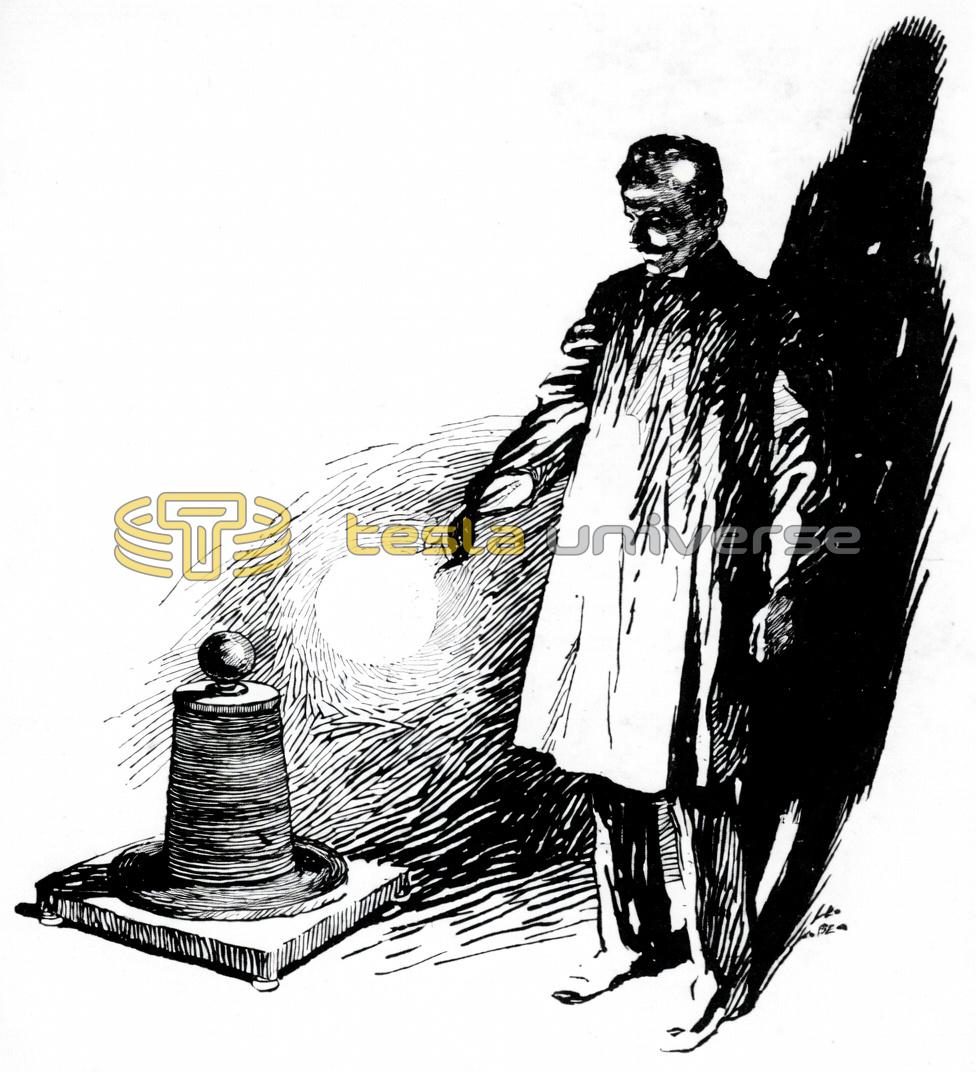
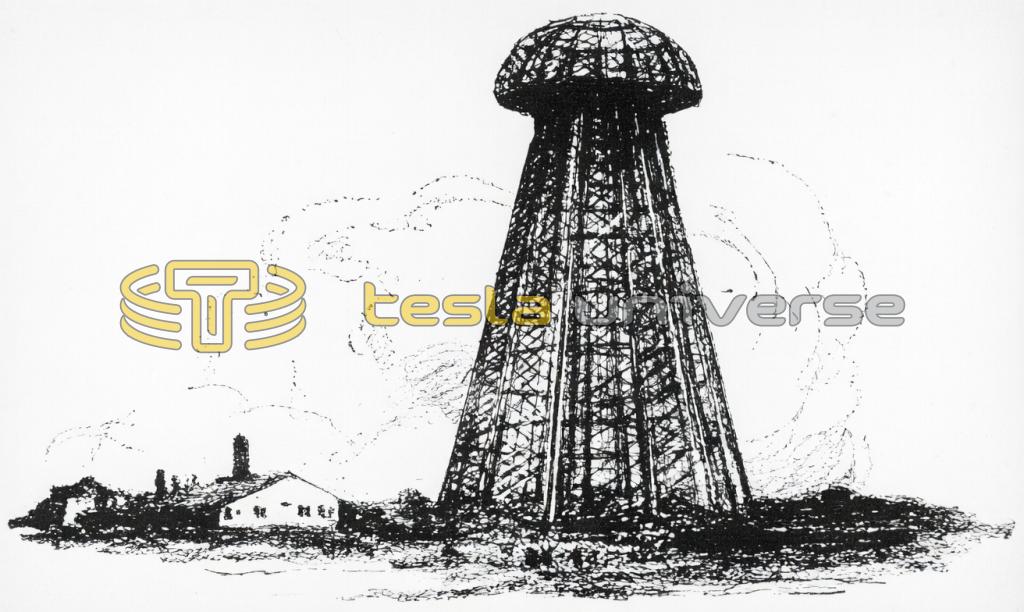
Tesla began the construction of his first commercial world-wireless plant out near Shoreham, Long Island. About $600,000 were expended upon a huge tower and other equipment, and a million more were needed to complete the station. But the hopes of an expectant public were downed when it was suddenly reported that the tower had been destroyed by explosives. An unfortunate series of unforeseen events, entirely apart from technical consideration, followed the demolition of the tower, and for the time being the plant and the work had to be abandoned.
It was a great setback for Tesla, and again he disappeared from the public. But now conditions have become once more favorable, and in the near future a new plant will be built and the world will see its first superbroadcasting station. Then power transmitting stations will be built which will be capable of supplying, wirelessly, over great distances, electrical power for home and industrial needs — utilizing, if need be, the tremendous unused water power in the most remote regions.
By a system of individualization the inventor is able to send any number of separate and distinct waves from a single station at the same time, and each of these waves can be made non-interfering and non-interferable.
Besides those uses mentioned as being extracted from the technical statement, Tesla intends to use his first commercial station for the following: The establishment of a secret and non-interferable government telegraph service; universal distribution of general news, by telegraph or telephone, in connection with the press; the establishment of a world system of intelligence transmission for exclusive private use; the interconnection and operation of all the stock tickers in the world; a world system of musical distribution; the universal registration of time by cheap clocks, indicating the hour with astronomical precision and requiring no attention whatever; world transmission of photographs, drawings, type or handwritten letters, or checks, etc.; the establishment of a universal marine service enabling the navigators of all ships to steer perfectly without compass, to determine the exact location, hour and speed, to prevent collisions and disasters, etc.
Then there will be stations of greater power to supply energy capable of running lamps, motors, and other electrical apparatus, at all points of the earth. Under their great alternating pressure, the entire earth will rhythmically pulsate, electrically, like a huge heart, and current may be tapped on the surface, under it, or high in the air. By correct design of the apparatus, a single receiving outfit can literally “suck up” all the available energy of the ground over an area of two hundred square miles, and convert it into light and power by means of vacuum lamps and high-frequency motors. This system is especially valuable for farms and isolated communities, and for the driving of automobiles and airplanes.
With the world-wireless system off his hands, Tesla proposes to make public, in degrees, two thousand other inventions, some correlated and others in widely different fields, which he has created and developed during the past twenty-five years. Among them will be his radical gas turbine with a perfectly smooth rotor; models of which have already been built up to 10,000 horsepower; a superpowered airplane, having a wing spread not necessarily greater than eight feet, and being capable of rising vertically, standing still, or traveling horizontally at a tremendous speed, a “sailless ship,” embodying unique principles which make it much more efficient than the Flettner rotor ships so widely discussed a short time ago, and a system of stereoscopic moving pictures.
It is interesting to note that a technical statement by Tesla in 1900 — then speaking of the immediate applications of his apparatus — mentioned applications of his system that Hertz wave engineers are still trying to make practical: “It makes possible not only the instantaneous and precise wireless transmission of any kind of signals, messages or characters to all parts of the world, but also the interconnection of the existing telegraph, telephone, and other signal systems without any change in their present equipment. By its means, for instance, a telephone subscriber here may call up and talk to any other subscriber on the globe.”
Tesla is almost a purely mental worker. His greatest inventions were conceived in his brain and perfected before even a drawing or a model was made. In this way every part remains fluid and interchangeable right to the end, and the possibility of error due to mechanical imperfections is eliminated.
“There is enough data,” Tesla says, “through has already been put into usable form to determine the effect of any piece of apparatus that can be devised by pure calculation. In all my inventive career I have never perfected a theory or a device in my mind that did not work in practice exactly as I had conceived it.
“In my work, I first get a feeling that there is a solution to a problem. This feeling means much to me for when I get it I always eventually succeed in working out the problem. Probably it is an indication that the subconscious mind is diligently on the track or has already found a solution.
“Then I think generally over everything centrally on any one point. I often, even years, with an idea in such a way in my head. Finally I close around and the idea and the vantage that was at first blurred gets sharper and sharper until in time it becomes a reality. The general form is ascertained. I proceed to perfect the machine idea — decide whether or not it will work efficiently whether one thing or another will improve it. The vision is so clear that I can tell if a certain part is out of balance. And finally I can give exact measurements to the workmen without having made even a sketch. The models are not to experiment with but simply to prove the ideas which I create in my mind.”
Even Tesla, however, bows to the infinity of knowledge which always lies ahead: “The accomplishments of the mind and the imagination are unlimited. At times my thoughts reach out into fields so vast that I become afraid and have to recall them.”
In summarizing this great inventor’s achievements, we must never forget his dauntless courage. Genius is forever thwarted by custom and tradition, and Tesla was not spared. After he had taken the principles upon which he based his induction motor, for instance, right out of the depths of the blue, he had a man’s job to get science and industry to give him even a hearing. One of the ablest electrical engineers in the country at the time, condemned his systems and apparatus on the spot. The story goes that he sold his last portrait of George Washington to help pay for the experimental machinery which enabled him to prove his inventions worthy to a group of financiers.
Later, Tesla had to fight all kinds of opposition, commercial and individual. In the midst of some of his most promising work, a fire razed his Grand street laboratory, destroying, among other things, over a thousand historic models.
However, despite all his misfortune, as a “freelance” inventor, Tesla has made over two million dollars. Wrapped up in his work, he is smilingly oblivious to everything else and he has assured me that he is confident he will make that much more — not because he is aiming for the money, but because it will come to him as the natural return as the result of some of his recent endeavors.
One evening, as we walked to the subway station, the great inventor frequently halted to describe figures on the pavement with his cane; in this way helping to explain some theory or peculiar method of construction. It reminded me vividly of a story he once told of an incident which took place at Budapest. Tesla was strolling leisurely through the City Park with a friend, close to sundown. Many books that he had liked had been committed to memory, word for word, and the entrancing atmosphere that preceded dusk called forth a beautiful passage from Goethe’s “Faust.” While speaking these glorious words, a vision of his long dreamed-of induction motor, complete, perfect, operable, came into his mind like a flash. With a stick he drew on the sand the vision he had seen and his friend understood. It was the same motor that he presented to the American Institute of Electrical Engineers six years later. To Tesla, the vision was so real that in a moment of ecstasy he cried to his friend, “Look! Watch me reverse my motor!” and he did it, demonstrating with his stick.