Nikola Tesla Articles
If Electricity-Through-Ground Idea Works, Power Could Be Dirt Cheap
By ROBERT J. SCHADEWALD
Will Mische never expected to find himself in a dispute with electrical engineers when he began reading about Nikola Tesla a year ago.
Mische had never even heard of Tesla until then. Mische isn't even a scientist, though he has a high interest in science and has read a lot of technical literature.
Mische, who has a master's degree in sociology, works at the Anoka office of the Minnesota Department of Employment Services. Now, after reading about Tesla's work, he also heads the People's Power Project, a group that hopes to show that electric power can be sent through the ground without transmission lines.
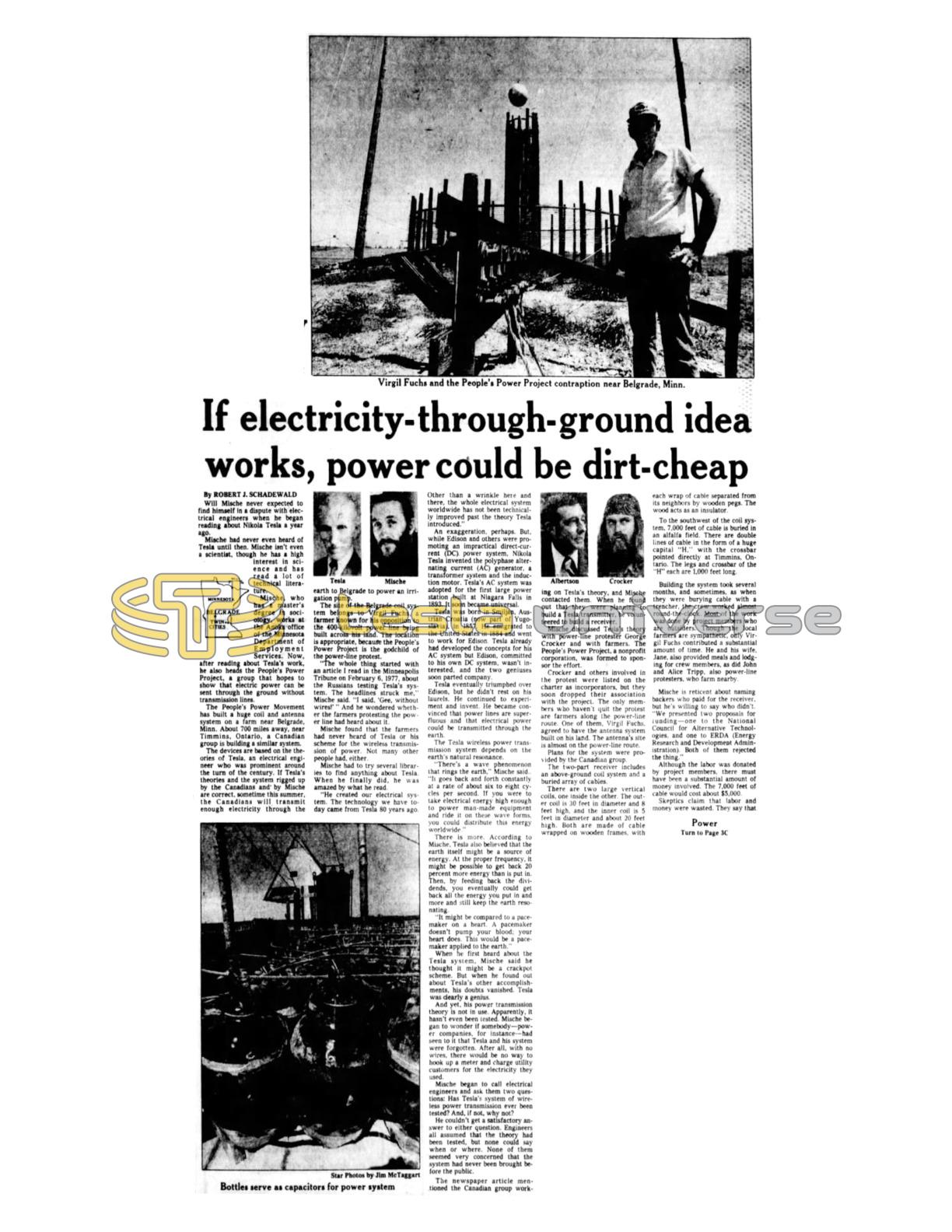
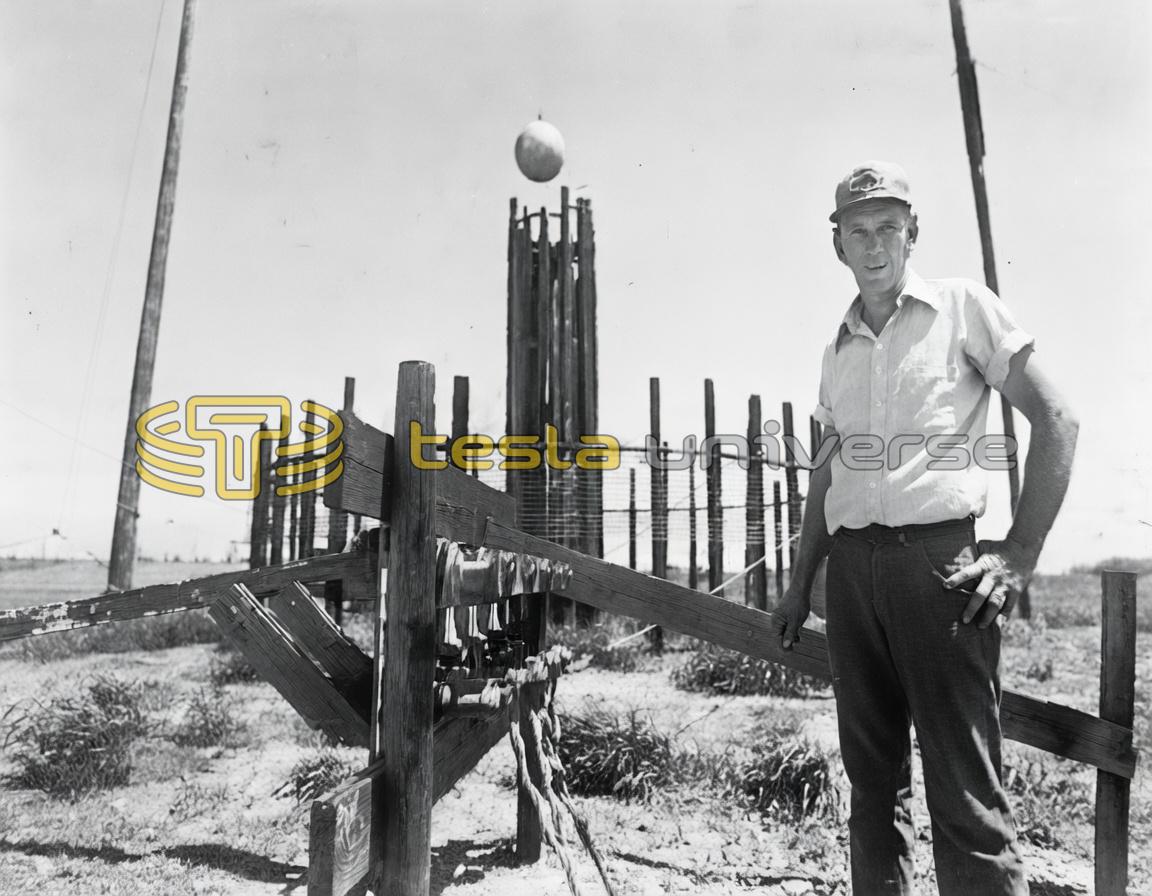
The People's Power Movement has built a huge coil and antenna system on a farm near Belgrade, Minn. About 700 miles away, near Timmins, Ontario, a Canadian group is building a similar system.

The devices are based on the theories of Tesla, an electrical engineer who was prominent around the turn of the century. If Tesla's theories and the system rigged up by the Canadians and by Mische are correct, sometime this summer, the Canadians will transmit enough electricity through the earth to Belgrade to power an irrigation pump.
The site of the Belgrade coil system belongs to Virgil Fuchs, a farmer known for his opposition to the 400-kilovolt power line being built across his land. The location is appropriate, because the People's Power Project is the godchild of the power-line protest.
"The whole thing started with an article I read in the Minneapolis Tribune on February 6, 1977, about the Russians testing Tesla's system. The headlines struck me," Mische said. "I said, 'Gee, without wires!'" And he wondered whether the farmers protesting the power line had heard about it.
Mische found that the farmers had never heard of Tesla or his scheme for the wireless transmission of power. Not many other people had, either.
Mische had to try several libraries to find anything about Tesla. When he finally did, he was amazed by what he read.
"He created our electrical system. The technology we have today came from Tesla 80 years ago. Other than a wrinkle here and there, the whole electrical system worldwide has not been technically improved past the theory Tesla introduced."
An exaggeration, perhaps. But, while Edison and others were promoting an impractical direct-current (DC) power system, Nikola Tesla invented the polyphase alternating current (AC) generator, a transformer system and the induction motor. Tesla's AC system was adopted for the first large power station built at Niagara Falls in 1893. It soon became universal.
Tesla was born in Smiljan, Austrian Croatia (now part of Yugoslavia), in 1857. He emigrated to the United States in 1884 and went to work for Edison. Tesla already had developed the concepts for his AC system but Edison, committed to his own DC system, wasn't interested, and the two geniuses soon parted company.
Tesla eventually triumphed over Edison, but he didn't rest on his laurels. He continued to experiment and invent. He became convinced that power lines are superfluous and that electrical power could be transmitted through the earth.
The Tesla wireless power transmission system depends on the earth's natural resonance.
"There's a wave phenomenon that rings the earth," Mische said. "It goes back and forth constantly at a rate of about six to eight cycles per second. If you were to take electrical energy high enough to power man-made equipment and ride it on these wave forms, you could distribute this energy worldwide."
There is more. According to Mische, Tesla also believed that the earth itself might be a source of energy. At the proper frequency, it might be possible to get back 20 percent more energy than is put in. Then, by feeding back the dividends, you eventually could get back all the energy you put in and more and still keep the earth resonating.
"It might be compared to a pacemaker on a heart. A pacemaker doesn't pump your blood; your heart does. This would be a pacemaker applied to the earth."
When he first heard about the Tesla system, Mische said he thought it might be a crackpot scheme. But when he found out about Tesla's other accomplishments, his doubts vanished. Tesla was clearly a genius.
And yet, his power transmission theory is not in use. Apparently, it hasn't even been tested. Mische began to wonder if somebody — power companies, for instance — had seen to it that Tesla and his system were forgotten. After all, with no wires, there would be no way to hook up a meter and charge utility customers for the electricity they used.
Mische began to call electrical engineers and ask them two questions: Has Tesla's system of wireless power transmission ever been tested? And, if not, why not?
He couldn't get a satisfactory answer to either question. Engineers all assumed that the theory had been tested, but none could say when or where. None of them seemed very concerned that the system had never been brought before the public.
The newspaper article mentioned the Canadian group working on Tesla's theory, and Mische contacted them. When he found out that they were planning to build a Tesla transmitter, he volunteered to build a receiver.
Mische discussed Tesla's theory with power-line protester George Crocker and with farmers. The People's Power Project, a nonprofit corporation, was formed to sponsor the effort.
Crocker and others involved in the protest were listed on the charter as incorporators, but they soon dropped their association with the project. The only members who haven't quit the protest are farmers along the power-line route. One of them, Virgil Fuchs, agreed to have the antenna system built on his land. The antenna's site is almost on the power-line route.
Plans for the system were provided by the Canadian group.
The two-part receiver includes an above-ground coil system and a buried array of cables.
There are two large vertical coils, one inside the other. The outer coil is 30 feet in diameter and 8 feet high, and the inner coil is 5 feet in diameter and about 20 feet high. Both are made of cable wrapped on wooden frames, with each wrap of cable separated from its neighbors by wooden pegs. The wood acts as an insulator.
To the southwest of the coil system, 7,000 feet of cable is buried in an alfalfa field. There are double lines of cable in the form of a huge capital "H," with the crossbar pointed directly at Timmins, Ontario. The legs and crossbar of the "H" each are 1,000 feet long.
Building the system took several months, and sometimes, as when they were burying cable with a trencher, the crew worked almost round-the-clock. Most of the work was done by project members who are outsiders. Though the local farmers are sympathetic, only Virgil Fuchs contributed a substantial amount of time. He and his wife, Jane, also provided meals and lodging for crew members, as did John and Alice Tripp, also power-line protesters, who farm nearby.
Mische is reticent about naming backers who paid for the receiver, but he's willing to say who didn't. "We presented two proposals for funding — one to the National Council for Alternative Technologies, and one to ERDA (Energy Research and Development Administration). Both of them rejected the thing."
Although the labor was donated by project members, there must have been a substantial amount of money involved. The 7,000 feet of cable would cost about $5,000.
Skeptics claim that labor and money were wasted. They say that the system is theoretically unsound.
One prominent skeptic is Vernon Albertson, professor of electrical engineering at the University of Minnesota and one of the engineers Mische consulted early in his research. Albertson has been quoted to the effect that, if the Belgrade antenna system works, he will retire to the north woods and become a hermit.
"If they have sensitive enough instruments," Albertson said, "they may detect something. But they certainly won't pull enough power out of the ground to run an irrigation system."
Albertson believes that if Tesla's wireless power transmission theory really is untested, there may be very good reasons. "Anyone who has a good background in either electromagnetic waves or electrical engineering would probably not go ahead and do the experiment they're trying to do," he said.
Mische said he plans to visit Albertson at his hermitage.
"How can the man say it won't work when he hasn't read this?" Mische said, referring to Tesla's notebook, which has just become available in English. "The electrical theory we operate under today is Tesla's theory, and Tesla himself said it would work."
Something else is clear from Tesla's notebook. The antenna system at Belgrade will have to be modified slightly before it can be tested.
"What we built," Mische said, "is from the drawings and specifications given us by the Canadians, who at the time did not even have Tesla's notes themselves. They were drawing their conclusions from a book on Tesla."
The completed Belgrade system has been idle for almost a year, waiting to be tested. Ironically, in spite of their head start, the Canadians haven't finished their transmitter. They are very secretive about their plans, but Mische hopes they will be ready to go sometime this summer.
If for some reason the Canadians don't come through, the People's Power Project is prepared to build its own transmitter somewhere. That could cause another delay. It probably would be necessary to get a license from the Federal Communications Commission and to file an environmental impact statement before pumping energy into the ground.
But Mische said there are alternatives. Several other U.S. groups are studying Tesla's ideas, and one of them might build a transmitter. Or, if the Soviets really are experimenting with a Tesla system, perhaps they could be persuaded to cooperate.
Mische has no doubts about Tesla's theory, whether the People's Power Project proves it or not.
"Sure as I'm sitting here it's going to work." he said about Tesla's system. "As far as our technology out at Belgrade goes, we may be entirely off base. If it doesn't work, it doesn't mean that Tesla was wrong. It may mean that somebody more technically astute than we will have to try it."
ROBERT J. SCHADEWALD is a freelance writer from Rogers.