Nikola Tesla Articles
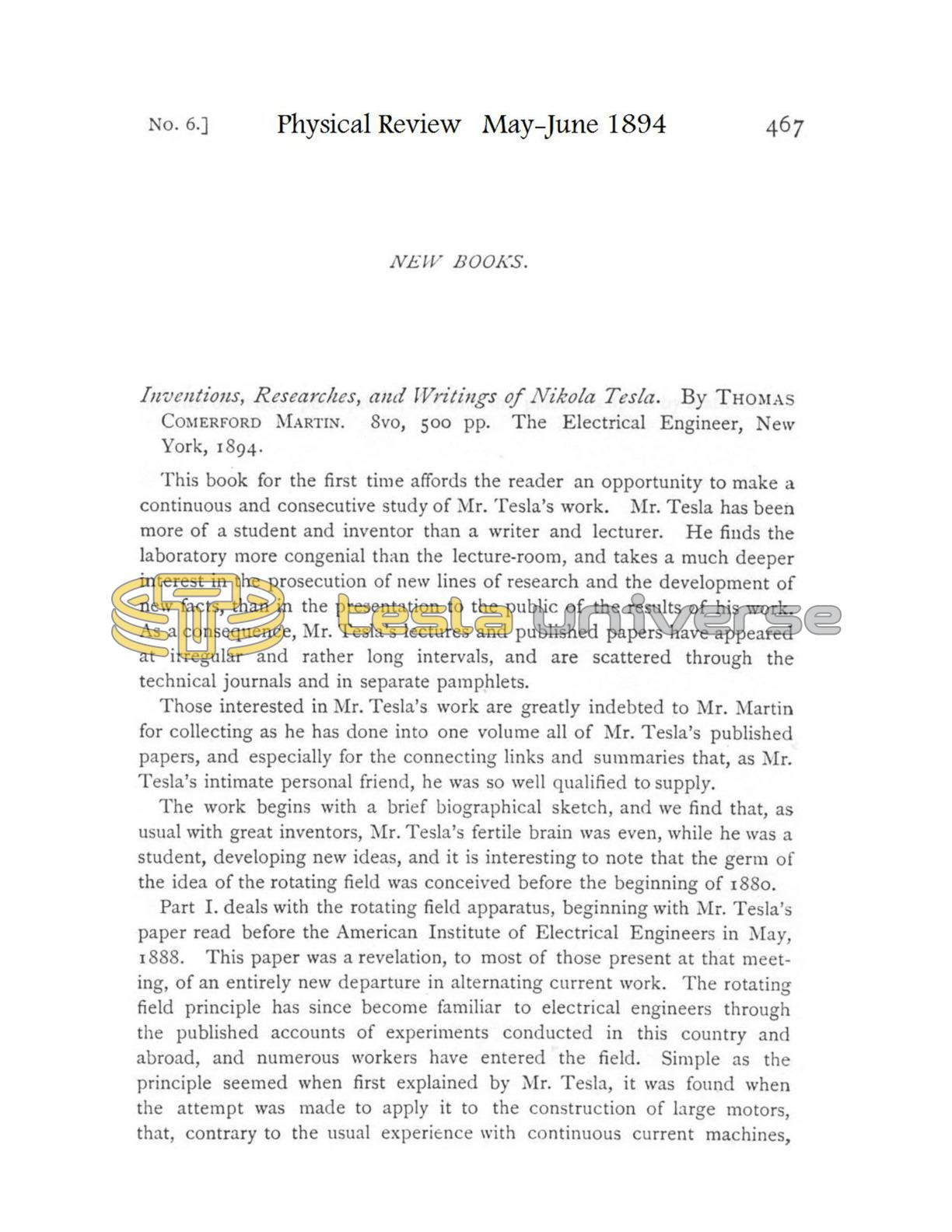
Inventions, Researches, and Writings of Nikola Tesla - Review
Inventions, Researches, and Writings of Nikola Tesla. By THOMAS COMERFORD MARTIN. Svo, 500 pp. The Electrical Engineer, New York, 1894.
This book for the first time affords the reader an opportunity to make a continuous and consecutive study of Mr. Tesla's work. Mr. Tesla has been more of a student and inventor than a writer and lecturer. He finds the laboratory more congenial than the lecture-room, and takes a much deeper interest in the prosecution of new lines of research and the development of new facts, than in the presentation to the public of the results of his work. As a consequence, Mr. Tesla's lectures and published papers have appeared at irregular and rather long intervals, and are scattered through the technical journals and in separate pamphlets.
Those interested in Mr. Tesla's work are greatly indebted to Mr. Martin for collecting as he has done into one volume all of Mr. Tesla's published papers, and especially for the connecting links and summaries that, as Mr. Tesla's intimate personal friend, he was so well qualified to supply.
The work begins with a brief biographical sketch, and we find that, as usual with great inventors, Mr. Tesla's fertile brain was even, while he was a student, developing new ideas, and it is interesting to note that the germ of the idea of the rotating field was conceived before the beginning of 1880.
Part I. deals with the rotating field apparatus, beginning with Mr. Tesla's paper read before the American Institute of Electrical Engineers in May, 1888. This paper was a revelation, to most of those present at that meeting, of an entirely new departure in alternating current work. The rotating field principle has since become familiar to electrical engineers through the published accounts of experiments conducted in this country and abroad, and numerous workers have entered the field. Simple as the principle seemed when first explained by Mr. Tesla, it was found when the attempt was made to apply it to the construction of large motors, that, contrary to the usual experience with continuous current machines, the large motors were less efficient than the small ones, especially when operated at high frequencies. With the talent brought to bear upon the subject, sources of loss have been discovered and eliminated, and the motors improved until now they stand nearly on a par in efficiency with continuous current motors.
The chapters which follow in Part I. describe a great variety of forms of rotary field motors. In some the difference of phase is obtained on branches from a single circuit by the proper proportioning of resistance and self-induction. In others, a "magnetic lag" in peculiarly formed polar-projections serves to produce the rotary effort by the use of a single alternating current. Many of these forms could hardly be developed into efficient commercial machines, but they are curious examples of the working of alternating currents, and are especially interesting here as showing the extreme fertility of Mr. Tesla's mind.
Part II. relates to Mr. Tesla's high frequency experiments. In it are published in full Mr. Tesla's three lectures delivered respectively, at New York, May 20, 1891; at London and Paris, 1892; and at Philadelphia and St. Louis in 1893. The lectures are preceded by a review by Mr. Martin.
It is to be regretted that this review is not more discriminating. Instead of pointing out what properly belongs to Mr. Tesla, and what had already been done by other experimenters, he leaves the reader to infer that everything described is Mr. Tesla's work. The claim for novelty of the experiments seems, in some cases, to be unduly exaggerated. The operation of electrical devices by means of one wire is spoken of as though it were something before unheard of; and yet, how does it differ in principle from the old method of measuring the capacity of a condenser by charging it through a galvanometer? One wire from the battery passes through the galvanometer and terminates in the condenser. Close the key, and a current rushes through the galvanometer coil into the condenser and swings the needle. Substitute an alternating potential for the constant potential of the battery, and an alternating current would flow through the galvanometer coil.
The writer more than ten years ago showed that the needle of a galvanometer would be deflected by the rush of electricity into the coil when a glass rod charged by rubbing with a silk handkerchief was brought to one terminal, the other terminal having no connection with anything whatever. Deflection in the opposite direction was caused by charging the coil through the other terminal. Deflection was also produced by discharging the coil by one of its terminals. The coil used in this experiment was very thoroughly insulated, and held the charge given to it for some time. This was a case of an electrical device actuated through one connection only, the generator being a glass rod and a silk handkerchief. The writer did not consider it anything wonderful; in fact, it was just what he expected would take place in a coil sufficiently well insulated, and having a sufficient number of convolutions.
How are we to understand the statement on page 120 that Mr. Tesla has demonstrated, that for the production of light-waves, "primarily," electrostatic effects must be brought into play? It does not appear that Mr. Tesla has produced light-waves primarily, in any way.
But the writer does not wish to be understood as finding nothing except for criticism in Mr. Martin's summary; far otherwise. The reader will find it an excellent résumé of the results portrayed in Mr. Tesla's lectures, and will find it very useful, even after having read the lectures themselves.
Referring to the experiments exhibited by Mr. Tesla in his three lectures, their novelty seems to the writer to consist more in the brilliancy and magnitude of the results than in the development of anything radically new. By this he does not mean in any way to belittle the value of Mr. Tesla's work. His experiments are no less a revelation if they only exhibit old phenomena in a new light, and demonstrate experimentally facts that were before only theoretically known. By means of a high frequency alternating machine, and still further by the extremely rapid Hertzian oscillations, the old induction coil is made to exhibit some wonderfully brilliant phenomena. Geissler tubes glow with unwonted brilliancy. In Crookes' tubes, in place of heating to redness only a tiny piece of platinum, a whole lamp filament or a block of carbon is rendered incandescent. In consequence of the high frequency, great differences in the phenomena are produced by exceedingly small changes in.capacity, and many of the experiments strikingly illustrate this fact.
In the title to Mr. Tesla's New York lecture we find that he proposes to deal with high frequency phenomena "and their application to methods of artificial illumination." It is in this last that the practical engineer is specially interested; and the first question that occurs to him is, what is the efficiency of the methods hinted at by Mr. Tesla? [We do not find the methods more than hinted at in these lectures, and there is nowhere any light thrown upon the question of efficiency.] Knowing as we do the losses that accompany the use of high frequencies and high potentials, such as those due to disturbances in surrounding media, and currents in conductors due to their capacity, it would be interesting to learn what method Mr. Tesla may have in view for eliminating these. Mr. Tesla speaks of using an electrostatic screen for a conducting wire, and remarks that such a screen would have the same effect as removing all objects to an infinite distance. The writer does not know of any such screen.
A metallic sheath would serve as a screen only if its own potential were maintained constant, and that could only be if it were in perfect conducting communication with the earth. The effect of any such sheath, whether connected to earth or not, would increase the capacity of the conductor.
The scheme of lighting by means of isolated vacuum tubes in a rapidly alternating electrostatic field is an attractive one, but the plates forming the boundaries of such a field would have considerable capacity. To charge them to a potential of a hundred thousand volts would require a considerable quantity of electricity, and if this charge were reversed many thousand times per second, the transfer of that quantity of electricity would mean a considerable current, and this current would be continually flowing whether any work were being done or not.
To be efficient it would be necessary that the capacity of the system when the lights were not in use should be extremely small, and should be largely increased by bringing them into action. Is it likely that such a relation could be achieved?
In the single wire distribution about which so much is said in the lectures, the result is only reached by a very accurate adjustment of frequency, potential, and capacity. Supposing the question of efficiency settled, would not such a system still be inapplicable for an extended distribution where lamps are to be turned on and off, on account of the nicety of the adjustments required? Would not the balance be destroyed with every lamp turned off or on. Is it not true that in any system involving the use of very high potentials and high frequencies capacity becomes a most important factor, and that small changes in capacity may interfere seriously with the working of the system?
In closing his London lecture Mr. Tesla tells us that his screened cables will not be made, "for ere long intelligence — transmitted without wires — will throb through the earth like a pulse through a living organism." But how many people could use the earth at once? Would not the telephone girls' frequent answer, "line in use," have to be accepted in that case as at least plausible?
In the Franklin Institute lecture a number of pages are given to the subject of resonance. The writer is not sure that he understands fully the statements and illustrations in that part of the lecture, and will only refer to one or two points.
The statement that "pure" resonance effects are impossible in nature evidently means simply that motion as we have to deal with it cannot be maintained without the constant consumption of energy. This is a fact perfectly well known, and is, of course, true of vibratory motion as well as of any other.
A body acted on by a force ceases to increase in velocity when the resistances it meets with equal the force applied. A vibrating body kept in motion by successive small impulses derived from another body which vibrates in unison with it, which is all there is of resonance, ceases to increase in vibration when the resistances it meets with equal the impulses, or, in other words, when the loss of energy during each vibration is equal to the energy received during the same time. If the energy of the receiver is employed for some useful purpose, it must, of course, receive from the original vibrating body as much energy as is used; otherwise it will cease to vibrate.
When Mr. Tesla says that in "electrical vibration it is of enormous importance to arrange the conditions so that the vibration is effected with the greatest freedom," it is the same as saying that the waste of energy must be reduced to a minimum, and this is just as true when electrical energy is transferred in other ways.
It is also just as important that the transfer should be efficiently effected.
The case of the resonant tuning-forks, where one is sounded and imparts its vibrations to all the surrounding air, a small portion of which air imparts its vibration to the other fork, is an example of a very inefficient way of transferring energy. The energy of the first fork is mainly frittered away in imparting useless vibration to the surrounding air. If the energy of the first fork could be efficiently transferred, the vibration of the second might be maintained in mercury, and if agitation of the mercury were the object to be attained, it might be efficiently effected; and yet the means of transferring the energy from one fork to the other might be such that no effective vibration could be imparted unless the two forks were tuned to unison.
In short, when energy is to be transmitted by means of periodic motions, it may be desirable or convenient to use receivers having a definite vibration period of their own, in which case they must be adjusted to unison with the generator; but the use of such receivers does not increase or diminish the necessity of observing the other conditions of efficient transformation; viz. that as little energy as possible should be used outside of the receivers, and that in the receivers as little energy as possible should be consumed except for the useful purpose. In any case the use of resonant receivers introduces a new difficulty, that of adjusting them to unison, and maintaining unison under the varying demands for energy by the consumers.
Now it seems to the writer that in the transmission of energy electrically by means of high frequency and high potential currents the difficulties in preventing losses are greatly increased; and although, by the use of such high potentials, light may be obtained by means of discharges through rarefied gases without the accompaniment of so large a proportion of energy in the form of dark heat, yet the losses in the use of electrical energy in this form, and applied in this way, seem to much more than counterbalance the efficiency of the luminous source itself.
As has been already said, Mr. Tesla has devised some wonderfully brilliant and striking experiments illustrative of the action of high potential and high frequency currents, but when it comes to the application of these to artificial illumination he is silent upon the all-important question of efficiency, and from such information as we have, it would seem that very little progress had been made toward any reasonable result in that direction.
Part III. treats of miscellaneous inventions. These are of interest as showing the diversified character of Mr. Tesla's work. Some of them show great ingenuity, but probably there are few of them to which Mr. Tesla would to-day attach any practical value.
Part IV. relates to Mr. Tesla's World's Fair exhibit, and to the oscillator, which was made the subject of the lecture before the members of the Electrical Congress.
The personal exhibit was itself a very interesting one, showing as it did, the progress of Mr. Tesla's work, especially in the development of the rotating field apparatus. The reader will be glad to find embodied here brief but excellent descriptions of the separate pieces of apparatus there exhibited.
The oscillators shown by Mr. Tesla at the Congress lecture were very ingeniously designed, and would no doubt give a fairly uniform vibration under varying loads; but the claim that the vibrations would be so uniform under all conditions, that a clock actuated by the apparatus "would keep absolutely correct time" is probably not intended to be taken literally. The apparatus appears to be an excellent one for the production of alternating currents whose frequency can be accurately known, and it may serve an excellent purpose in experiments and investigations, and perhaps for telegraphy, but the writer is unable to feel that confidence in the great future of this apparatus that he felt in that of the rotating field motors when they were first explained to him in Mr. Tesla's laboratory.
The chapter devoted to the oscillators in this volume is very brief, and does not describe very fully the oscillators themselves, or the apparatus used in connection with them.
The work of Mr. Tesla described in this volume covers a period of hardly eight years. In that time the rotating field principle was developed, and a multitude of different forms of motors embodying the principle were built. The high frequency alternators, induction coils, condensers, lamps, vacuum tubes, etc., etc., have all been developed through successive experimental failures, and the immense variety of apparatus shown in successful operation on the occasion of the three lectures on high frequency phenomena are only a tithe of the instruments and apparatus built. All this shows not only Mr. Tesla's wonderful fertility, but his industry and perseverance as well. The writer understands that it is wholly his own work; the few assistants employed by him in his laboratory being only mechanics who could give him no help in the development of the apparatus. Few men can point to more work accomplished in so short a time.
WILLIAM A. ANTHONY.