Nikola Tesla Articles
Inventor as Fantastic as His Wireless Theory
By MARK PEARSON
Times Staff Writer
Nikola Tesla — inventor, genius, eccentric. Who was this potential millionaire who died a pauper, the man whose theories and inventions may be the answer to our energy problems, some say?
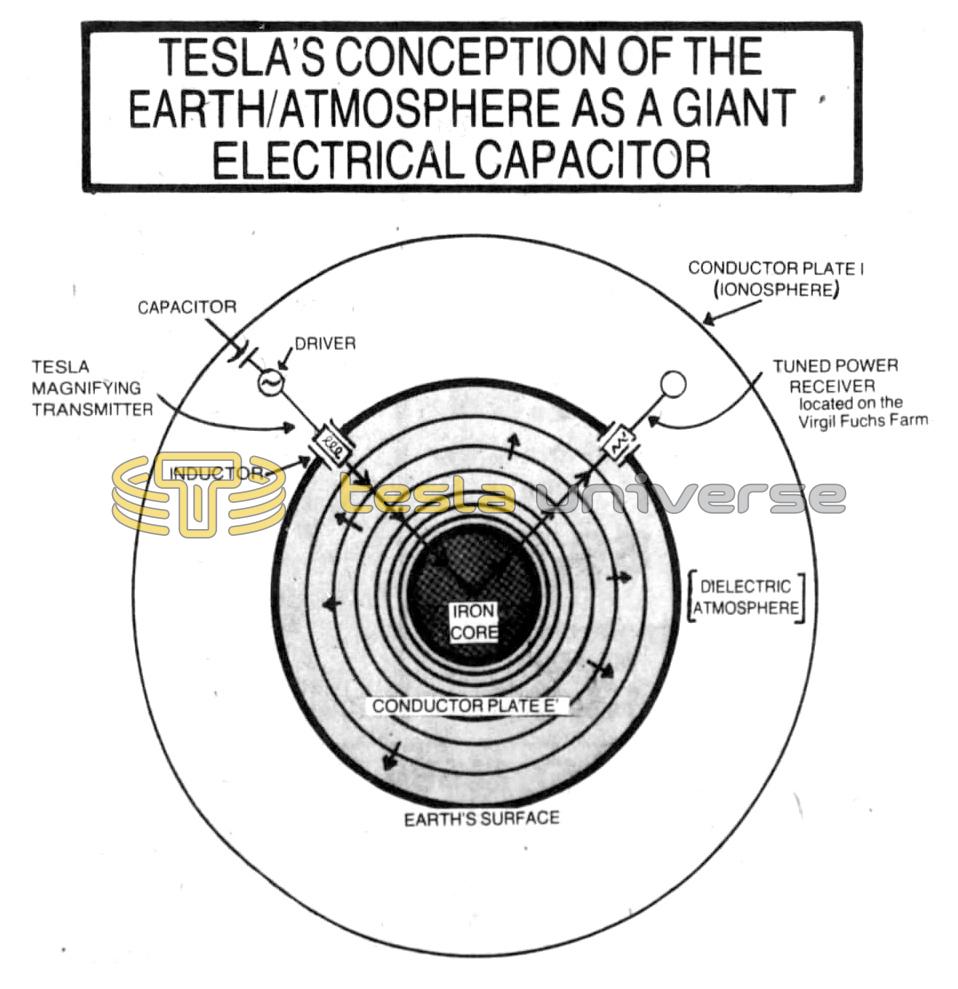
His long-ignored theory for the wireless transmission of electricity is being revived and will be tested on the Belgrade farm of Virgil Fuchs. Surveying for the experiment begins this weekend, and sometime in June 100 million volts of electricity will be "pumped" into the ground in Timmons, Canada, and sent to Belgrade.
Sheldon Nidle, a New York scientist who is working on the receiver to be built on Fuchs' farm, explains that according to Tesla's theories, that immense electrical charge will go to the opposite end of the world and bounce back, setting off waves of electrical energy. The energy wave, according to Nidle, will spread out throughout the world similar to the waves spreading out from a rock thrown into a still pool.
Nidle said according to Tesla's theories a tuned receiver on the Fuchs farm will convert the energy waves into electricity which will, if it works, run an approximately 75-horsepower motor.
Sound fantastic?
Well, the life of the man who came up with the theory was, by some accounts, fantastic.
Tesla was born in 1856 in the village of Smiljan in the Croatian province of today's Yugoslavia. His father was a professional soldier turned priest.
Tesla's father urged him to go into theology and as a child, accounts written about him say Tesla experienced strange visions. Tesla himself later wrote:
"I saw new scenes. These were at first blurred and indistinct and would flit away when I tried to concentrate my attention upon them. They gained strength and distinctness and finally assumed the concreteness of real things. I soon discovered that my best comfort was attained if I simply went on in my vision further and further getting new impressions all the time...."
Tesla first began inventing at age 17. He realized then that his visions were a precious gift, allowing him to design in his mind machines he wished to create. His inventions, according to Nidle, always worked the first time. But the acute sensitivity which allowed Tesla to convert his mental inventions to physical ones plagued him, according to written accounts. In a 1919 biographical account he described his violent aversion to women's earrings and obsession for crystals. He was revolted at the touch of another person's hair, got a fever simply by looking at a peach and became nauseous by glancing at small squares of paper floating in a liquid.
Tesla's sensitivity is rewarded later
Tesla's sensitivity heightened when he began working around the clock as chief engineer at the first telephone exchange in Budapest, and he came close to having a nervous breakdown. But after he recovered he created one of his greatest invention—the alternating current motor. He later sold it to George Westinghouse and it is used in virtually all electrical devices today.
Tesla worked in strict privacy. He lived as a recluse, staying for many years in New York City's Waldorf Astoria after he came to the United States in 1884.
Tesla's experiments led him to believe the electrical properties of the negatively charged earth and the positively charged upper atmosphere could be used to create an almost unlimited supply of electricity.
To test his idea, he built a 75 million watt transmitter which he claimed lit 200 50-watt bulbs at a distance of 26 miles. Tesla claimed that only 5 percent of the energy was wasted.
The latter third of Tesla's life remains somewhat of a mystery. Billionaire J.P. Morgan financed some of Tesla's experiments when Tesla built an experimental station in Long Island, N.Y. In 1912 Tesla refused the Nobel Prize in Physics when it was awarded to him and Thomas Edison jointly.
He was legally recognized for his pioneer work in wireless radio transmission one year after his death in 1943 when the U.S. Supreme Court wrote an opinion stating that several of the important features of Guglielmo Marconi's wireless invention had been anticipated by Tesla.
What is yet to come of Tesla's work remains to be seen. He left behind an estate of 100,000 documents written in four different languages. This includes 13,780 pages of biographical material, 75,000 pages of letters, 34,552 pages of scientific material and 5,297 pages of technical drawings and plans.
And his wireless transmission theory that was ignored for so many years is now getting some attention. Canadian officials reportedly are looking at Tesla's theories in hopes of cutting the expense of constructing transmission lines. They would like to transmit some of their country's vast potential hydroelectric power in the north to urban centers in the south.
And Canada isn't the only country looking at Tesla. Russian experiments and the reception of radio signals similar to those needed to conduct Tesla's experiments have been reported.
Will Mische, the St. Cloud-based member of the People's Power Project which is helping build the experimental receiver on the Fuchs farm, called Tesla's wireless transmission theory "Tesla's greatest gift to man." Mische, who said he works as an employment counselor for the State of Minnesota, said the People's Power Project is a loose-knit group of people who have come together, spurred by the controversy taking place in connection with the power line cooperatives are trying to build in Central Minnesota.
The receiver on the Fuchs farm, Mische said, is being financed and built by the group itself.
Mische said the interest in Tesla's work appears to be taking nationwide proportions. He refers to the groups taking interest in Tesla's work as the "network."
Tentative plans are in the works for an international conference on Tesla's work. State legislators and University of Minnesota professors have begun sounding out interest and sources of financing for such a project. A spokesman for the group working on the conference said it is hoped the conference could take place about the time the experiment on Fuchs' farm does.
Writing about his wireless transmission project, Tesla once said:
"Impossible as it seemed, this planet, despite its vast extent, behaves like a conductor of limited dimensions.... Not only was it possible to send telegraphic messages to any distances without wires....but also to impress on the entire globe the faint modulation of the human voice.
"Far more significant is the ability to transmit power in unlimited amounts to almost any territorial distance and without loss."
If Tesla was right remains to be seen. And what if he is....?
