Nikola Tesla Articles
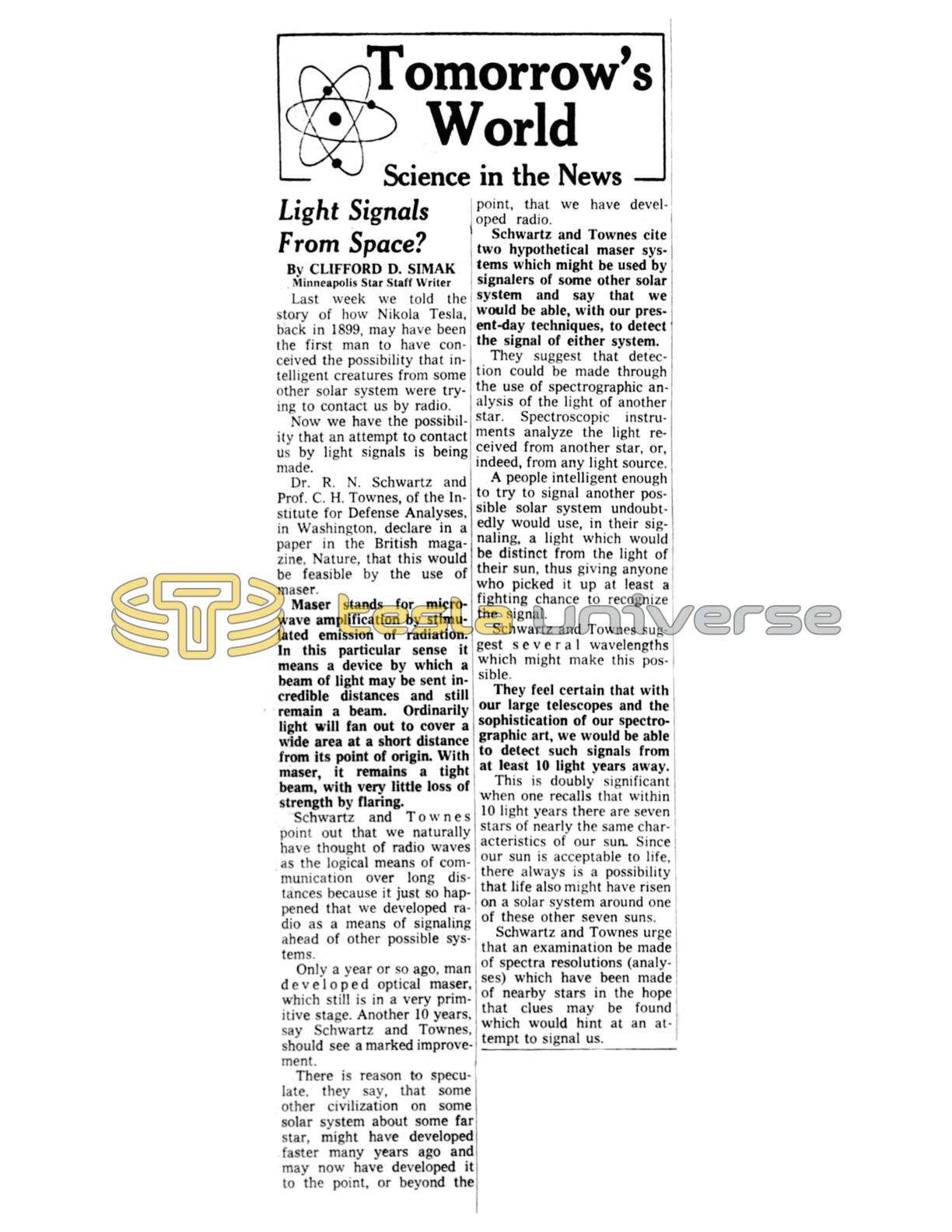
Light Signals from Space
By CLIFFORD D. SIMAK
Minneapolis Star Staff Writer
Last week we told the story of how Nikola Tesla, back in 1899, may have been the first man to have conceived the possibility that intelligent creatures from some other solar system were trying to contact us by radio.
Now we have the possibility that an attempt to contact us by light signals is being made.
Dr. R. N. Schwartz and Prof. C. H. Townes, of the Institute for Defense Analyses, in Washington, declare in a paper in the British magazine, Nature, that this would be feasible by the use of maser.
Maser stands for microwave amplification by stimulated emission of radiation. In this particular sense it means a device by which a beam of light may be sent incredible distances and still remain a beam. Ordinarily light will fan out to cover a wide area at a short distance from its point of origin. With maser, it remains a tight beam, with very little loss of strength by flaring.
Schwartz and Townes point out that we naturally have thought of radio waves as the logical means of communication over long distances because it just so hap- pened that we developed radio as a means of signaling ahead of other possible systems.
Only a year or so ago, man developed optical maser, which still is in a very primitive stage. Another 10 years, say Schwartz and Townes, should see a marked improvement.
There is reason to speculate, they say, that some other civilization on some solar system about some far star, might have developed faster many years ago and may now have developed it to the point, or beyond the point, that we have devel- oped radio.
Schwartz and Townes cite two hypothetical maser systems which might be used by signalers of some other solar system and say that we would be able, with our present-day techniques, to detect the signal of either system.
They suggest that detection could be made through the use of spectrographic analysis of the light of another star. Spectroscopic instruments analyze the light received from another star, or, indeed, from any light source.
A people intelligent enough to try to signal another possible solar system undoubtedly would use, in their signaling, a light which would be distinct from the light of their sun, thus giving anyone who picked it up at least a fighting chance to recognize the signal.
Schwartz and Townes suggest several wavelengths which might make this possible.
They feel certain that with our large telescopes and the sophistication of our spectrographic art, we would be able to detect such signals from at least 10 light years away.
This is doubly significant when one recalls that within 10 light years there are seven stars of nearly the same characteristics of our sun. Since our sun is acceptable to life, there always is a possibility that life also might have risen on a solar system around one of these other seven suns.
Schwartz and Townes urge that an examination be made of spectra resolutions (analyses) which have been made of nearby stars in the hope that clues may be found which would hint at an attempt to signal us.