Nikola Tesla Articles
New U.S. Commemoratives Honor 2 Yonkers Inventors
By Von McNamara
Special to The Herald Statesman
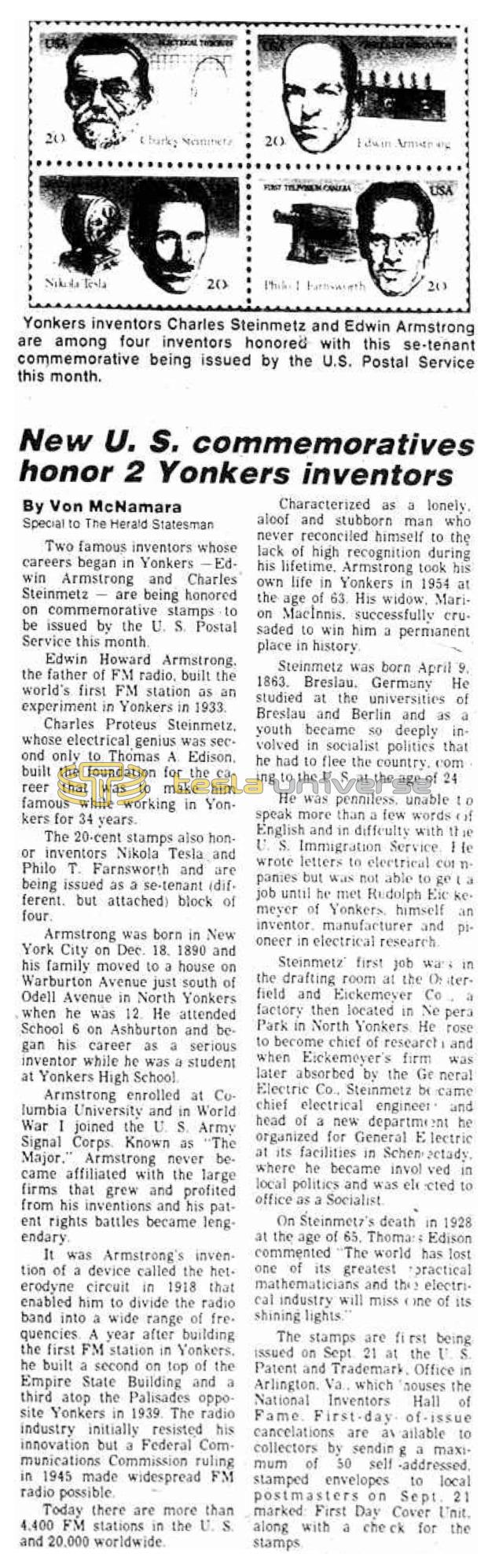
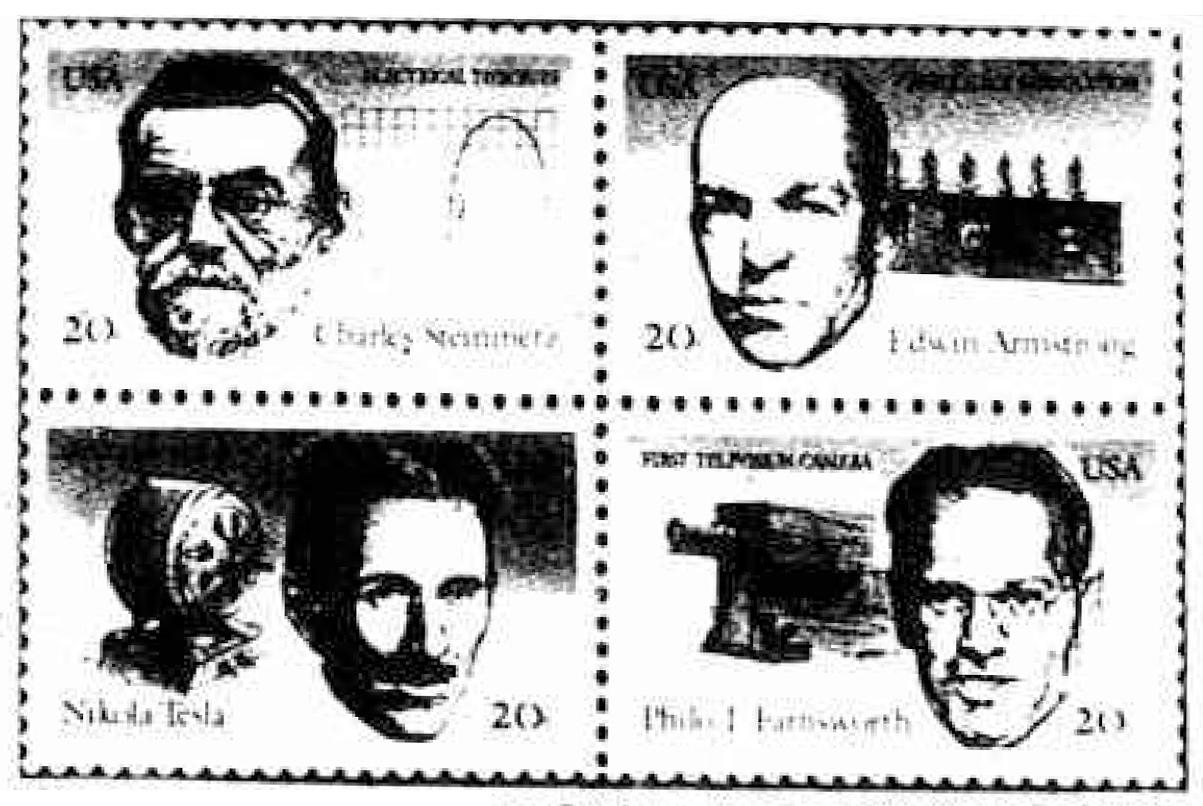
Two famous inventors whose careers began in Yonkers — Edwin Armstrong and Charles Steinmetz — are being honored on commemorative stamps to be issued by the U. S. Postal Service this month.
Edwin Howard Armstrong, the father of FM radio, built the world's first FM station as an experiment in Yonkers in 1933.
Charles Proteus Steinmetz, whose electrical genius was second only to Thomas A. Edison, built the foundation for the career that was to make him famous while working in Yonkers for 34 years.
The 20-cent stamps also honor inventors Nikola Tesla and Philo T. Farnsworth and are being issued as a se-tenant (different, but attached) block of four.
Armstrong was born in New York City on Dec. 18, 1890 and his family moved to a house on Warburton Avenue just south of Odell Avenue in North Yonkers when he was 12. He attended School 6 on Ashburton and began his career as a serious inventor while he was a student at Yonkers High School.
Armstrong enrolled at Columbia University and in World War I joined the U. S. Army Signal Corps. Known as "The Major," Armstrong never became affiliated with the large firms that grew and profited from his inventions and his patent rights battles became legendary.
It was Armstrong's invention of a device called the heterodyne circuit in 1918 that enabled him to divide the radio band into a wide range of frequencies. A year after building the first FM station in Yonkers, he built a second on top of the Empire State Building and a third atop the Palisades opposite Yonkers in 1939. The radio industry initially resisted his innovation but a Federal Communications Commission ruling in 1945 made widespread FM radio possible.
Today there are more than 4,400 FM stations in the U. S. and 20,000 worldwide.
Characterized as a lonely, aloof and stubborn man who never reconciled himself to the lack of high recognition during his lifetime. Armstrong took his own life in Yonkers in 1954 at the age of 63. His widow, Marion MacInnis, successfully crusaded to win him a permanent place in history.
Steinmetz was born April 9, 1863, Breslau, Germany. He studied at the universities of Breslau and Berlin and as a youth became so deeply involved in socialist politics that he had to flee the country, coming to the U. S. at the age of 24.
He was penniless, unable to speak more than a few words of English and in difficulty with the U. S. Immigration Service. He wrote letters to electrical companies but was not able to get a job until he met Rudolph Eickemeyer of Yonkers, himself an inventor, manufacturer and pioneer in electrical research.
Steinmetz' first job was in the drafting room at the Osterfield and Eickemeyer Co., a factory then located in Nepera Park in North Yonkers. He rose to become chief of research and when Eickemeyer's firm was later absorbed by the General Electric Co., Steinmetz became chief electrical engineer and head of a new department he organized for General Electric at its facilities in Schenectady, where he became involved in local politics and was elected to office as a Socialist.
On Steinmetz's death in 1928 at the age of 65, Thomas Edison commented "The world has lost one of its greatest practical mathematicians and the electrical industry will miss one of its shining lights."
The stamps are first being issued on Sept. 21 at the U. S. Patent and Trademark Office in Arlington, Va., which houses the National Inventors Hall of Fame. First-day-of-issue cancelations are available to collectors by sending a maximum of 50 self-addressed, stamped envelopes to local postmasters on Sept. 21 marked First Day Cover Unit, along with a check for the stamps.