Nikola Tesla Articles
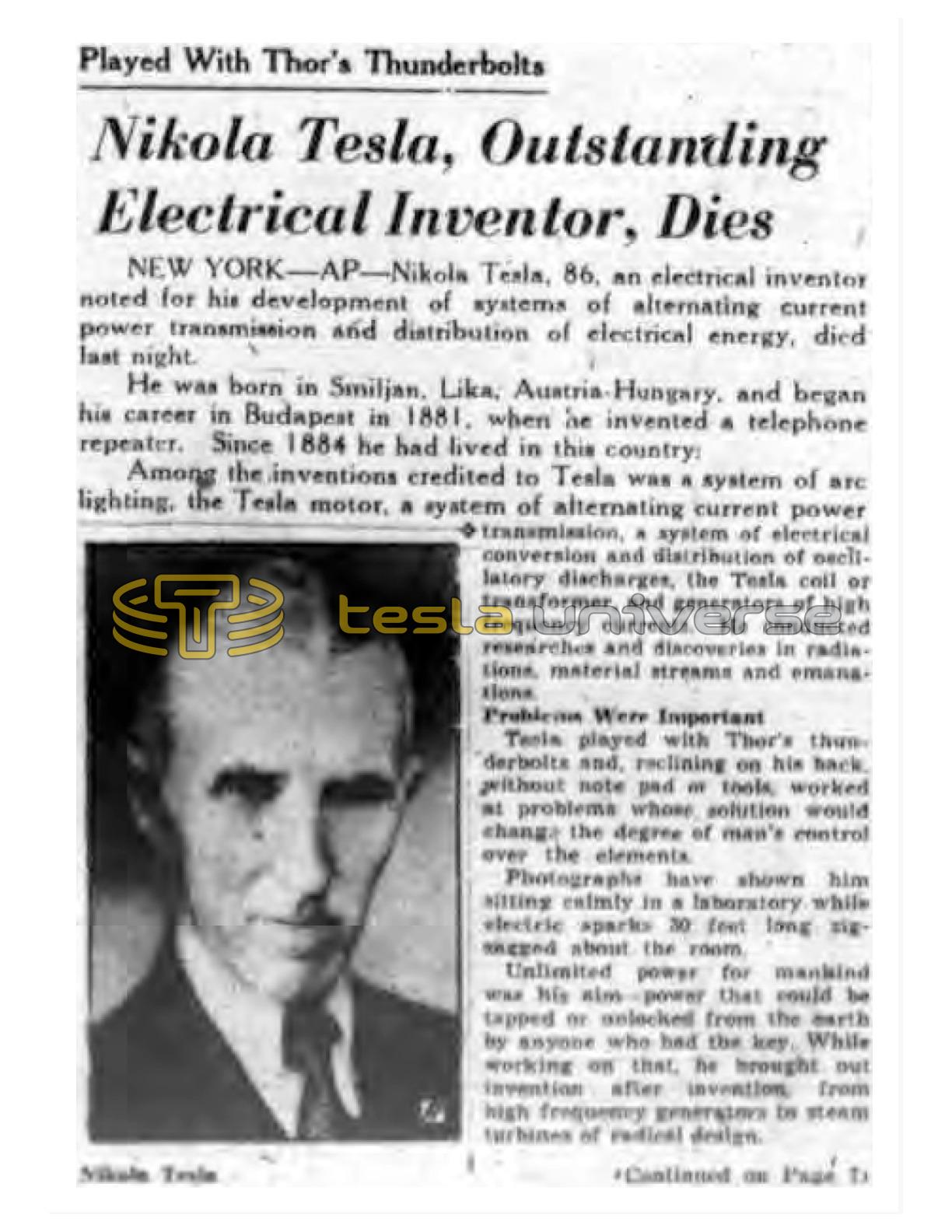
Nikola Tesla, Outstanding Electrical Inventor, Dies
Played With Thor’s Thunderbolts
NEW YORK — AP — Nikola Tesla, 86, an electrical inventor noted for his development of systems of alternating current power transmission and distribution of electrical energy, died last night.
He was born in Smiljan, Lika, Austria-Hungary, and began his career in Budapest in 1881, when he invented a telephone repeater. Since 1884 he had lived in this country.
Among the inventions credited to Tesla was a system of arc lighting, the Tesla motor, a system of alternating current power transmission, a system of electrical conversion and distribution of oscillatory discharges, the Tesla coil or transformer, and generators of high frequency currents. He conducted researches and discoveries in radiations, material streams and emanations.
Problems Were Important
Tesla played with Thor’s thunderbolts and, reclining on his back, without note pad or tools, worked at problems whose solution would change the degree of man’s control over the elements.
Photographs have shown him sitting calmly in a laboratory while electric sparks 30 feet long zigzagged about the room.
Unlimited power for mankind was his aim — power that could be tapped or unlocked from the earth by anyone who had the key. While working on that, he brought out invention after invention, from high frequency generators to steam turbines of radical design.
The son of a Greek clergyman and a Serbian mother who was the daughter of an inventor, Tesla was born July 10, 1857, in Smiljan, a village of Austrian Croatia, and grew up with ideas buzzing in his head.
Many Honorary Degrees
He got his schooling at the Polytechnic Institute in Gratz and at the University of Prague. In after years such institutions as Yale, Columbia and Vienna Polytechnic loaded him with honorary degrees.
His practical career began in 1881 at Budapest, where he brought out his first invention, a telephone repeater. Three years later, when he was 27 years old, he migrated to the United States and became an American citizen.
For a time he worked at Orange, N. J., with the late Thomas A. Edison, specifically in designing motors and generators. He described Edison as “by far the most successful and probably the last exponent of the purely empirical method of investigation.”
He soon went into research on his own book, sending forth a stream of inventions. He conceived the first effective method of using alternating electrical current. Four years after landing in the United States, he patented an induction motor, making it possible to convert electrical energy into mechanical energy more efficiently and economically than by direct current.
Had Many Inventions
The principle of the rotary magnetic field embodied in the apparatus used to transmit power from Niagara Falls, was his invention.
Other work which helped raise him to a place among the Titans of American inventiveness included a system of arc lighting, a system of electric conversion and distribution by oscillatory discharges, researches and discoveries in radiations, material streams and emanations.
New forms of dynamos, transformers, induction coils, condensers and other electrical apparatus also were chalked up to the credit of his genius.
A bachelor always, his daily routine was unusual. His hour for retiring was 5:30 A. M. and he usually got up at 10:30 A. M. But he once confessed that his problems often kept him from sleeping, even in the brief hours he was abed.
“I roll around and work on them,” he said.
Would Predict Marvels
When, on his birthday, reporters sought him out in the New York apartment hotel where he lived and worked in seclusion, he would predict future marvels that flared next day in headlines.
In 1934, when he was 67 and famed as a radio pioneer, he announced the perfection of a system of transmitting power without wires. He said it would be possible to send power to the greatest terrestrial distances with smaller losses than in relatively short metallic circuits.
It could be used for ships and aircraft, illumination and machinery, he said, and one of its most desirable uses would be to light isolated homes by vacuum tubes.
The invention comprised, he explained, an electrical generator which would deliver its energy into the earth, whence it could be unlocked by anyone having the proper electrical “key.” In 1931 he said he was working to develop a new source of power, “a source to which no previous scientist has turned, to the best of my knowledge.”
Saw Planes Without Engines
Planes without engines, darting through the air by dint of wireless power would come, he said at another interview, and wireless directed force, far more powerful than the much discussed “death ray,” would enable battleships to snuff out every enemy airship that appeared on the horizon.
“I have already demonstrated experimentally,” he said in 1927, “that I can transmit power by wireless halfway around the earth without losing one-half of one per cent of it. I hope in time to put up my power plant to give to the world my best invention.”
Deserts could be made to bloom, he said, by making the moisture of the air obedient to human control through the touch of air-piercing electrical current. And in 1931, in his 75th birthday interview, he declared he had discovered a means of transmitting thousands of horsepower of energy from one planet to another. This he believed, might open the way for inter-planetary communication.
Sometimes he tossed off ideas with no apparent concern as to what became of them. In 1928 he got patents for an “air flivver,” a sort of combined helicopter and airplane, but he was not particularly interested in building it.
“Illuminating The Sky”
As far back as 1915 he was talking about “robbing the ocean of its terrors by illuminating the sky, thus avoiding collisions at sea and other disasters caused by darkness.”
“We will draw unlimited quantities of water from the ocean,” he was quoted as saying, “and irrigate the deserts and other arid regions. In this way we will fertilize the soil and derive any amount of power from the sun.”
Tesla’s wireless power idea won him the financial backing of the late J. Pierpont Morgan. On Long Island he built a tall steel tower to send out wireless power, but Morgan died, money was lacking and the apparatus finally was dismantled.
In Colorado, in 1899, the inventor built a huge induction coil by which, he said, he generated and sent out wireless waves the same year that Marconi established wireless telegraphic communication between France and England. Tesla claimed priority in the invention of wireless transmission of intelligence.
Formerly he had a laboratory in Houston street, New York, but it was burned and never rebuilt. Afterwards he lived most of the time in apartments or hotel suites, amid his terrifying but harmless “lightning” machines.
Kept 4 Pet Pigeons
Once, the story goes, he moved from a ritz hotel after maids complained. It seems he kept four pet pigeons nested in a drawer of his rolltop desk.
He was a striking figure, with slate gray hair, bushy brows and pale, thin face. His eyes and high-pitched voice radiated energy.
“My life has been so wonderful,” he used to say, “that it almost surpasses anything in fiction because every great desire I have ever had has invariably been materialized.
“When I was about nine years old I used to construct little water turbines in the streams that rushed down the mountains near my home. On one occasion I told my uncle, a metropolitan of the Greek church, that some day I would put a water wheel in Niagara Falls, about which I had read. So, in 1895, when I saw my turbines in action at Niagara Falls, I realized my boyhood dream.”
Reprints
- Inventor DeadAuburn Citizen (NY) — January 8th, 1943
- Nikola Tesla, 86, Inventor of Electrical Appliances, DiesRome Sentinel — January 8th, 1943
- Nikola Tesla, Inventor, Dies (Lockport Union)Lockport Union — January 8th, 1943