Nikola Tesla Articles
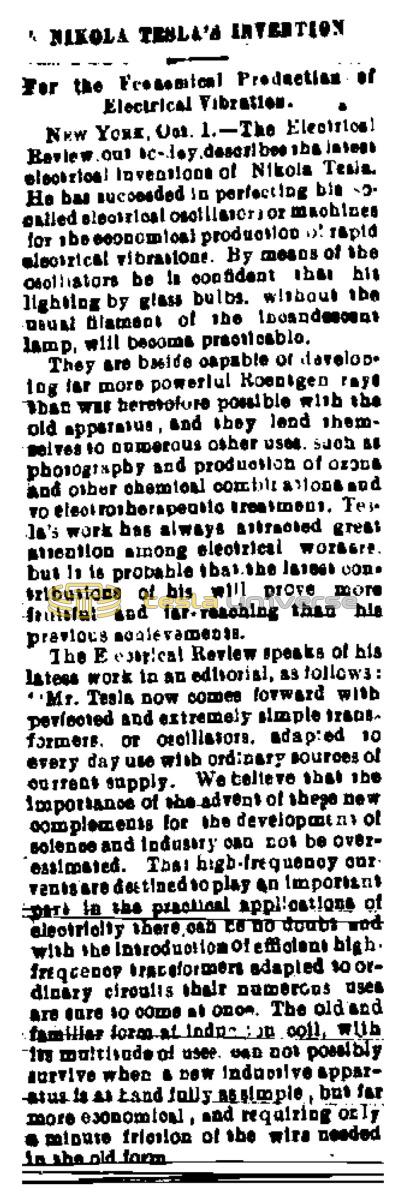
Nikola Tesla's Invention
For the Economical Production of Electrical Vibration.
NEW YORK, Oct. 1. — The Electrical Review of to-day describes the latest electrical inventions of Nikola Tesla. He has succeeded in perfecting his so-called electrical oscillators, or machines for the economical production of rapid electrical vibrations. By means of the oscillators he is confident that his lighting by glass bulbs, without the usual filament of the incandescent lamp, will become practicable.
They are beside capable of developing far more powerful Roentgen rays than was heretofore possible with the old apparatus, and they lend themselves to numerous other uses, such as photography and production of ozone and other chemical combinations and to electrotherapeutic treatment. Tesla’s work has always attracted great attention among electrical workers, but it is probable that the latest contributions of his will prove more fruitful and far-reaching than his previous achievements.
The Electrical Review speaks of his latest work in an editorial, as follows: “Mr. Tesla now comes forward with perfected and extremely simple transformers, or oscillators, adapted to every day use with ordinary sources of current supply. We believe that the importance of the advent of these new complements for the development of science and industry can not be overestimated. That high-frequency currents are destined to play an important part in the practical applications of electricity there can be no doubt and with the introduction of efficient high-frequency transformers adapted to ordinary circuits their numerous uses are sure to come at once. The old and familiar form of induction coil, with its multitude of uses, can not possibly survive when a new inductive apparatus is at hand fully as simple, but far more economical, and requiring only a minute fraction of the wire needed in the old form.”
Reprints
- Nikola Tesla's Invention (reprint)Utica Daily Press — October 1st, 1896