Nikola Tesla Articles
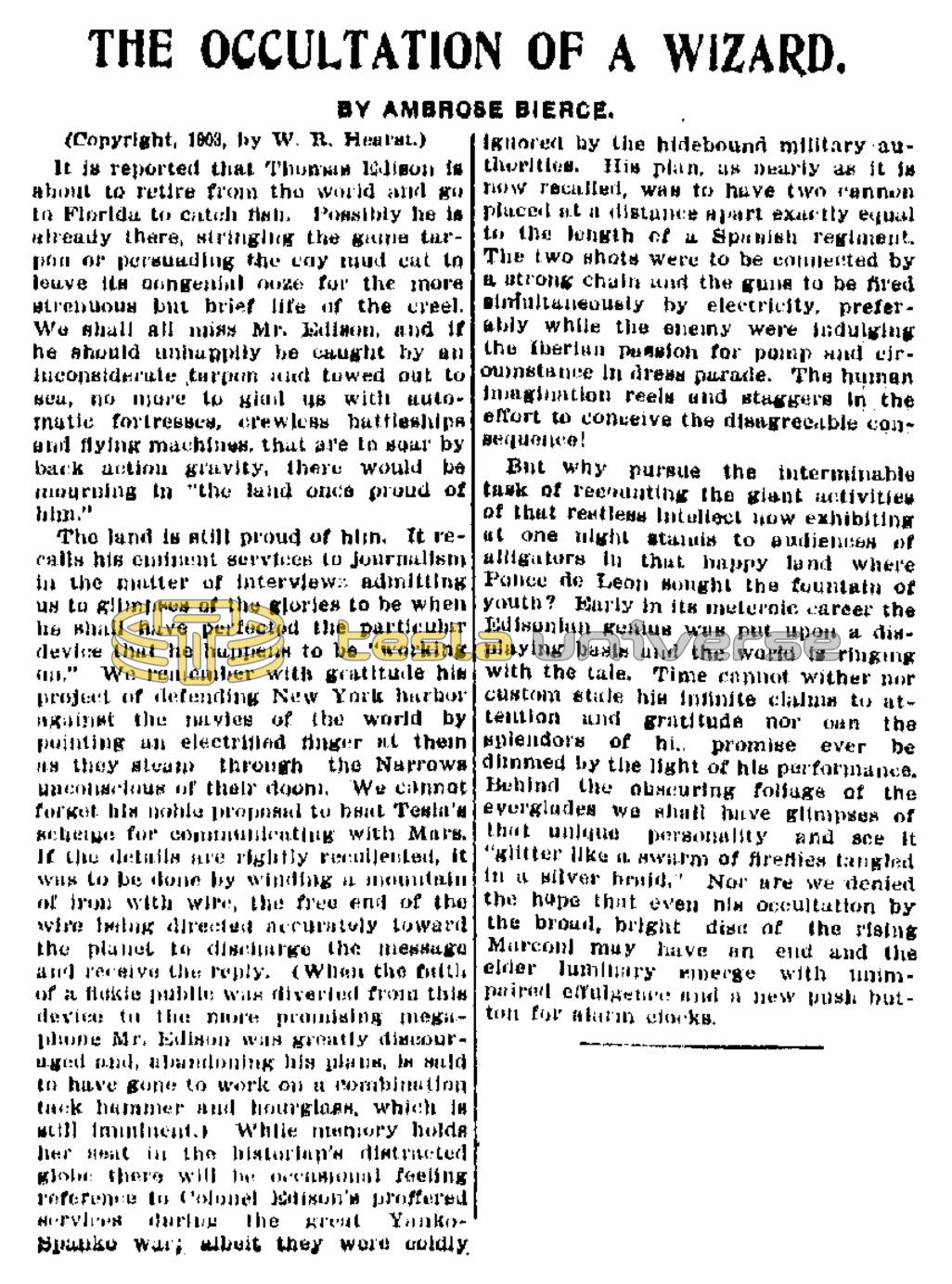
The Occultation of a Wizard
(Copyright, 1903, by W. R. Hearst.)
It is reported that Thomas Edison is about to retire from the world and go to Florida to catch fish. Possibly he is already there, stringing the game tarpon or persuading the coy mud cat to leave its congenial ooze for the more strenuous but brief life of the creel. We shall all miss Mr. Edison, and if he should unhappily be caught by an inconsiderate tarpon and towed out to sea, no more to glad us with automatic fortresses, crewless battleships and flying machines, that are to soar by back action gravity, there would be mourning in “the land once proud of him.”
The land is still proud of him. It recalls his eminent services to journalism in the matter of interviews: admitting us to glimpses of the glories to be when he shall have perfected the particular device that he happens to be “working on.” We remember with gratitude his project of defending New York harbor against the navies of the world by pointing an electrified finger at them as they steam through the Narrows unconscious of their doom. We cannot forget his noble proposal to beat Tesla’s scheme for communicating with Mars. If the details are rightly recollected, it was to be done by winding a mountain of iron with wire, the free end of the wire being directed accurately toward the planet to discharge the message and receive the reply. (When the faith of a fickle public was diverted from this device to the more promising megaphone Mr. Edison was greatly discouraged and, abandoning his plans, is said to have gone to work on a combination tack hammer and hourglass, which is still imminent.) While memory holds her seat in the historian’s distracted globe there will be occasional feeling reference to Colonel Edison’s proffered services during the great Yanko-Spanko war; albeit they were coldly ignored by the hidebound military authorities. His plan, as nearly as it is now recalled, was to have two cannon placed at a distance apart exactly equal to the length of a Spanish regiment. The two shots were to be connected by a strong chain and the guns to be fired simultaneously by electricity, preferably while the enemy were indulging the Iberian passion for pomp and circumstance in dress parade. The human imagination reels and staggers in the effort to conceive the disagreeable consequence!
But why pursue the interminable task of recounting the giant activities of that restless intellect now exhibiting at one night stands to audiences of alligators in that happy land where Ponce de Leon sought the fountain of youth? Early in its meteoric career the Edisonian genius was put upon a displaying basis and the world is ringing with the tale. Time cannot wither nor custom stale his infinite claims to attention and gratitude nor can the splendors of his promise ever be dimmed by the light of his performance. Behind the obscuring foliage of the everglades we shall have glimpses of that unique personality and see it “glitter like a swarm of fireflies tangled in a silver braid.” Nor are we denied the hope that even his occultation by the broad, bright disc of the rising Marconi may have an end and the elder luminary emerge with unimpaired effulgence and a new push button for alarm clocks.