Nikola Tesla Articles
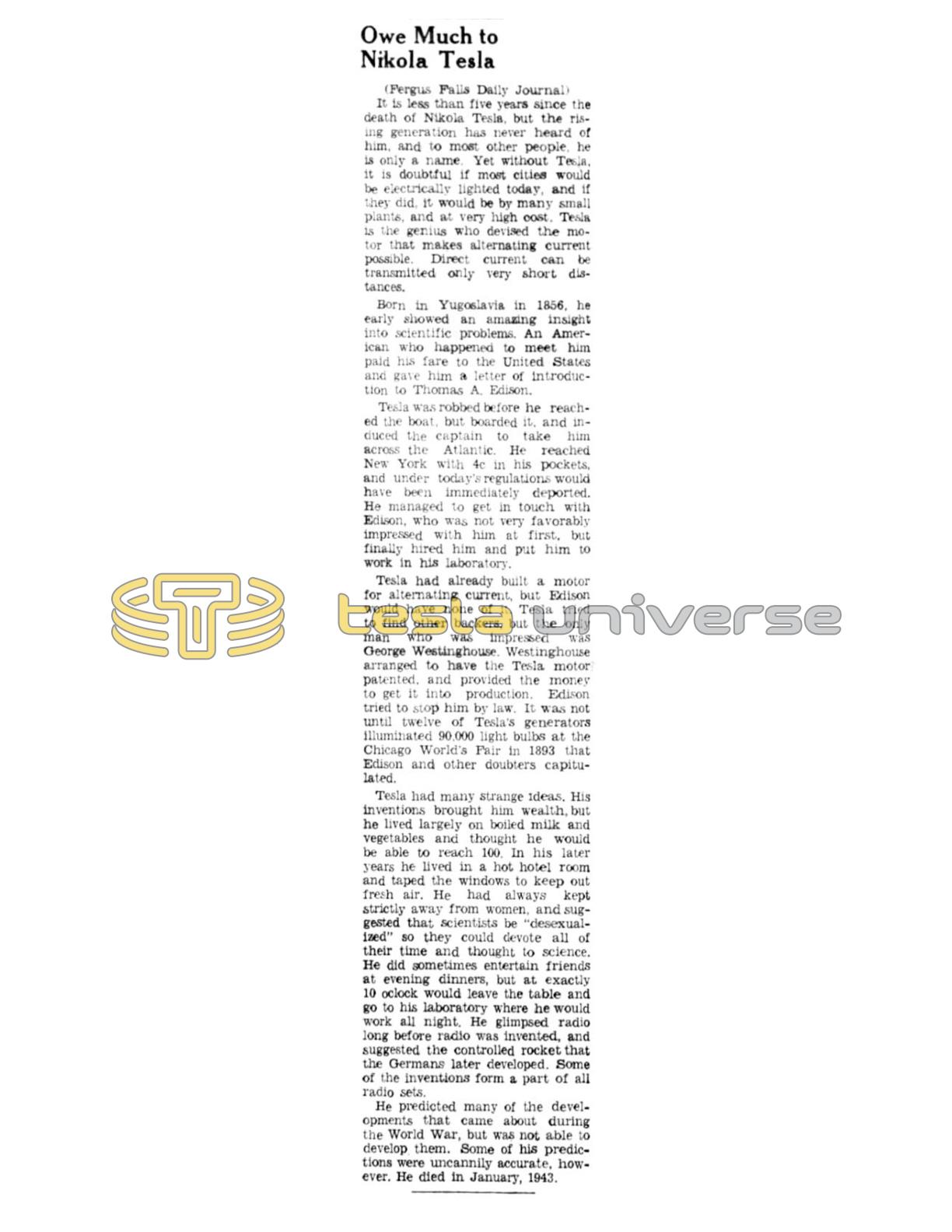
Owe Much to Nikola Tesla
(Fergus Falls Daily Journal)
It is less than five years since the death of Nikola Tesla, but the rising generation has never heard of him, and to most other people, he is only a name. Yet without Tesla, it is doubtful if most cities would be electrically lighted today, and if they did, it would be by many small plants, and at very high cost. Tesla is the genius who devised the motor that makes alternating current possible. Direct current can be transmitted only very short distances.
Born in Yugoslavia in 1856, he early showed an amazing insight into scientific problems. An American who happened to meet him paid his fare to the United States and gave him a letter of introduction to Thomas A. Edison.
Tesla was robbed before he reached the boat, but boarded it, and induced the captain to take him across the Atlantic. He reached New York with 4c in his pockets, and under today's regulations would have been immediately deported. He managed to get in touch with Edison, who was not very favorably impressed with him at first, but finally hired him and put him to work in his laboratory.
Tesla had already built a motor for alternating current, but Edison would have none of it. Tesla tried to find other backers, but the only man who was impressed was George Westinghouse. Westinghouse arranged to have the Tesla motor patented, and provided the money to get it into production. Edison tried to stop him by law. It was not until twelve of Tesla's generators illuminated 90.000 light bulbs at the Chicago World's Fair in 1893 that Edison and other doubters capitulated.
Tesla had many strange ideas. His inventions brought him wealth, but he lived largely on boiled milk and vegetables and thought he would be able to reach 100. In his later years he lived in a hot hotel room and taped the windows to keep out fresh air. He had always kept strictly away from women, and suggested that scientists be "desexualized" so they could devote all of their time and thought to science. He did sometimes entertain friends at evening dinners, but at exactly 10 oclock would leave the table and go to his laboratory where he would work all night. He glimpsed radio long before radio was invented, and suggested the controlled rocket that the Germans later developed. Some of the inventions form a part of all radio sets.
He predicted many of the developments that came about during the World War, but was not able to develop them. Some of his predictions were uncannily accurate, however. He died in January, 1943.