Nikola Tesla Articles
Phenomena of Alternating Current Induction
About three years ago I had the pleasure of bringing to the attention of the American Institute of Electrical Engineers at its annual meeting, certain phenomena of the repulsive action between conductors such as coils of wire traversed by alternating electric currents. It was then noted that if such a current be sent through a circuit wound as a coil, and either provided with an iron core, or not so provided, and permitted to induce in another coil or circuit a current under conditions which allowed a lag or displacement of phase of the latter from its theoretical position, a repulsive effort would be exerted, tending to remove one coil from proximity with the other, or to deflect one of them to a position such that the plane of the coils would be at right angles one to the other.
Many modifications of the arrangements of the coils were described and apparatus based upon the principle of inductive repulsion, as I called it, were touched upon. I need not now enlarge upon these matters. It may suffice to say that current indicators and potential indicators or voltmeters have been constructed embodying the principle as applied to the quantitative measurement of alternating currents. Arc lamps have been made in which the regulation of the carbons has been effected by the repulsive action of a coil traversed by the current fed to the lamp, or by a derived current around the arc, acting on a closed band or circuit movable with the regulating and feeding frame of the lamp. Various forms of alternating-current motors have been made in which the revolving portion is composed of coils arranged to be closed upon themselves, and inductively acted upon by the currents in what may be called the field or inducing coils connected with the alternating current source. The principle has been applied in other apparatus, such as regulating mechanism for alternating currents and in electric meters.
It is my purpose this evening to bring before the institute some experimental apparatus showing the action of inductive repulsion in some of its phases, following this by a brief account of a number of other effects somewhat allied to it, with experimental demonstrations of the same. Some of these experiments were to be seen at the Paris Exposition of last year in connection with my exhibit there, and others of them are more recent still, while still others have never been shown at all in public. The field is a fruitful one, and there is not time to touch upon other than the more striking and perhaps interesting phases of the actions exhibited, which are susceptible of modification to a great extent by changes in proportion and arrangement of apparatus.
I may here revert to one experiment, which is almost a repetition of one I made about five years ago. If a copper disc or closed coil be balanced in front of another coil and parallel thereto, it will be noticed that on passing a current into the second coil the disc or closed coil will be repelled slightly, and if the current be afterwards shunted or cut off there will be a slight attraction. By opening and closing the shunt so as to put the current successively on and off the coil, there will be alternate repulsions and attractions exhibited. Let the current, however, be so put on and off very quickly, and the attractive effect will become less than the repulsive effect, and the disc or closed coil will be driven away or bodily repelled. Replace, now, the intermittent current by an alternating current, which reverses many times per second, and the repulsive effect alone is noticed, provided that the disc or closed coil is of sufficient mass and conductivity to allow currents of high self-induction to be set up in it, whereby such disc or coil or current in it may, as it were, exert a controlling influence upon the magnetic field in immediate proximity to it.
The amount of this repulsive effect may, under favourable circumstances, become so great as to give with moderate-current densities a very considerable pressure or force.
I have selected some particular instances of this action for our experiments, as it will be understood that time is too short to show many variations of the effect as found in numerous experimental trials.
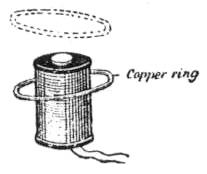
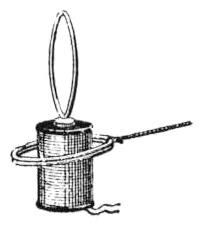
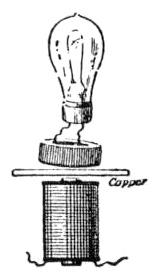
Placing a copper ring over a coil which has been wound upon an iron core, and passing an alternating current through the coil, gives so much repulsive effect that the ring is thrown forcibly away and up into the air (Fig. 1). Or, again, the ring may be supported for a moment in free air, though its condition is one of unstable equilibrium. Further, we may arrange a string or thread to so guide the ring that it cannot move laterally though free to fall towards the alternating-current coil (Fig. 2). It is in this case supported in the magnetic field of the coil and away from it. It takes a position of balance between the repulsive effect and its own weight, which are opposed forces. As a curious variation, another copper ring (Fig. 2) may be added under the former, to which it seems to be attracted as though magnetised, after which both rings are supported as one. The explanation is very simple. The currents induced in both rings are in the same direction at any instant and produce attraction. The bearing of this will be seen in later experiments where rotary actions are produced.
Copper plates are but imperfect discs and act as closed coils. Aluminium rings, having much less weight than copper, might at first be expected to be more readily supported, but it must be remembered that the conductivity of aluminium is much less than that of copper, and hence that since the effect depends on current induced and retardation of phase or lag of such current, copper is the better on account of its high conductivity.
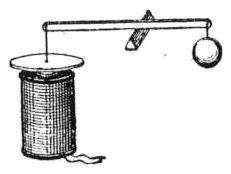
By attaching the closed ring or coil to a balance beam (Fig. 3), we are able to measure the amount of force exerted with different currents, and the different materials or constructions.
Such measurements show very decidedly that the repulsive effort depends on the strength of the current in the inducing coil, and in the ring or closed coil, and on the relation of the position of the waves of induced current in the closed coil or ring with those of the inducing coil. The effects are, properly considered, magnetic repulsive effects of the opposing fields of the induced and inducing currents relatively.
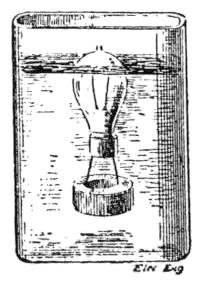
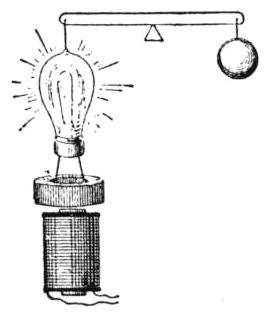
When the closed coil or disc is mounted so that it can only turn on an axis in its plane then the repulsion resolves itself into a deflection of its plane to a position at right angles to the plane of the inducing coil, or, more strictly, to parallelism with the direction of the magnetic lines set up by such inducing coil. The effect of the control exhibited by such a closed circuit of good conducting power over the magnetic field of the inducing coil, is seen by interposing such closed circuits between the inducing coil and another coil acting as a secondary and feeding an incandescent lamp (Fig. 4). The light of the lamp is cut down and extinguished thereby, as the alternating field is now almost completely shielded from the secondary. The coil feeding the lamp undergoes a slight repulsion. This is easily exhibited by placing in a glass jar with water a lamp and coil, the lamp wires being connected with the coil terminals, and so loading it that it just sinks to the bottom of the jar. Placing this above the inducing coil so as to bring it into the alternating magnetic field is attended not only with the lighting of the lamp under water, but there is noticed a repulsion or floating of the lamp to a certain point (Fig. 5), at which its tendency to sink just balances the repulsion exerted. So long as the lamp remains so suspended in the water its brilliancy is constant, notwithstanding that the strength of the inducing current be raised or lowered considerably. It is, of course, unnecessary to use water to balance the lamp coil; a beam and counterpoise weight will suffice (Fig. 5a).
In utilising the repulsive action for obtaining movement from alternating currents, the closed coil or circuit may be mounted in various ways.
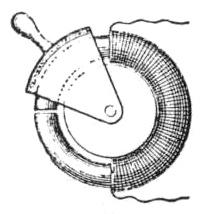
A convenient form is one in which a bent core of iron wire or plates which may be a ring is wound over with insulated wire at a portion only of its surface. A closed band or secondary is pivotally mounted, so as to pass over the curved core, and also over the wire covered portion if moved around the pivot by a suitable carrier (Fig. 6). A spring or weight may tend to cause the closed band to pass over the wire-covered portion of the core. Currents sent in the wire coil produce repulsion and movement of the closed band about the pivots to a position on the core removed from the coil.
This apparatus, and some of its modifications, is a valuable reactive coil, which gives a smooth variation, and hence is called a "smoothly-acting reactive coil," for it enables us by changing the relation of the closed band or secondary circuit to affect the inductive resistance, as it may be termed, or the impedance of the coil wound on the core, the changes being made by swinging the closed band on its pivotal support by a suitable operating handle. It so varies the effects in an alternating circuit as to represent those of variable resistance in a continuous-current circuit, but it does this without much loss of energy, and not by steps, but through the finest gradations. The power is greatly increased by the provision of a movable iron armature for the core, centrally placed and pivoted, carrying the closed secondary coil upon it.
It is easy to see that by placing on a laminated armature core a series of coils which can be suitably short-circuited by a commutator, and placing such armatures between poles of alternating magnetic polarity, or, better, surrounding such armature by coils for producing directly in it an alternation of magnetic states, while the magnetic circuit is completed by an outside magnetic circuit of laminated iron, we have obtained a rotary motor for alternating currents which may be termed a transformer-motor, since the armature currents are induced and not obtained from the outside.
But by properly constructing such a machine, it is not necessary to have a commutator if we are content to start the motor initially by some means, for we may close the armature coils on themselves, pass alternating current through the field coils so as to establish an alternating field in which the armature exists, and it will be found that the machine will turn in the direction in which it has been started and run up to a speed depending on the construction. I have constructed a number of such machines, some of which are self-starting without a commutator. They are made self-starting by special features of construction. Whether they can be made of high or fair efficiency remains to be seen. Using only one alternating current they can, of course, be used on existing lines.
There are a number of curious effects to be described which depend on a shifting or propagation of magnetic lines of force.
Many of these effects were worked out conjointly by Mr. M. J. Wightman and myself, and some of the ways of exhibiting them are due to the skill of my workmen carrying on the construction of apparatus.
The principles may be briefly stated as follows:
1. If two or more closed circuits are similarly affected inductively by an alternating magnetic field, they will attract one another and tend to move into parallelism.
2. Iron or steel masses placed in an alternating magnetic field give rise to shifting magnetism, or lines of force moving laterally, and may, therefore, act to move closed circuits in the path of such shifting lines.
3. Closed circuits in alternating magnetic fields, or fields of varying intensity, give rise to shifting magnetism or lines of force moving laterally to their direction, and may, therefore, act to move other closed circuits in the path of such lines.
4. Iron or steel masses may, when placed in an alternating magnetic field, interact with other such masses, or with closed electric circuits, so as to produce movement of such masses or circuits relatively, or give rise to tendencies to so move, the effects depending on continual adaptations of shifting magnetism and retained magnetism relatively.
The experimental demonstration of these principles can be carried out with very simple apparatus. The explanations of the actions which occur in accordance with known principles are in many cases very evident, and in others are arrived at with a little study. Nevertheless, the experiments illustrate, in a marked manner, properties of matter and peculiarities of magnetic action which will probably never be fully understood unless the nature of the ether and its relations to what we call matter are discovered.
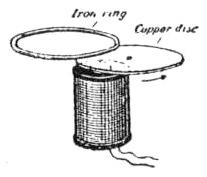
We will return to the case of the ring attracting another ring to it. Here we have the case of like currents in parallel direction producing attraction. Such an action can be made continuous. We have only to place a ring or plate over the alternating-current coil or pole of its core and then bring a copper disc free to revolve on pivots into proper position relatively thereto. This can best be done by placing the ring or plate so as to be somewhat to one side of the pole, so as to shade it in part, as it were, while a part of the pivoted disc is placed under it, or over it, in front of the alternating field pole (Fig. 7). The disc then revolves from the unshaded portion of the pole towards the shaded portion where the closed ring or plate is placed.
The actions are due to lines of magnetic force at each alternation of current in the magnetising coil below meeting a retarding influence or opposition to their development over that part of the pole shaded by the copper ring or plate owing to currents induced therein. The copper disc is the seat of similar currents, but chiefly about those portions not shaded by the ring or plate. Owing to self-induction, these currents in ring and plate tend to persist into the period of reversal of the field. This gives rise to a movement of those portions of the disc where current is flowing into a position directly adjacent to the ring or the currents flowing in it, an action which is repeated at every alternation and results in a revolution of the disc. While this explanation is probably the simplest it must be borne in mind that it is but an expression of a set of magnetic actions or changes in the magnetic field; such magnetic field being the resultant of the changing force of the original alternating inducing field and of the magnetic effects of the currents set up in a ring or plate and the disc, both of which latter have a retarding action due to self-induction of the currents in them.
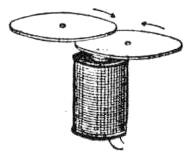
If, now, two discs be used instead of one (Fig. 8), it will be found that they may each shade a portion of the pole, and that the discs, if made to overlap, will both revolve in opposite directions relatively.
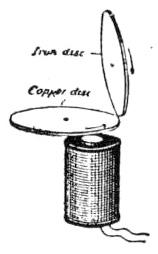
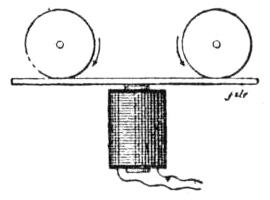
An iron disc may be substituted for one of the discs above and used with the fixed plate or ring below it, and so be caused to revolve, and its position can be changed so that it is in a plane vertical to the plane of the plate or ring (Fig. 9). Also, it may be similarly used in relation to the revolving copper disc. In fact, the positions of two copper discs pivoted so as to be revolvable, or of a copper and iron disc, may be greatly varied and effects of rotation obtained.
If we vary the experiment by placing a closed coil around a part of an iron core upon which is also wound a coil which can be put into an alternating-current circuit the effects obtainable are similar to those described above - that is, the structure becomes capable of revolving copper or iron discs held near it. The direction of revolution is such as to indicate a propagation of magnetism or magnetic polarity at a retarded rate through that portion of the iron core covered by the closed coil. In this respect a bar of iron unlaminated, or not divided, is the same as a core surrounded by a closed coil, for it is also capable of causing the rotation of the discs, when such a bar is abutted to a laminated core alternatively magnetised, or when such a bar is surrounded at part of its length only by the magnetising coil. A bar of steel substituted for the iron, even if well laminated, is able to cause brisk rotations of the copper or iron discs.
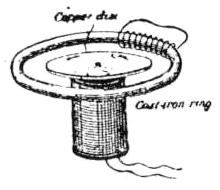
With hardened steel the action is the more marked, a file serving for the experiment. Here the "hysteresis," or coercive force, or magnetic friction retards the propagation of the magnetic wave. By laying a large file flatwise against the alternating magnet pole at about the middle of the file (Fig. 10) two discs of copper or iron may be kept revolving, or one each of copper and iron held over those portions of the file projecting from the pole of the magnet over which it is laid will revolve. The iron disc may be held vertically, and the copper horizontally or flatwise to the file.
Cast iron behaves like steel, though more feebly. A ring of cast iron, having a closed coil wound on one part (Fig. 11), can be laid on the pole of the alternating magnet coil, and it will rotate an iron disc concentric with it if the placing of the closed coil portion of the ring is not made so as to bring it either over the pole or diametrically opposite that point, the best effect being obtained when it is alongside of the pole.
A small motor of a curious type has been made, utilising the principle of shading the pole by closed circuits. A laminated ring (Fig. 12) is wound over with wire, but has a slot cut through it, dividing the ring, and causing it to present two pole faces opposite to each other at the cut part. Each pole is arranged by a set of closed copper bands to be "shaded," as I term it. A copper disc free to turn introduced by one edge into the slot turns rapidly and exerts some power.
Removing the disc it is found that a silver coin can be inserted into the slot and will be drawn into it and propelled with some force through the same, while a lead coin, or coin of base metal, will be scarcely affected. This is due to the vigorous currents which can exist in the silver, owing to its high conductivity, while the very low effect of the lead is due to the opposite cause.
To obtain a rotary effect on a copper disc we can, however, simplify matters very much by using no closed circuit at all, nor even a steel piece. We may place the disc partly over the alternating pole and then hold over the disc a bundle of iron wires or unwound core, taking care to offset its axes to some extent from that of the pole towards which it and the disc are presented. The result is at once a rapid revolution of the disc in the direction of the offsetting.
*Abstract of a lecture delivered before the American Institute of Electrical Engineers at Columbia College, April 2, 1890.