Nikola Tesla Articles
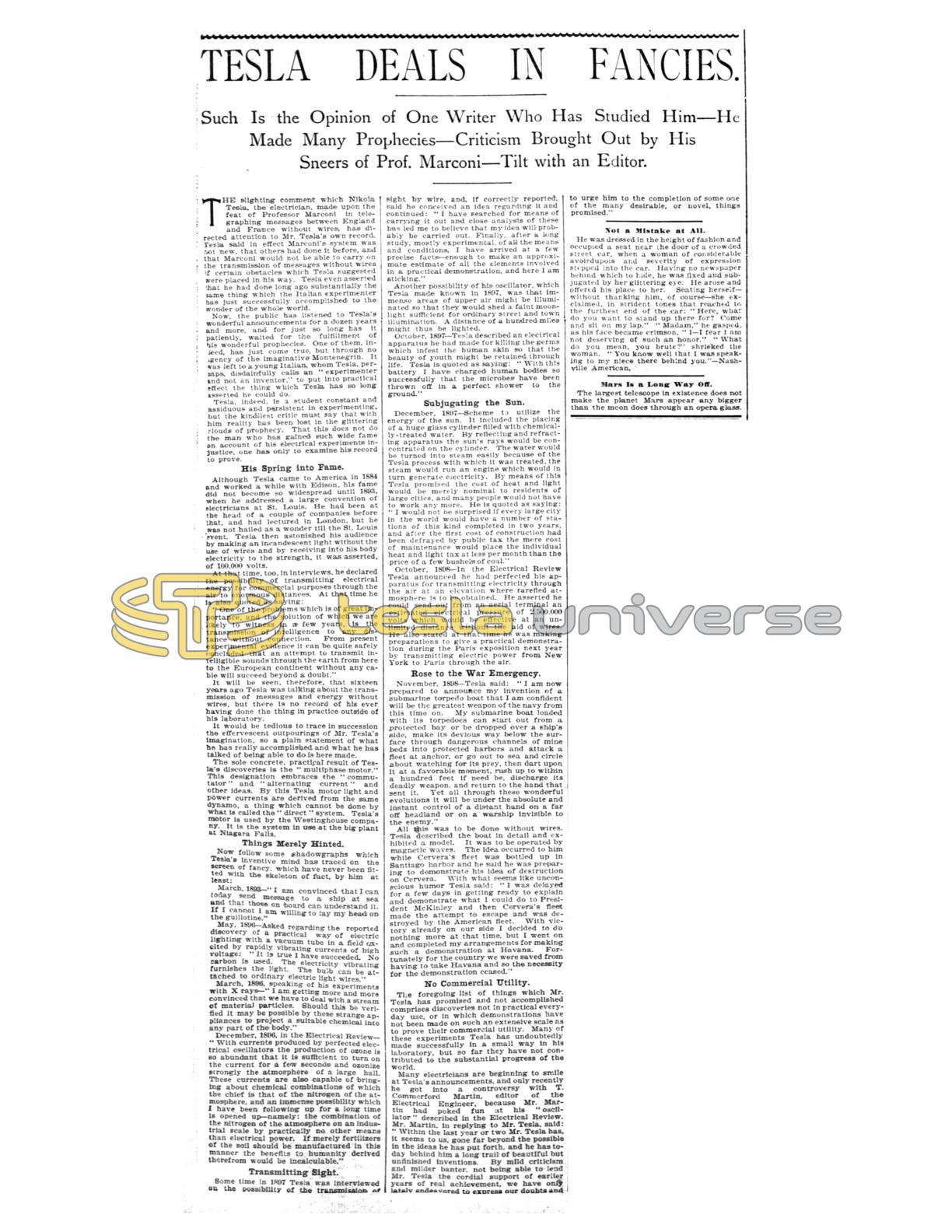
Tesla Deals in Fancies
Such Is the Opinion of One Writer Who Has Studied Him — He Made Many Prophecies — Criticism Brought Out by His Sneers of Prof. Marconi — Tilt with an Editor.
The slighting comment which Nikola Tesla, the electrician, made upon the feat of Professor Marconi in telegraphing messages between England and France without wires, has directed attention to Mr. Tesla's own record. Tesla said in effect Marconi's system was not new, that others had done it before, and that Marconi would not be able to carry on the transmission of messages without wires if certain obstacles which Tesla suggested were placed in his way. Tesla even asserted that he had done long ago substantially the same thing which the Italian experimenter has just successfully accomplished to the wonder of the whole world.
Now, the public has listened to Tesla's wonderful announcements for a dozen years and more, and for just so long has it patiently waited for the fulfillment of his wonderful prophecies. One of them, indeed, has just come true, but through no agency of the imaginative Montenegrin. It was left to a young Italian, whom Tesla, perhaps, disdainfully calls an "experimenter and not an inventor." to put into practical effect the thing which Tesla has so long asserted he could do.
Tesla, indeed, is a student constant and assiduous and persistent in experimenting, but the kindliest critic must say that with him reality has been lost in the glittering clouds of prophecy. That this does not do the man who has gained such wide fame on account of his electrical experiments injustice, one has only to examine his record to prove.
His Spring into Fame.
Although Tesla came to America in 1884 and worked a while with Edison, his fame did not become so widespread until 1893, when he addressed a large convention of electricians at St. Louis. He had been at the head of a couple of companies before that, and had lectured in London, but he was not hailed as a wonder till the St. Louis event. Tesla then astonished his audience by making an incandescent light without the use of wires and by receiving into his body electricity to the strength, it was asserted, of 100,000 volts.
At that time, too, in interviews, he declared the possibility of transmitting electrical energy for commercial purposes through the air to enormous distances. At that time he is also quoted as saying:
"One of the problems which is of great importance, and the solution of which we are likely to witness in a few years, is the transmission of intelligence to any distance without connection. From present experimental evidence it can be quite safely concluded that an attempt to transmit intelligible sounds through the earth from here to the European continent without any cable will succeed beyond a doubt."
It will be seen, therefore, that sixteen years ago Tesla was talking about the transmission of messages and energy without wires, but there is no record of his ever having done the thing in practice outside of his laboratory.
It would be tedious to trace in succession the effervescent outpourings of Mr. Tesla's imagination, so a plain statement of what he has really accomplished and what he has talked of being able to do is here made.
The sole concrete, practical result of Tesla's discoveries is the "multiphase motor." This designation embraces the "commutator" and "alternating current" and other ideas. By this Tesla motor light and power currents are derived from the same dynamo, a thing which cannot be done by what is called the "direct" system. Tesla's motor is used by the Westinghouse company. It is the system in use at the big plant at Niagara Falls.
Things Merely Hinted.
Now follow some shadowgraphs which Tesla's inventive mind has traced on the screen of fancy, which have never been fitted with the skeleton of fact, by him at least:
March, 1893 — "I am convinced that I can today send message to a ship at sea and that those on board can understand it. If I cannot I am willing to lay my head on the guillotine."
May, 1896 — Asked regarding the reported discovery of a practical way of electric lighting with a vacuum tube in a field excited by rapidly vibrating currents of high voltage: "It is true I have succeeded. No carbon is used. The electricity vibrating furnishes the light. The bulb can be attached to ordinary electric light wires."
March, 1896, speaking of his experiments with X rays — "I am getting more and more convinced that we have to deal with a stream of material particles. Should this be verified it may be possible by these strange appliances to project a suitable chemical into any part of the body."
December, 1896, in the Electrical Review — "With currents produced by perfected electrical oscillators the production of ozone is so abundant that it is sufficient to turn on the current for a few seconds and ozonize strongly the atmosphere of a large hall. These currents are also capable of bringing about chemical combinations of which the chief is that of the nitrogen of the atmosphere, and an immense possibility which I have been following up for a long time is opened up — namely: the combination of the nitrogen of the atmosphere on an industrial scale by practically no other means than electrical power. If merely fertilizers of the soil should be manufactured in this manner the benefits to humanity derived therefrom would be incalculable."
Transmitting Sight.
Some time in 1897 Tesla was interviewed on the possibility of the transmission of sight by wire, and, if correctly reported, said he conceived an idea regarding it and continued: "I have searched for means of carrying it out and close analysis of these has led me to believe that my idea will probably be carried out. Finally, after a long study, mostly experimental, of all the means and conditions, I have arrived at a few precise facts-enough to make an approximate estimate of all the elements involved in a practical demonstration, and here I am sticking."
Another possibility of his oscillator, which Tesla made known in 1897, was that immense areas of upper air might be illuminated so that they would shed a faint moonlight sufficient for ordinary street and town illumination. A distance of a hundred miles might thus be lighted.
October, 1897 — Tesla described an electrical apparatus he had made for killing the germs which infest the human skin so that the beauty of youth might be retained through life. Tesla is quoted as saying: "With this battery I have charged human bodies so successfully that the microbes have been thrown off in a perfect shower to the ground."
Subjugating the Sun.
December, 1897 — Scheme to utilize the energy of the sun. It included the placing of a huge glass cylinder filled with chemically-treated water. By reflecting and refracting apparatus the sun's rays would be concentrated on the cylinder. The water would be turned into steam easily because of the Tesla process with which it was treated, the steam would run an engine which would in turn generate electricity. By means of this Tesla promised the cost of heat and light would be merely nominal to residents of large cities, and many people would not have to work any more. He is quoted as saying: "I would not be surprised if every large city in the world would have a number of stations of this kind completed in two years, and after the first cost of construction had been defrayed by public tax the mere cost of maintenance would place the individual heat and light tax at less per month than the price of a few bushels of coal."
October, 1898 — In the Electrical Review Tesla announced he had perfected his apparatus for transmitting electricity through the air at an elevation where rarefied atmosphere is to be obtained. He asserted he could send out from an aerial terminal an estimated electrical pressure of 2,500,000 volts which would be effective at an unlimited distance without the aid of wires. He also stated at that time he was making preparations to give a practical demonstration during the Paris exposition next year by transmitting electric power from New York to Paris through the air.
Rose to the War Emergency.
November, 1898 — Tesla said: "I am now prepared to announce my invention of a submarine torpedo boat that I am confident will be the greatest weapon of the navy from this time on. My submarine boat loaded with its torpedoes can start out from a protected bay or be dropped over a ship's side, make its devious way below the surface through dangerous channels of mine beds into protected harbors and attack a fleet at anchor, or go out to sea and circle about watching for its prey, then dart upon it at a favorable moment, rush up to within a hundred feet if need be, discharge its deadly weapon, and return to the hand that sent it. Yet all through these wonderful evolutions it will be under the absolute and instant control of a distant hand on a far off headland or on a warship invisible to the enemy."
All this was to be done without wires. Tesla described the boat in detail and exhibited a model. It was to be operated by magnetic waves. The idea occurred to him while Cervera's fleet was bottled up in Santiago harbor and he said he was preparing to demonstrate his idea of destruction on Cervera. With what seems like unconscious humor Tesla said: "I was delayed for a few days in getting ready to explain and demonstrate what I could do to President McKinley and then Cervera's fleet made the attempt to escape and was destroyed by the American fleet. With victory already on our side I decided to do nothing more at that time, but I went on and completed my arrangements for making such a demonstration at Havana. Fortunately for the country we were saved from having to take Havana and so the necessity for the demonstration ceased."
No Commercial Utility.
The foregoing list of things which Mr. Tesla has promised and not accomplished comprises discoveries not in practical everyday use, or in which demonstrations have not been made on such an extensive scale as to prove their commercial utility. Many of these experiments Tesla has undoubtedly made successfully in a small way in his laboratory, but so far they have not contributed to the substantial progress of the world.
Many electricians are beginning to smile at Tesla's announcements, and only recently he got into a controversy with T. Commerford Martin, editor Electrical Engineer, because Mr. Martin had poked fun at his "oscillator" described in the Electrical Review. Mr. Martin, in replying to Mr. Tesla, said: "Within the last year or two Mr. Tesla has, it seems to us, gone far beyond the possible in the ideas he has put forth, and he has today behind him a long trail of beautiful but unfinished inventions. By mild criticism and milder banter, not being able to lend Mr. Tesla the cordial support of earlier years of real achievement, we have only lately endeavored to express our doubts and to urge him to the completion of some one of the many desirable, or novel, things promised."
Not a Mistake at All.
He was dressed in the height of fashion and occupied a seat near the door of a crowded street car, when a woman of considerable avoirdupois and severity of expression stepped into the car. Having no newspaper behind which to hide, he was fixed and subjugated by her glittering eye. He arose and offered his place to her. Seating herself — without thanking him, of course — she exclaimed, in strident tones that reached to the furthest end of the car: "Here, what do you want to stand up there for? Come and sit on my lap." "Madam," he gasped. as his face became crimson, "I — I fear I am not deserving of such an honor." "What do you mean, you brute?" shrieked the woman. "You know well that I was speaking to my niece there behind you." — Nashville American,
Mars Is a Long Way Off.
The largest telescope in existence does not make the planet Mars appear any bigger than the moon does through an opera glass.
Reprints
- Is Tesla a Fraud? (reprint)Wichita Eagle — April 16th, 1899