Nikola Tesla Articles
Tesla Motor Patents in Litigation
In the infringement suit which the Westinghouse Electric and Manufacturing Company brought against the Catskill Illuminating and Power Company some interesting facts appear concerning the Tesla motor. The case was decided in favor of the Westinghouse company by the United States Circuit Court of the Southern District of New York, but has been carried up to the United States Circuit Court of Appeals by the Catskill company. The appealed case was called for Monday, November 10th, but was postponed until last Monday, at which time it came up for a rehearing. In the brief for the appellant, prepared by Charles A. Brown of Chicago, many interesting historical facts are presented.
The patents on which it is claimed the Catskill company is infringing were applied for by Nikola Tesla on December 8, 1888. These patents were granted as improvements to prior patents granted to the same inventor, and relate to the rotating-field motor. The infringement proceedings involve the working principles of the Scheefer meter.
An idea of the slight knowledge of the action of the electric current in dynamo-electric machines some 14 years ago may be obtained from the following, which is an extract from a paper read before the American Institute of Electrical Engineers by Mr. Tesla in May, 1888: "In our dynamo machines, it is well known, we generate alternate currents which we direct by means of a commutator, a complicated device, and, it may be justly said, the source of most of the troubles experienced in the operation of the machines. Now, the currents so directed cannot be utilized in the motor, but they must — again by means of a similar unreliable device — be reconverted into their original state of alternate currents. The function of the commutator is entirely external, and in no way does it affect the internal working of the machines. In reality, therefore, all machines are alternate-current machines, the currents appearing as continuous only in the external circuit during their transit from generator to motor. In view simply of this fact, alternate currents would commend themselves as a mere direct application of electrical energy, and the employment of continuous currents would only be justified if we had dynamos which would primarily generate, and motors which would be directly actuated by, such currents.
"But the operation of the commutator on a motor is twofold; first, it reverses the currents through the motor; and, secondly, it effects, automatically, a progressive shifting of the poles of one of its magnetic constituents. Assuming, therefore, that both of the useless operations in the systems, that is to say, the directing of the alternate currents on the generator and reversing the direct currents on the motor, be eliminated, it would still be necessary, in order to cause a rotation of the motor, to produce a progressive shifting of the poles of one of its elements, and the question presented itself — How to perform this operation by the direct action of alternate currents?" From the above one easily understands what rapid strides have been made in the applications of electricity since that time. It seems scarcely possible to realize how short a time it has taken to develop a science which, 15 years ago, was just becoming known to the inventor.
Another instance of the work being done on the alternating current is shown in a paper written by G. Ferraris in April, 1888. He conceived the idea of the rotating-field principle or mode of operation of a motor obtained by the direct action of two out-of-phase alternating currents in fixed energizing coils of the motor, and he embodied it in illustrative apparatus and lectured at the Turin Institution on the subject, a full disclosure of his work having been published on April 22, 1888. The important thing in the mind of Ferraris was the motor and its rotating-field mode of operation, and that the method of producing the required out-of-phase alternating currents was of no consequence. Records show that for four or five years he had been working on inductive and other split-phase methods, measuring the difference of phase obtained under different conditions and generally determining the laws of transformers, the differences in phases of currents, the retardation of induction, etc.
Mr. Ferraris treated the obtaining of the necessary out-of-phase relationship of the currents as a manifest thing. Either two independent and originally out-of-phase currents of the same period or rapidity of alternation could be employed, or the two could be obtained from a single alternating current. And he describes three ways of obtaining them from a single alternating current, and describes it as manifest and well-known matter in the following: "The effects above described may be produced (the rotating magnetic field) by means of a single alternating current. It is, in fact, always possible in various ways to obtain the two currents necessary to produce the component magnetic forces from a single alternating current, and to vary the difference of phase between them within certain limits. One way of doing this is by letting the current pass through the primary coil of a transformer. Then the original current and the induced current are at our disposal.
"Another method of obtaining the same result consists in producing the two component fields from the two secondary currents produced in two transformers, or in two portions of the same transformer traversed by the primary current. Finally, to produce the forces, two derived currents can be used. If in one of the circuits resistances free from self-induction are introduced, and in the other circuit a coil of small resistance and high self-induction, it may be brought about that, while the mean intensities of the two currents are equal, or have a predetermined ratio, the phases of the currents themselves differ considerably." Ferraris, from his knowledge of the electrical laws governing split-phasing predicted the failure of such a source of out-of-phase currents for power-transmission purposes, but suggested the utility for meter purposes, a prediction which has been fulfilled by the present developments of the art.
Again, Shallenberger, in the spring of 1888, developed a meter having a rotating-field motive device run by out-of-phase currents, obtained by split-phase apparatus from a single source. The device was gotten up as a meter for single-phase alternating-current systems, just then coming into use.
Borel and Paccaud devised a motor apparatus operated by split-phase currents some time in 1887, the publication and patents occurring in the summer of 1888.
Meylan, in La Lumiere Electrique, July 14, 1888, describing the Borel meters for alternating currents, says, in the course of a description of the work of Ferraris, and after setting out the rotating idea: "How is it possible now to attain the two alternating currents which we need? Nothing is simpler, and there are many means offered us for that; in the first place by the use of a transformer; one of the coils is inserted in the primary circuit and the other in the secondary circuit... Another arrangement that allows of obtaining currents with a difference of phase consists in putting the two circuits in multiple arc and in inserting in one of the branches a large self-induction." Thus the idea of using split-phase currents and split-phase apparatus for producing the necessary out-of-phase currents seems to have come naturally to all to whom the rotating-field motor idea became known, and the fact that such a motor required two or more out-of-phase alternating currents.
What all the technical men of that day seem to have been seeking for, was the modern economical multiphase system of transmitting power. The Tesla motor required double circuits, and these the inventors were trying to do away with by some means which would still retain the full and undiminished power-carrying capacity of the currents.
The Tesla invention of the May 1, 1888, patents solved the problem of the utilization in a motor of double-phase alternating currents for power-transmission purposes, and did this by a peculiar construction of motor, to wit, with two or more independent energizing circuits and such a connection of those circuits with the source or sources of the double-phase currents (an alternating-current dynamo) that that out-of-step characteristic of the currents was preserved in the energizing coils of the motor, and a rotating or whirling magnetic field was thereby produced, which caused the armature to start up and rotate.
The invention of the patents in suit, granted December 8, 1888, is not addressed to the utilization of two-phase currents in a motor, but to a way of producing the necessary two out-of-phase currents. Whereas, in the patents of May 1, 1888, the two-phase currents were produced separately in fact and in point of time by the separate coils of the ordinary polyphase alternating-current generator, in the patents in suit the two out-of-phase currents employed are produced from a single-phase alternating current, one being delayed or made to lag more than the other by the inductive or the derivative method. The original unitary current is divided into two currents, and the two are then artificially thrown out of step with relation to each other, and in that condition they enter and operate the motor.
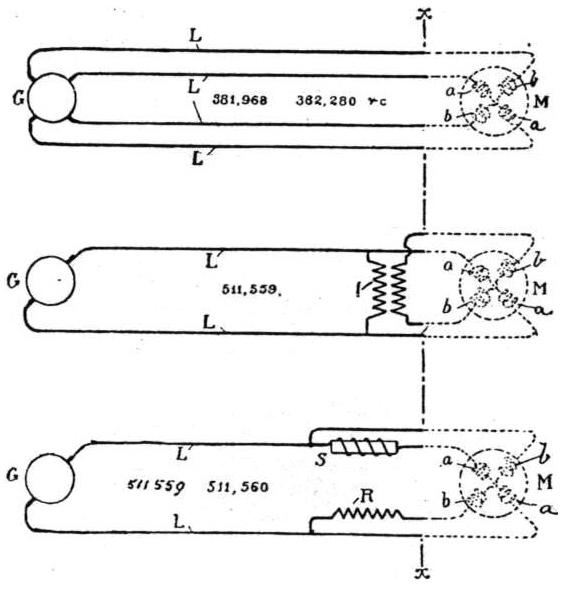
For a better idea of the relation of the two sets of Tesla patents to each other, the three diagrams, shown in Fig. 1 are given. The first is typical of the earlier Tesla patents and the second and third of the patents now in suit. In these diagrams are shown in dotted lines those parts of the apparatus that make use of the out-of-phase alternating currents after they are produced, and in full lines those parts of the apparatus which are involved in the production of the out-of-phase alternating currents prior to their utilization. (G) is the generator; (L), the line wires; (M), the motor; (a) and (b), the two independent energizing circuits of the motor; (I), an induction coil or transformer; (S), a self-induction coil; (R), a resistance coil. The line (x) (x) separates the current-producing parts of the systems from the current-utilizing parts.
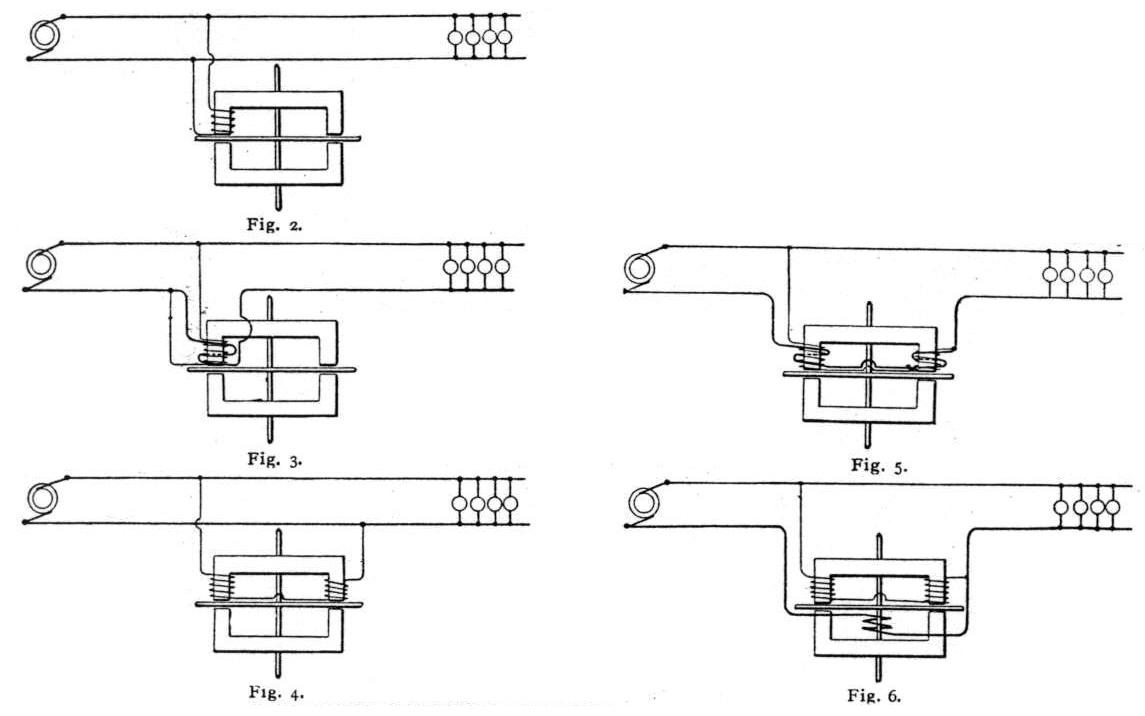
The Scheefer meter, which, as has been said, is involved in the infringement suit, is shown in Fig. 6. Figs. 2, 3, 4 and 5 are diagrams of development stages. Fig. 2 represents a disk which is operated by means of a single energizing circuit, wound upon a field core similar to that of the Scheefer meter. This is wound upon one leg of the core and causes a rotation by means of a difference in the strength of the magnetic poles. It makes no difference whether this winding upon one leg of the core be a series or a shunt winding. In either case the meter will rotate and will be in one case a meter which will measure volts (that is, when it has a pressure winding), and which will in the other case measure current or amperes (when it has a current winding). The trouble with a meter like this is that it will not measure watts unless both windings are superposed, but when both windings are superposed upon the same leg of the core, as in Fig. 3, a rotation is obtained, which is in proportion to the volts times the amperes, or the watts, because both the pressure and the series windings are delivering their magnetic fluxes into the circuit and causing rotation of the disk.
The trouble with this meter, however, is that, because it is under the influence of the shunt winding at all times, even when there is no load connected in circuit, a rotation will ensue and the meter will register when there are no lights in the circuit. To obviate this difficulty, Mr. Scheefer put upon both legs of the core a shunt winding, and thereby secured two opposing balanced tendencies to rotation (Fig. 4), which exactly balanced each other. There would be no rotation, therefore, in the disk with this arrangement under no-load. Now if to the shunt windings which thus balance each other in their effect upon the disk are added two series windings which assist the shunt winding on one leg and oppose the effect of the shunt winding upon the other leg, a rotation will ensue which is in proportion to the watts, and a wattmeter will be the result. This arrangement is shown in Fig. 5.
This is a meter which will operate to secure the same result as the Scheefer meter. The Scheefer meter, however, takes the series winding, and for convenience in arrangement, places it between the two legs of the magnet, and causes it to operate by its magnetic flux to strengthen one pole and weaken the other. It is by this last step that infringement is claimed.
While considering either one of the two devices (Figs. 5 and 6) it will be readily understood that the magnetic flux produced by the shunt winding upon the two legs of the magnetic cores creates a north pole at one end and a south pole at the other end. The series winding, whether placed upon each leg of the core or placed in the center between the two legs, operates by its magnetic flux to strengthen one pole and weaken the other. There results from this condition of unbalanced poles the following action: Each pole sets up in the disk eddy currents, which produce magnetic effects opposed to that of the core. There will be repulsion, therefore, between the magnetic poles created in the disk and the magnetic poles of the field. The stronger pole, however, having a predominating effect, will drive away the polar region created in proximity to it upon the disk, and will thus overcome the opposing tendency of the other pole. In addition to this repulsion effect, there will be likewise an attraction between the strong pole and the polar regions of the opposite sign in the disk, which will tend to assist the rotation of the disk. The meter may have a difference of phase in the circuits of its two windings, but this depends wholly upon the character of the translating devices connected in circuit therewith. It continues to operate whether there is a difference of phase or not, and it operates according to the same principle of operation, whether there is a difference of phase between the currents of its energizing circuits or not.
The essential feature of the patents in suit is the rotating or whirling field of force. This rotating or whirling field of force, as defined in the Tesla patents, is produced by the blending of the fluxes due to the independent energizing circuits of the motor. As expressed by Mr. Ferraris in his disclosure of the inventions of the patents, "the magnetic fields produced by two electric currents are superposed" in order to produce the rotating field. The Tesla rotating or whirling field of force requires the superposition of the magnetic fluxes in one and the same space. Otherwise they do not lose themselves in a resultant. This superposition of the magnetic fields does not occur, and the operation of thereby securing a resultant in accordance with the law of the parallelogram of forces does not proceed in the Scheefer apparatus.
On the contrary, the arrangement of the parts necessary to bring about that operation is practically reversed. The fluxes or lines of force or operating magnetic fields of the two out-of-phase currents do not traverse the same space or cross each other at an angle in that space. As a consequence, there is no parallelogram of forces brought into play. Again, the fluxes due to the separate currents are exerted in lines that are parallel to each other and independent of each other and far apart, and they maintain their independence throughout. There is no resultant in the sense of the Tesla patents. The individual fluxes do not lose themselves in a resultant. There is no motion of a resultant which is essential to the rotation of the armature. In the Scheefer meter the currents co-act, not on the principle of the parallelogram of forces, nor through the action of a resultant magnetizing force, the whirling of which whirls the armature, but on a different principle.
It does not operate by a difference of phase, but by a principle of attraction and repulsion, distinct from that of the Tesla patents. The defendant asserts, moreover, that the patents in suit are completely anticipated and void on that account.