Nikola Tesla Articles
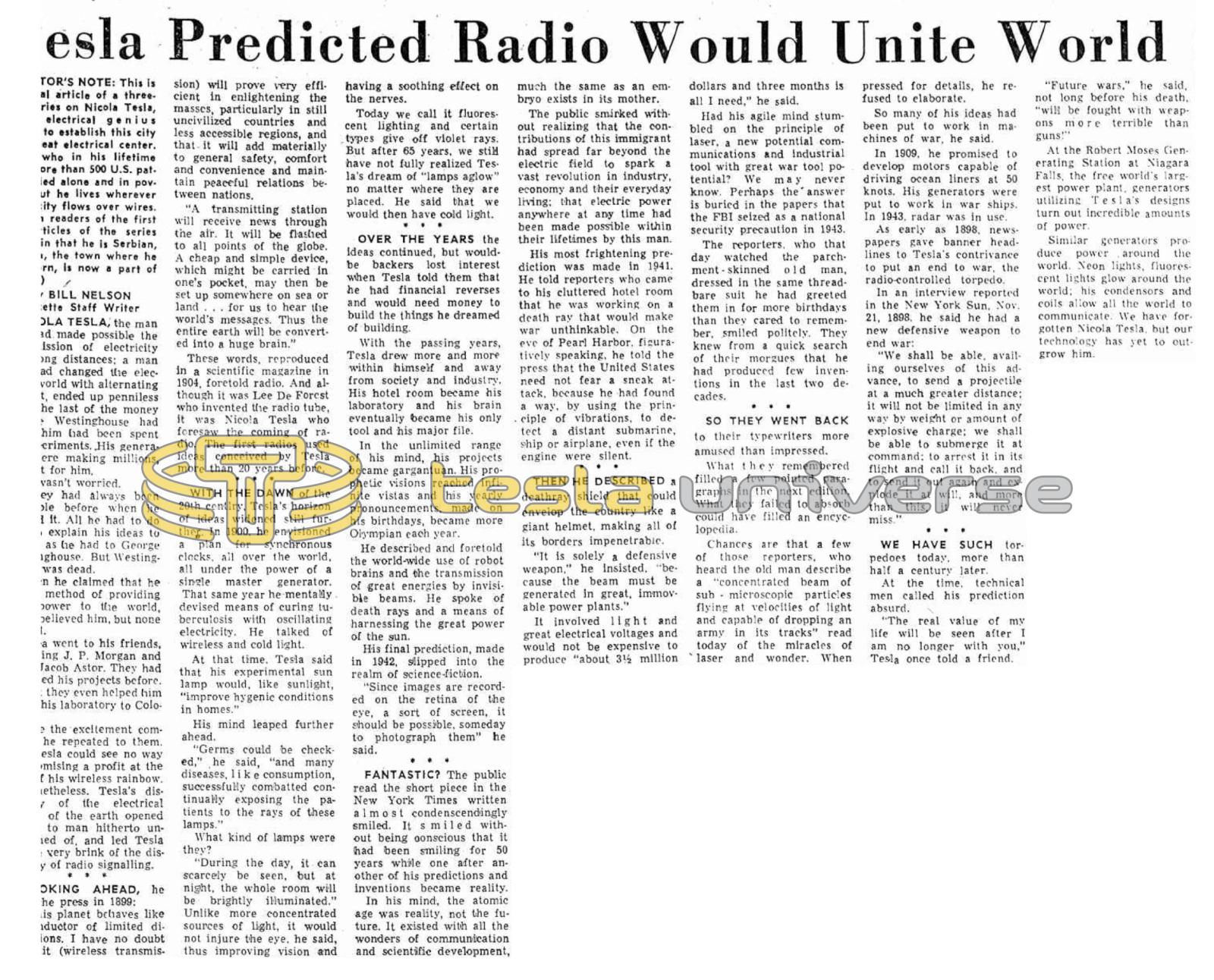
Tesla Predicted Radio Would Unite World
Webmaster note: This article is incomplete, but because of its uniqueness, it is being posted as-is with the hope that someone will be able to help locate the missing portion. If you have any information, please contact us.
The content in this box has been partially generated by AI to fill in the missing letters from the scan. It should not be considered 100% accurate. The content below the box is original.
EDITOR’S NOTE: This is the final article of a three-part series on Nikola Tesla, electrical genius who helped to establish this city as an electrical center. He who in his lifetime more than 500 U.S. patents lived alone and in poverty. He lives wherever electricity flows over wires. For readers of the first two articles of the series, know that he is Serbian, born in the town where he was born, is now a part of Yugoslavia.
By BILL NELSON
Gazette Staff WriterNIKOLA TESLA, the man who made possible the transmission of electricity over long distances; a man who had changed the electrical world with alternating current, ended up penniless when he lost of the money he had spent with Westinghouse. His generators were making millions, but not for him. He wasn’t worried.
He had always been broke before when he started. All he had to do was explain his ideas to George Westinghouse. But Westinghouse was dead.
When he claimed that he had a method of providing power to the world, few believed him, but none helped.
He went to his friends, including J. P. Morgan and Jacob Astor. They had helped his projects before. But they even helped him move his laboratory to Colorado.
Despite the excitement that accompanied the announcement that Tesla could see no way of realizing a profit at the end of his wireless rainbow. Nevertheless, Tesla’s discovery of the electrical nature of the earth opened the door to man hitherto undreamed of, and led Tesla to the very brink of the discovery of radio signalling.
LOOKING AHEAD, he told the press in 1899:
“This planet behaves like a conductor of limited dimensions. I have no doubt that
(wireless transmission) will prove very efficient in enlightening the masses, particularly in still uncivilized countries and less accessible regions, and that it will add materially to general safety, comfort and convenience and maintain peaceful relations between nations.
“A transmitting station will receive news through the air. It will be flashed to all points of the globe. A cheap and simple device, which might be carried in one’s pocket, may then be set up somewhere on sea or land . . . for us to hear the world’s messages. Thus the entire earth will be converted into a huge brain.”
These words, reproduced in a scientific magazine in 1904, foretold radio. And although it was Lee De Forest who invented the radio tube, it was Nicola Tesla who foresaw the coming of radio. The first radios used ideas conceived by Tesla more than 20 years before.
WITH THE DAWN of the 20th century, Tesla’s horizon of ideas widened still further. In 1900, he envisioned a plan for synchronous clocks, all over the world, all under the power of a single master generator.
That same year he mentally devised means of curing tuberculosis with oscillating electricity. He talked of wireless and cold light.
At that time, Tesla said that his experimental sun lamp would, like sunlight, “improve hygienic conditions in homes.”
His mind leaped further ahead.
“Germs could be checked,” he said, “and many diseases, like consumption, successfully combatted continually exposing the patients to the rays of these lamps.”
What kind of lamps were they?
“During the day, it can scarcely be seen, but at night, the whole room will be brightly illuminated.” Unlike more concentrated sources of light, it would not injure the eye, he said, thus improving vision and having a soothing effect on the nerves.
Today we call it fluorescent lighting and certain types give off violet rays. But after 65 years, we still have not fully realized Tesla’s dream of “lamps aglow” no matter where they are placed. He said that we would then have cold light.
OVER THE YEARS the ideas continued, but would-be backers lost interest when Tesla told them that he had financial reverses and would need money to build the things he dreamed of building.
With the passing years, Tesla drew more and more within himself and away from society and industry. His hotel room became his laboratory and his brain eventually became his only tool and his major file.
In the unlimited range of his mind, his projects became gargantuan. His prophetic visions reached infinite vistas and his yearly pronouncements, made on his birthdays, became more Olympian each year.
He described and foretold the world-wide use of robot brains and the transmission of great energies by invisible beams. He spoke of death rays and a means of harnessing the great power of the sun.
His final prediction, made in 1942, slipped into the realm of science-fiction.
“Since images are recorded on the retina of the eye, a sort of screen, it should be possible, someday to photograph them,” he said.
FANTASTIC? The public read the short piece in the New York Times written almost condescendingly smiled. It smiled without being conscious that it had been smiling for 50 years while one after another of his predictions and inventions became reality.
In his mind, the atomic age was reality, not the future. It existed with all the wonders of communication and scientific development, much the same as an embryo exists in its mother.
The public smirked without realizing that the contributions of this immigrant had spread far beyond the electric field to spark a vast revolution in industry, economy and their everyday living; that electric power anywhere at any time had been made possible within their lifetimes by this man.
His most frightening prediction was made in 1941. He told reporters who came to his cluttered hotel room that he was working on a death ray that would make war unthinkable. On the eve of Pearl Harbor, figuratively speaking, he told the press that the United States need not fear a sneak attack, because he had found a way, by using the principle of vibrations, to detect a distant submarine, ship or airplane, even if the engine were silent.
THEN HE DESCRIBED a deathray shield that could envelop the country like a giant helmet, making all of its borders impenetrable.
“It is solely a defensive weapon,” he insisted, “because the beam must be generated in great, immovable power plants.”
It involved light and great electrical voltages and would not be expensive to produce “about 3½ million dollars and three months is all I need,” he said.
Had his agile mind stumbled on the principle of laser, a new potential communications and industrial tool with great war tool potential? We may never know. Perhaps the answer is buried in the papers that the FBI seized as a national security precaution in 1943.
The reporters, who that day watched the parchment-skinned old man, dressed in the same threadbare suit he had greeted them in for more birthdays than they cared to remember, smiled politely. They knew from a quick search of their morgues that he had produced few inventions in the last two decades.
SO THEY WENT BACK to their typewriters more amused than impressed.
What they remembered filled a few pointed paragraphs in the next edition. What they failed to absorb could have filled an encyclopedia.
Chances are that a few of those reporters, who heard the old man describe a “concentrated beam of sub-microscopic particles flying at velocities of light and capable of dropping an army in its tracks” read today of the miracles of laser and wonder. When pressed for details, he refused to elaborate.
So many of his ideas had been put to work in machines of war, he said.
In 1909, he promised to develop motors capable of driving ocean liners at 50 knots. His generators were put to work in war ships. In 1943, radar was in use.
As early as 1898, newspapers gave banner headlines to Tesla’s contrivance to put an end to war, the radio-controlled torpedo.
In an interview reported in the New York Sun, Nov. 21, 1898, he said he had a new defensive weapon to end war:
“We shall be able, availing ourselves of this advance, to send a projectile at a much greater distance; it will not be limited in any way by weight or amount of explosive charge; we shall be able to submerge it at command; to arrest it in its flight and call it back, and to send it out again and explode it at will, and more than this, it will never miss.”
WE HAVE SUCH torpedoes today, more than half a century later.
At the time, technical men called his prediction absurd.
“The real value of my life will be seen after I am no longer with you,” Tesla once told a friend.
“Future wars,” he said, not long before his death, “will be fought with weapons more terrible than guns!”
At the Robert Moses Generating Station at Niagara Falls, the free world’s largest power plant, generators utilizing Tesla’s designs turn out incredible amounts of power.
Similar generators produce power around the world. Neon lights, fluorescent lights glow around the world; his condensers and coils allow all the world to communicate. We have forgotten Nikola Tesla, but our technology has yet to outgrow him.