Nikola Tesla Articles
Tesla's Method of Operating Alternating Current Motors with Condensers
If the terminals or plates of a condenser be connected with two points of a circuit, the potentials of which are made to rise and fall in rapid succession, the condenser allows the passage, or, more strictly speaking, the transferrence of a current, although its plates or armatures may be so carefully insulated as to prevent almost completely the passage of a current of unvarying strength or direction and of moderate electromotive force; again, if a circuit, the terminals of which are connected with the plates of the condenser, possess a certain self-induction, the condenser will overcome or counteract to a greater or less degree, dependent upon well-understood conditions, the effects of such self-induction; third, if two points of a closed or complete circuit through which a rapidly rising and falling current flows, be shunted or bridged by a condenser, a variation in the strength of the currents in the branches, and also a difference of phase of the currents therein, is produced.
These effects Mr. Tesla has utilized and applied in a variety of ways in the construction and operation of his well-known alternating motors, as, by producing a difference in phase in the two energizing circuits of an alternating-current motor by connecting the two circuits in derivation, and connecting up a condenser in series in one of the circuits.
In an alternating-current motor of the type which has an armature coil or circuit closed upon itself, however, the latter represents not only an inductive resistance, but one which is periodically varying in value, both of which facts complicate, and render difficult, the attainment of the conditions best suited to the most efficient working of the motors. The most efficient working conditions, in other words, require, first, that for a given inductive effect upon the armature there should be the greatest possible current through the armature or induced coils, and, second, that there should always exist between the currents in the energizing and the induced circuits a given relation of phase: Hence whatever tends to decrease the self-induction and increase the current in the induced circuits will, other things being equal, increase the output and efficiency of the motor, and the same will be true of causes that operate to maintain the mutual attractive effect between the field-magnets and armature at its maximum. He secures these results by connecting with the induced circuit a condenser, and also by constructing the motor in a special manner.
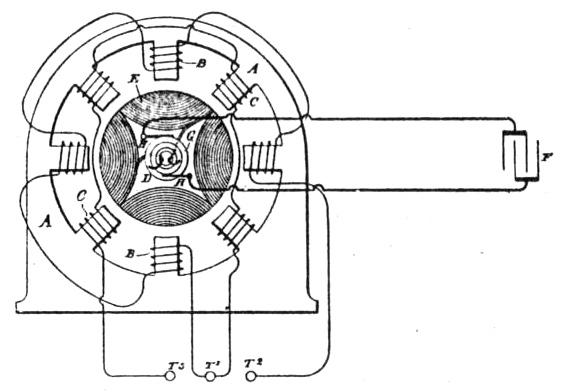
The general plan of operation adopted by Mr. Tesla is illustrated in Fig. 1. A A in this figure represent the frame and field-magnets of an alternating-current motor, the poles or projections of which are wound with coils B and C, so that the alternating currents flowing through the circuits, respectively, will have a difference of phase. Within the influence of this field is an armature-core D, wound with coils E. In Mr. Tesla's motors of this description, heretofore these coils have been closed upon themselves, or connected in a closed series; but in the present case each coil or the connected series of coils terminates in the opposite plates of a condenser F. For this purpose the ends of the series of coils are brought out through the shaft to collecting-rings G, which are connected to the condenser by contact brushes H, the condenser being independent of the machine. The armature-coils are wound or connected in such a manner that adjacent coils produce opposite poles.
The action of this motor and the effect of the plan followed in its construction are as follows: The motor being started in operation and the coils of the field-magnets being traversed by alternating currents, currents are induced in the armature coils by one set of field coils, as B, and the poles thus established are acted upon by the other set, C. The armature coils, however, have necessarily a high self-induction, which opposes the flow of the currents thus set up. The condenser F not only permits the passage or transferrence of these currents, but also counteracts the effects of self-induction, and by a proper adjustment of the capacity of the condenser, the self-induction of the coils, and the periods of the currents, the condenser may be made to overcome entirely the effect of the self-induction.
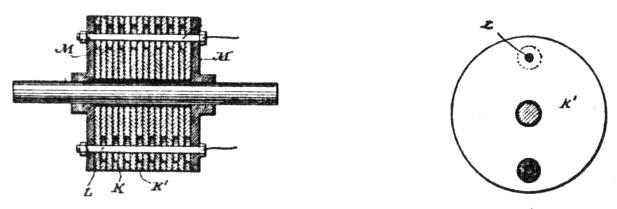
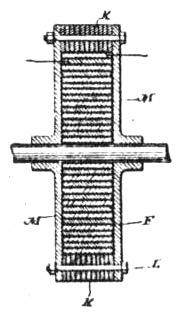
It is preferable on account of the undesirability of using sliding contacts of all kinds to combine the condenser with the armature directly, or make it a part of the armature. In some cases, as shown in Fig. 2, Mr. Tesla builds up the armature of annular plates K K, held by bolts L between heads M, which are secured to the driving shaft, and in the hollow space thus formed is placed a condenser F, generally by winding the two insulated plates spirally around the shaft. In other cases he utilizes the plates of the core itself as the plates of the condenser, as shown in Figs. 3 and 4.
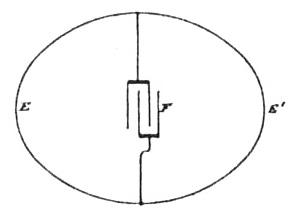
In motors in which the armature coils are closed upon themselves — as, for example, in any form of alternating-current motor in which one armature coil or set of coils is in the position of maximum induction with respect to the field coils or poles, while the other is in the position of minimum induction — the coils are connected in one series, and two points of the circuit thus formed are bridged by a condenser. This is illustrated in Fig. 5, in which E represents one set of armature coils and E' the other. Their points of union are joined through a condenser F. It will be observed that in this disposition the self-induction of the two branches K and K' varies with their position relatively to the field-magnet, and that each branch is alternately the predominating source of the induced current. Hence the effect of the condenser F is two fold. First, it increases the current in each of the branches alternately, and, secondly, it alters the phase of the currents in the branches, this being the well-known effect which results from such a disposition of a condenser with a circuit, as above described. This effect is favorable to the proper working of the motor, because it increases the flow of current in the armature circuits due to a given inductive effect, and also because it brings more nearly into coincidence the maximum magnetic effects of the coacting field and armature poles. This method of operation is more particularly adapted to systems in which a very high rate of alternation or change is maintained.