Nikola Tesla Articles
Tesla's New Rotary Machine
A machine based on a new principle, for use wherever a fluid is used as a vehicle of energy, has been invented by Nikola Tesla. Apparently it is capable of a wide variety of applications, from cases where velocity is to be imparted to the fluid, as in a pump, to those where the moving fluid is itself to operate machinery, either by its velocity alone or by its expansion. The fluid may be liquid or gaseous, and its velocity may be due to simple hydrostatic or gaseous pressure or to explosive combustion. Here, then, we have evidently a device capable of use wherever engines, turbines, pumps, or power-transformers of any kind are now in use. The new principle consists simply in the utilization of the fluid's internal friction and its adhesion to a smooth surface for giving it speed or imparting to machinery its speed already acquired. This operation is thus vastly smoother than in any known pump or engine, and wasteful and injurious jerks are eliminated, as well as complicated parts. The new invention, which is in practical operation at one of the Edison Company's stations in New York, was briefly described by Mr. Tesla before the National Electric Light Association last May, and an authoritative description is now published by The Electrical Review and Western Electrician (Chicago, September 9). Says Mr. Tesla:
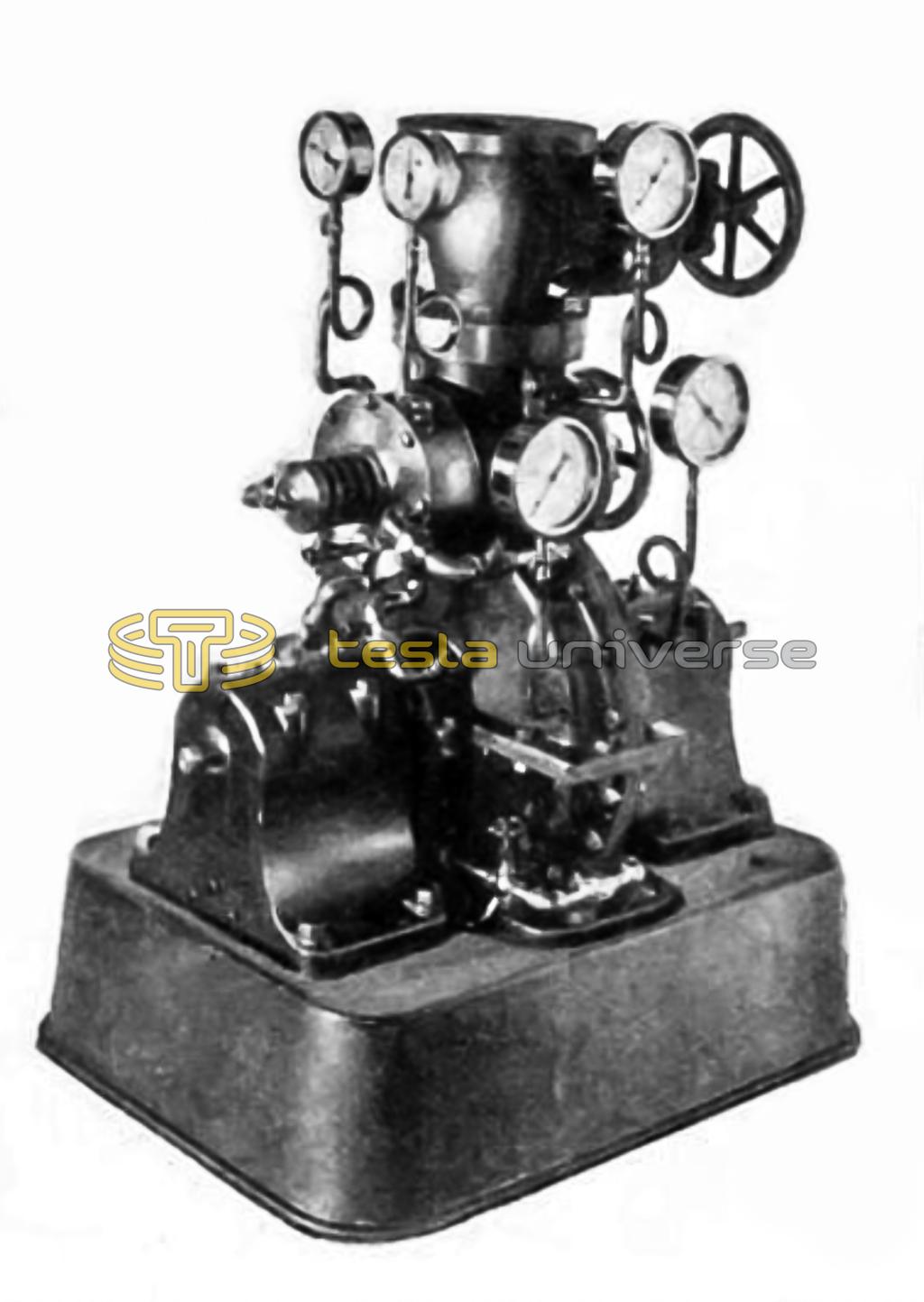
"In the practical application of mechanical power based on the use of a fluid as vehicle of energy it has been demonstrated that, in order to attain the highest economy, the changes in velocity and direction of movement of the fluid should be as gradual as possible. In the present forms of such apparatus, more or less sudden changes, shocks, and vibrations are unavoidable. Besides, the employment of the usual devices for imparting to, or deriving energy from a fluid, as pistons, paddles, vanes, and blades, necessarily introduces numerous defects and limitations and adds to the complication, cost of production, and maintenance of the machine.
"The purpose of the invention is to overcome these deficiencies and to effect the transmission and transformation of mechanical energy through the agency of fluids in a more perfect manner, and by means simpler and more economical than those heretofore employed.
"This is accomplished by causing the propelled or propelling fluid to move in natural paths or stream-lines of least resistance, free from constraint and disturbance such as occasioned by vanes or kindred devices, and to change its velocity and direction of movement by imperceptible degrees, thus avoiding the losses due to sudden variations while the fluid is receiving or imparting energy.
"It is well known that a fluid possesses, among others, two salient properties: adhesion and viscosity. Owing to these a body propelled through such a medium encounters a peculiar impediment known as ‘lateral,' or ‘skin resistance,' which is twofold: one arising from the shock of the fluid against the asperities of the solid substance, the other from internal forces opposing molecular separation. As an inevitable consequence a certain amount of the fluid is dragged along by the moving body. Conversely, if the body be placed in a fluid in motion, for the same reasons, it is impelled in the direction of movement. The accompanying drawings illustrate operative and efficient embodiments of the idea."


The illustrations show simply a set of smooth disks revolving in a case. When these are set in rotation and the fluid is admitted, it is dragged along in a spiral path, making possibly several revolutions, and is finally expelled through the outlet, having gradually gained in velocity during its trip. In this way the machine may function as a pump or as a device for the compression of air. The reversibility of the machine allows it also to function as a motor when a fluid under pressure or in rapid motion is fed to it. We read:
"The operation above described is reversible, for if water or air under pressure be admitted to the opening the runner is set in rotation in the direction of the dotted arrow by reason of the peculiar properties of the fluid which, traveling in a spiral path and with continuously diminishing velocity, reaches the orifices through which it is discharged. If the runner be allowed to turn freely, in nearly frictionless bearings, its rim will attain a speed closely approximating the maximum of that of the fluid in the volute channel and the spiral path of the particles will be comparatively long, consisting of many almost circular turns. If the load is put on and the runner slowed down the motion of the fluid is retarded, the turns are reduced, and the path is shortened."
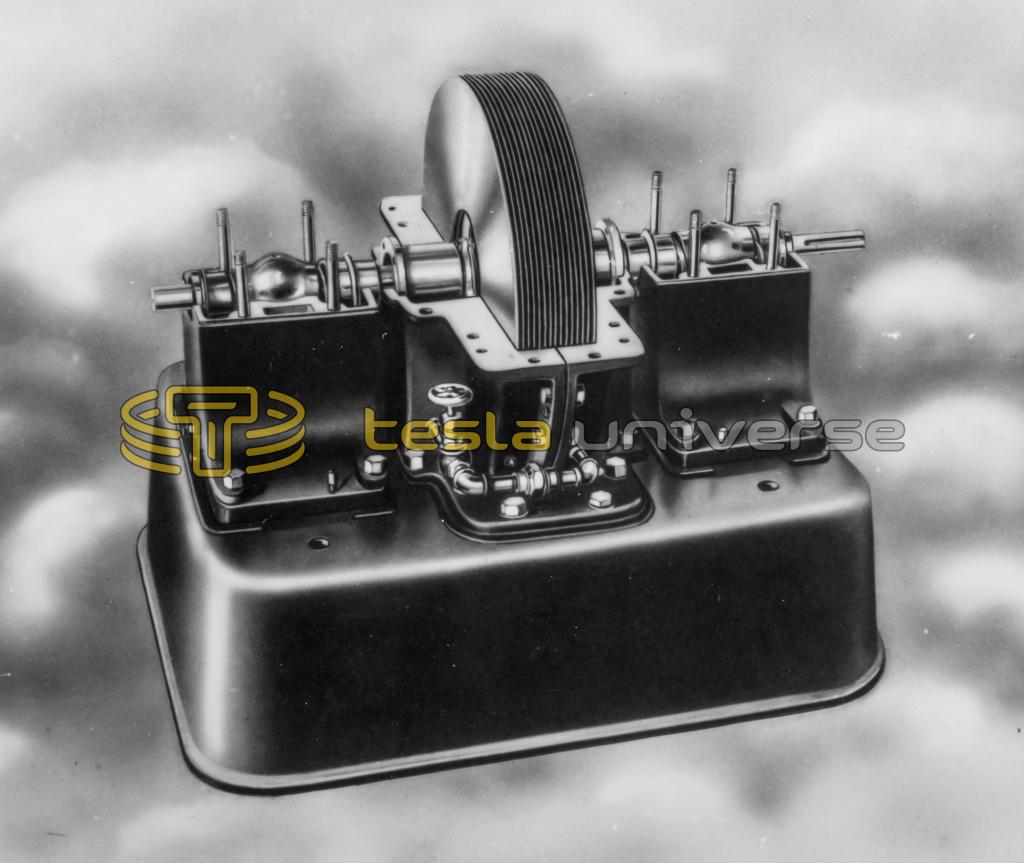
If steam be admitted, the machine will work like an engine under expansion, but if the expansion be allowed to take place before admission, it will operate like a turbine, being driven by the impact of the rapidly-moving particles. Says the inventor:
"The above description of the operation is suggested by experience and observation and is advanced merely for the purpose of explanation. The undeniable fact is that the machine does operate, both expansively and impulsively.
"When the expansion in the nozle is complete, or nearly so, the fluid pressure in the peripheral clearance space is small, as the nozle is made less divergent and its section enlarged, the pressure rises, finally approximating that of the supply. But the transition from purely impulsive to expansive action may not be continuous throughout, on account of critical states and conditions, and comparatively great variations of pressure may be caused by small changes of nozle velocity.
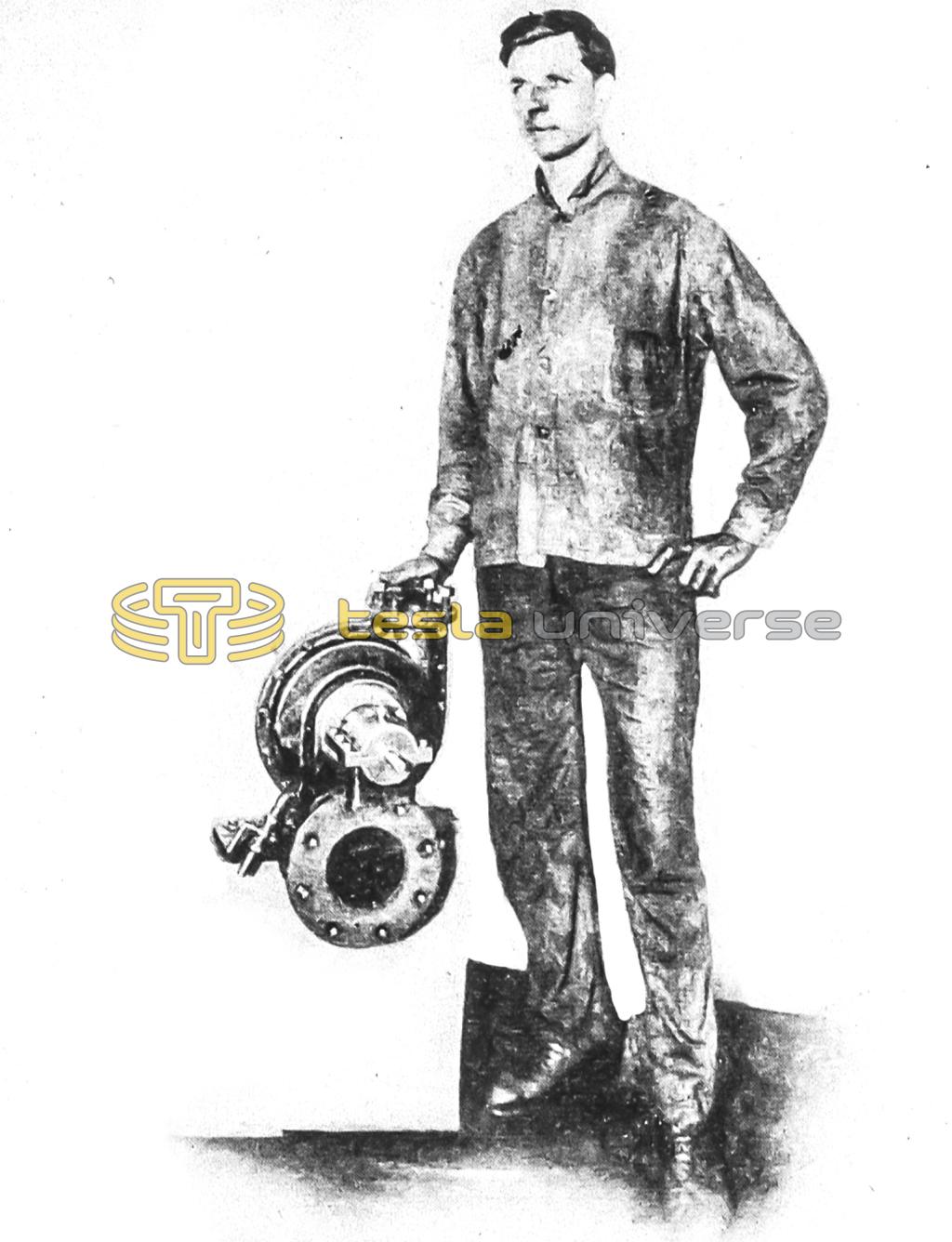
"In the preceding, it has been assumed that the pressure of supply is constant or continuous, but it will be understood that the operation will be, essentially, the same if the pressure be fluctuating or intermittent, as that due to explosions occurring in more or less rapid succession."
One of the special advantages claimed by the inventor for his device is its ease and simplicity of reversal, which may be effected simply by turning a valve. He says in conclusion:
"It is simple, light, and compact, subject to but little wear, cheap, and exceptionally easy to manufacture, as small clearances and accurate milling work are not essential to good performance. In operation it is reliable, there being no valves, sliding contacts, or troublesome vanes. It is almost free of windage, largely independent of nozle-efficiency, and suitable for high as well as for low fluid velocities and speeds of revolution. The principles of construction and operation are capable of embodiment in machines of the most widely different forms, and adapted for the greatest variety of purposes."